
How much grass seed do I need? Take your lawn's square footage, divide it by 1,000, and multiply by the seeding rate for your grass. For a new bahiagrass lawn that's 6 to 8 pounds per 1,000 square feet. Bermudagrass takes 1 to 2 pounds. Centipede takes a quarter to a half pound.
We're Epic Horizons Landscaping, based in North Port, Florida. Our crew lays sod and mows lawns every week in North Port, Venice, Port Charlotte and Englewood, so we hear this question a lot. Usually it comes from someone standing in a garden center aisle holding a bag of seed that will never grow the lawn they're looking at. Most seed charts skip that problem. We'll get to it right after the first set of numbers.
Every version of this question people type into Google gets its own answer below: per square foot, for 1,000 and 5,000 square feet, for a half acre, one acre and two acres, and for overseeding. The number comes first in each section. The Florida details come after it.
Pounds of seed = (square feet ÷ 1,000) × the rate per 1,000 sq ft on the label.
New lawn on bare soil: use the full rate.
Thickening a thin lawn with the same grass: use about half.
Round up to the next whole bag, or let our grass seed calculator do the math.
how much grass seed do i need
You need your lawn's square footage divided by 1,000, times the seeding rate for your grass. A new bahiagrass lawn takes 6 to 8 pounds per 1,000 square feet. Bermudagrass takes 1 to 2 pounds, centipede 0.25 to 0.5 pounds, tall fescue 6 to 8 and Kentucky bluegrass 2 to 3.
| Grass | New lawn (lb per 1,000 sq ft) | Thickening a thin lawn | Where it makes sense |
|---|---|---|---|
| Bahiagrass | 6 – 8 (UF/IFAS lists up to 10) | 3 – 5 | Florida and the Gulf Coast. The main lawn grass grown from seed here. |
| Bermudagrass (hulled) | 1 – 2 | 0.5 – 1 | The South, full sun only |
| Centipede | 0.25 – 0.5 | 0.1 – 0.25 | The Southeast. Struggles in alkaline, shell-heavy soil. |
| Zoysia (seeded varieties) | 1 – 2 | 0.5 – 1 | Only a few varieties come as seed. Most zoysia is sodded. |
| Tall fescue | 6 – 8 | 3 – 4 | The North and the transition zone. It won't survive a Florida summer. |
| Kentucky bluegrass | 2 – 3 | 1 – 1.5 | The North |
| Perennial ryegrass | 7 – 9 | 4 – 5 | The North. In Florida it's a winter-only grass. |
| St. Augustine | No seed sold | No seed sold | Sod or plugs only |
The gap between grasses comes down to seed size. Bahia seed is big and hard-coated, so it takes a lot of it by weight. Bermuda and centipede seed is tiny. One pound of it covers ground that would take several pounds of bahia. That's why you can't swap one bag for another and keep the same number.
The rate printed on your bag beats any chart, this one included. Coated seed weighs more per seed than raw seed, so its label rate runs higher for the same grass.
Now look at the last row of that table again. St. Augustine is the grass on most lawns in North Port, Venice, Port Charlotte and Englewood. It isn't on a single seed bag in any store. So what do you buy instead?
Why Florida St. Augustine grass comes on pallets, not in bags
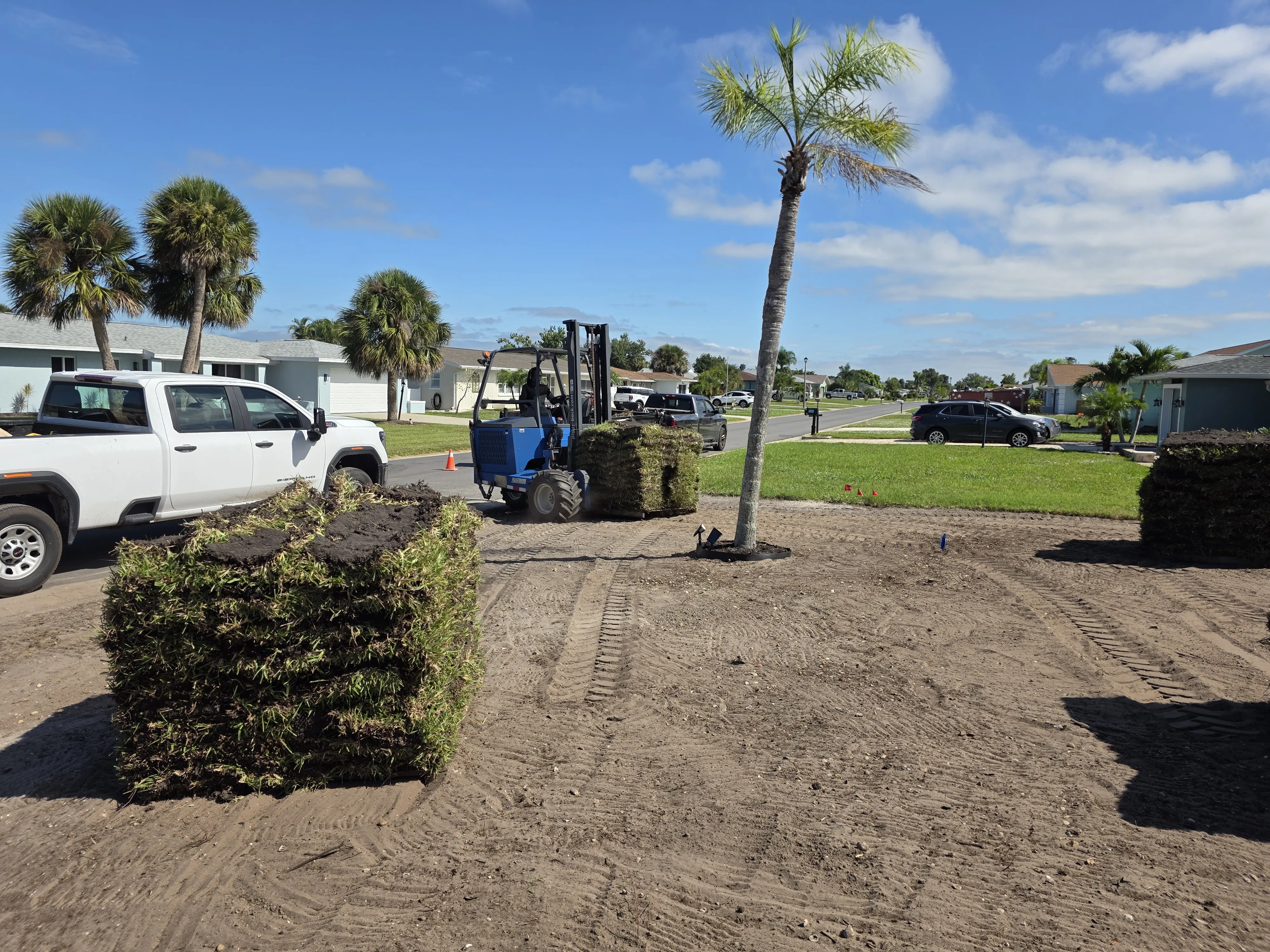
St. Augustine grass isn't sold as seed that grows a lawn, so in Florida you buy it as sod on pallets. A pallet of St. Augustine usually covers 400 to 500 square feet and runs about $130 to $250 for the grass alone in SW Florida. Add 5 to 10 percent to your square footage for cuts, then divide by pallet coverage.
If your lawn is Floratam or another St. Augustine, the seed question turns into a pallet question. A 2,400 square foot front yard plus 10 percent is 2,640 square feet. At 450 square feet per pallet, that's six pallets. The sod calculator does that math for any size, and our guide to St. Augustine grass pallets covers coverage, price and pickup in detail.
Here's how seed and sod actually compare on a SW Florida lot:
Dennis puts it plainly: "When somebody in North Port asks me how much seed to buy for their St. Augustine, I tell them to keep their money. That bag won't grow what they're looking at. Show me the bad spots and I'll tell you how many slabs it takes."
"Dennis and team were great to work with. Professional from start to finish. Hardworking guys, and they did a great job with my sod replacement and my mulching and weeding. I would recommend."
Jill Ammon, Google review
Seed still has a place here, though. Bahia on a big back lot, a cleared acre, a ditch bank. If that's your situation, here's the math by size, starting with the smallest unit there is.
how much grass seed do i need per square foot
Per square foot, you need very little seed: about 0.1 to 0.13 ounces of bahiagrass for a new lawn, roughly 0.02 to 0.03 ounces of bermudagrass, and under 0.01 ounces of centipede. Those amounts are too small to measure by hand, which is why seed labels and landscapers work per 1,000 square feet instead.
The per-square-foot number is handy for one job: patching a bare spot. A 6 by 8 foot dead patch is 48 square feet. In bahia, that's about 0.3 to 0.4 pounds of seed, a few good handfuls. Rake the soil loose first, spread the seed, and press it in so it touches dirt and not dead thatch.
In SW Florida, though, that bare patch is usually sitting in a St. Augustine lawn. Bahia seeded into St. Augustine grows in lighter and coarser, and it throws up tall, Y-shaped seed heads all summer. It never blends in. A St. Augustine patch gets a few slabs of St. Augustine sod cut in, and that's work our crew does all the time.
Bigger areas are where people start overbuying. The number most seed bags are built around is 1,000 square feet.
how much grass seed do i need for 1000 square feet
For 1,000 square feet of new lawn you need 6 to 8 pounds of bahiagrass, 1 to 2 pounds of hulled bermudagrass, or 0.25 to 0.5 pounds of centipede. Northern grasses run about 6 to 8 pounds of tall fescue, 2 to 3 of Kentucky bluegrass, or 7 to 9 of perennial ryegrass. Thickening an existing lawn takes about half.
A thousand square feet is smaller than most people picture. It's a 25 by 40 foot area. On a typical SW Florida lot, that's about the size of one side yard and a strip along the driveway.
More seed doesn't get you a better lawn. Seed spread too heavy crowds itself out, and in our humid heat a thick, wet mat of seedlings is a good place for rot to start. Spread the label rate, split into two passes walked in opposite directions, so you don't get stripes of thick and thin.
Most real lawns aren't 1,000 square feet, though. The next number is closer to what's actually behind a house in North Port or Port Charlotte.
how much grass seed do i need for 5000 square feet
For 5,000 square feet you need 30 to 40 pounds of bahiagrass, 5 to 10 pounds of bermudagrass, or 1.25 to 2.5 pounds of centipede for a new lawn. Thickening an existing bahia lawn that size takes 15 to 25 pounds. For new bahia, one 50-pound bag covers it with seed left over.
| Lawn size | Bahiagrass (lb) | Bermudagrass (lb) | Centipede (lb) |
|---|---|---|---|
| 1,000 sq ft | 6 – 8 | 1 – 2 | 0.25 – 0.5 |
| 2,500 sq ft | 15 – 20 | 2.5 – 5 | 0.6 – 1.25 |
| 5,000 sq ft | 30 – 40 | 5 – 10 | 1.25 – 2.5 |
| 10,000 sq ft | 60 – 80 | 10 – 20 | 2.5 – 5 |
| 10,890 sq ft (¼ acre) | 65 – 87 | 11 – 22 | 2.7 – 5.4 |
Here's what 5,000 square feet looks like on a real lot. A lot of the original lots in North Port and Port Charlotte are about 80 by 125 feet, or 10,000 square feet. Take out the house, the driveway, the pool cage and the beds, and the lawn left over is often somewhere around 4,000 to 6,000 square feet.
So measure what's actually grass. Break the yard into rectangles, multiply length by width for each one, and add them up. Don't count the house footprint, the lanai, the pool deck, or the plant beds. People who measure the whole lot buy double the seed they need.
Out on the bigger properties, the ones with acreage in the outer parts of Charlotte and Sarasota counties, the numbers stop being bags and start being a truckload.
how much grass seed do i need for 1/2 acre
A half acre is 21,780 square feet. A new lawn on that much ground takes about 130 to 175 pounds of bahiagrass seed, which is three to four 50-pound bags. It takes 22 to 44 pounds of bermudagrass or 5 to 11 pounds of centipede. Thickening a thin half acre of bahia takes about 65 to 110 pounds.
Very few half-acre lots are a full half acre of lawn. Subtract the house, drive and beds the same way you would on a small lot, and the seeded area often drops by a third.
This is the size where seed earns its keep. Sodding a full half acre in St. Augustine means roughly 50 pallets. That's why a lot of owners on bigger lots here split it: St. Augustine sod in the front yard, where the HOA and the neighbors see it, and bahia seed out back, where it just needs to hold the sand down and handle a mower.
how much grass seed do i need for 1 acre
One acre is 43,560 square feet. A new bahiagrass lawn needs about 260 to 350 pounds of seed, or six to seven 50-pound bags. Bermudagrass needs 44 to 87 pounds and centipede 11 to 22 pounds. At the University of Florida's upper bahia rate of 10 pounds per 1,000 square feet, an acre takes about 435 pounds.
| Area | Square feet | Bahia, new (6–8 lb) | Bahia, thickening (3–5 lb) | Bermuda (1–2 lb) | Centipede (0.25–0.5 lb) |
|---|---|---|---|---|---|
| ½ acre | 21,780 | 131 – 174 lb | 65 – 109 lb | 22 – 44 lb | 5 – 11 lb |
| 1 acre | 43,560 | 261 – 348 lb | 131 – 218 lb | 44 – 87 lb | 11 – 22 lb |
| 2 acres | 87,120 | 523 – 697 lb | 261 – 436 lb | 87 – 174 lb | 22 – 44 lb |
Rates in parentheses are pounds per 1,000 square feet. Seed sold for pasture often lists a much lower rate per acre. That rate is for cattle forage, where nobody minds if it takes a season or two to close in. For a lawn you want to mow, use the lawn rate.
At an acre, you're not walking this with a handheld spreader. You'll want a tow-behind spreader, and something to drag or roll the seed in afterward so it's touching soil.
And if that acre was just cleared, the seed is the easy part. Stumps, roots and ruts from equipment leave a lumpy field that holds water in every low spot. That's grading work before it's seeding work, which is why land clearing and grading so often end up on the same job. Double the acreage and timing starts to matter as much as the math.
how much grass seed do i need for 2 acres
Two acres is 87,120 square feet. A new bahiagrass lawn needs about 520 to 700 pounds of seed, or eleven to fourteen 50-pound bags. Bermudagrass needs 87 to 174 pounds and centipede 22 to 44 pounds. Thickening an existing two-acre bahia stand takes roughly 260 to 435 pounds.
Nobody runs sprinklers over two acres of new seed, so on a property this size the rain is your irrigation. In SW Florida, that makes timing the whole game.
Bahia sprouts slowly even in warm weather, and it slows down more as the nights cool off. Fall and winter seeding is a gamble here. Most people seeding big areas time it for spring into the start of the rainy season, usually late May into June, so the afternoon storms do the watering. The catch is that the same storms move seed on any slope, which we'll get to in the prep section below.
One more thing at this scale: you're buying a lot of seed. Before you load up 700 pounds of anything, there's a cheaper question to answer first. Does the ground you're seeding have grass on it already?
how much grass seed do i need for overseeding
For overseeding, use about half the new-lawn rate when you're thickening a thin lawn with the same grass: 3 to 5 pounds of bahia per 1,000 square feet, or 0.5 to 1 pound of bermuda. Winter overseeding with ryegrass for green color is different. UF/IFAS recommends about 10 pounds of annual ryegrass per 1,000 square feet.
"Overseeding" means two different jobs, and they use very different amounts of seed.
| What you're doing | Rate (lb per 1,000 sq ft) | When | What to expect |
|---|---|---|---|
| Thickening thin bahia | 3 – 5 | Spring to early summer | Same grass, fills the gaps |
| Thickening thin bermuda | 0.5 – 1 | Spring to early summer | Same grass, fills the gaps |
| Thickening tall fescue or bluegrass (northern lawns) | Fescue 3 – 4, bluegrass 1 – 1.5 | Early fall | Same grass, fills the gaps |
| Winter color, annual ryegrass (Florida) | About 10 | Late fall, once nights cool | Green all winter, dies out in spring heat |
| Winter color, perennial ryegrass (Florida) | 10 – 20 | Late fall | Acts like an annual here. It won't live through a Florida summer. |
| Thickening St. Augustine | Can't be done with seed | Any time | Plugs or replacement sod |
The ryegrass rates look high next to the bahia numbers because you're seeding into a full lawn and you want winter color everywhere, not just in the thin spots.
You can spread ryegrass over St. Augustine for a green winter. We don't love it. It means mowing through the months your lawn would normally get a break, and in spring the rye is still hanging on right when the St. Augustine is trying to green back up.
The other way people phrase this question usually comes from someone standing over one specific thin lawn. That gets a more specific answer.
how much grass seed do i need to overseed
To overseed an existing lawn, you need roughly half the new-lawn rate for your grass, spread over the thin areas only. For a full 3,000 square foot bahia lawn, that's 9 to 15 pounds. If only a third of the lawn is thin, seed that third and buy a third as much.
Before you buy any seed, figure out why the grass got thin. If the cause is still there, the new seed thins out for the same reason. These are the causes we see most around here:
- Standing water. North Port sits on spodosol, sandy soil with a hardpan layer underneath that water can't get through. Low spots stay soggy for days after a storm, and grass drowns. That's a grading and drainage fix.
- Sprinkler gaps. A dry crescent between heads means coverage is off. Seed won't fix a head that's tilted or clogged. Irrigation repair will.
- Shade. Grass under a thick oak canopy slowly thins out. Thinning the canopy with tree work lets light back in.
- Mowing too short. St. Augustine scalped below 3 inches gets weak and patchy fast.
- Insects. Some dead patches are bug damage. That's a question for a licensed pest control company. We don't treat or diagnose pests.
Fix the cause, then seed. Or, if it's St. Augustine, fix the cause and cut in new sod. Overseeding a single yard is one thing. Overseeding a whole acre takes a different plan.
how much grass seed do i need to overseed an acre
To overseed an acre of thin bahiagrass, you need about 130 to 220 pounds of seed, which is three to five 50-pound bags. Bermudagrass takes about 22 to 44 pounds per acre. Overseeding a full acre with annual ryegrass for winter color takes about 435 pounds at the 10-pound UF/IFAS rate.
New seed has to reach the soil, and on an established acre it's landing on top of living grass. Mow the bahia a notch lower than usual, bag or rake the clippings, then spread. Go in two passes at half the rate each, the second pass running crosswise to the first. Drag a mat or chain-link section behind the mower afterward to work the seed down.
Then water light and often until it sprouts, or time it so the rain does it for you. Seed that dries out after it starts to germinate dies, and sandy Florida soil dries out by lunchtime.
All of these numbers assume one thing: the ground under the seed is ready for it. On a lot of SW Florida properties, it isn't.
What has to happen before any seed goes down
Seed is cheap. The ground under it decides whether you end up with a lawn or a crop of weeds.
Grade first. Water has to run away from the house and toward the swale or the street. On flat, sandy lots with a hardpan layer underneath, a low spot becomes a pond every August, and seed sitting in a pond rots. Most grading means reshaping the soil you already have so the slope works.
Fill the low spots. If you're filling ruts or dips before you seed, the next thing you'll be asking is how much topsoil do i need. It comes down to the area of each low spot times the depth you're filling. Our topsoil calculator does that math in cubic yards.
Time it right. Warm-season seed wants warm soil and steady moisture. Here, that's spring into early summer.
Check with your HOA. A lot of communities around here have an approved grass list. Find out what's on it before you spread anything.
A summer downpour in SW Florida can wash a week's worth of fresh seed off a slope and into the swale in one afternoon. If any part of the area you're seeding slopes toward a ditch, a canal or the street, that's the part to sod, or at least to seed early in the season before the heavy storms set in.
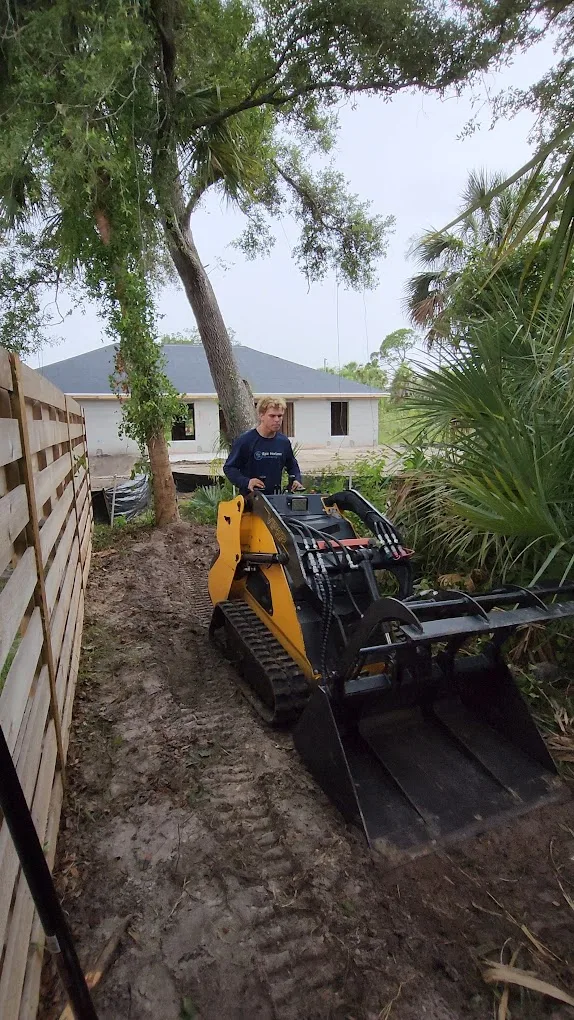
When we redo a lawn, it's sod. Our prep is grading, leveling and getting the water moving before a single slab goes down. If your yard is St. Augustine, or you'd rather have the lawn finished this week than in three months, that's the sod installation work our crew does every week.
Frequently asked questions
How much is a pallet of St. Augustine sod?
The St. Augustine grass pallet price in SW Florida usually runs $130 to $250 for the grass itself. Where you land depends on the variety, the supplier and the time of year. Delivery and installation are extra. The full breakdown is in our St. Augustine sod pallet cost guide.
How much does a pallet of St. Augustine sod weigh?
A loaded pallet weighs about 2,000 to 3,000 pounds. Freshly cut sod holding a lot of water sits at the heavy end. That's more than most half-ton pickups are rated to carry, which is why suppliers usually deliver with a forklift.
How many square feet does a St. Augustine grass sod pallet cover?
Usually 400 to 500 square feet, but it changes from one sod farm to the next. Ask your supplier for the exact number before you order. If you've seen it called a san augustine grass pallet, it's the same grass and the same pallet.
Can you buy St. Augustine grass seed?
No. St. Augustine isn't sold as seed that will grow a lawn. It's planted as sod or plugs, which is why most lawns in SW Florida are sodded. If you want St. Augustine, use the sod calculator instead of a seed calculator.
Can I put bahia seed in my St. Augustine lawn?
You can, but it won't match. Bahia grows in lighter and coarser than St. Augustine, and it sends up tall seed heads all summer. For thin or dead spots in a St. Augustine lawn, replacement sod is the fix that blends in.
How often does grass need to be cut?
In SW Florida, about every 5 to 7 days from May through September and every 10 to 14 days in winter. Never cut off more than a third of the blade at once. Keep St. Augustine at 3.5 to 4 inches. Our crew mows every week, and our SW Florida mowing schedule covers it month by month.
Is it cheaper to seed or sod a lawn in Florida?
Seed is cheaper for material, and the gap gets big on large areas. But seed limits you to bahia, bermuda or centipede, and it takes weeks of watering and weed pulling to fill in. Sod costs more up front, gives you a finished lawn the day it's laid, and it's the only way to get St. Augustine.