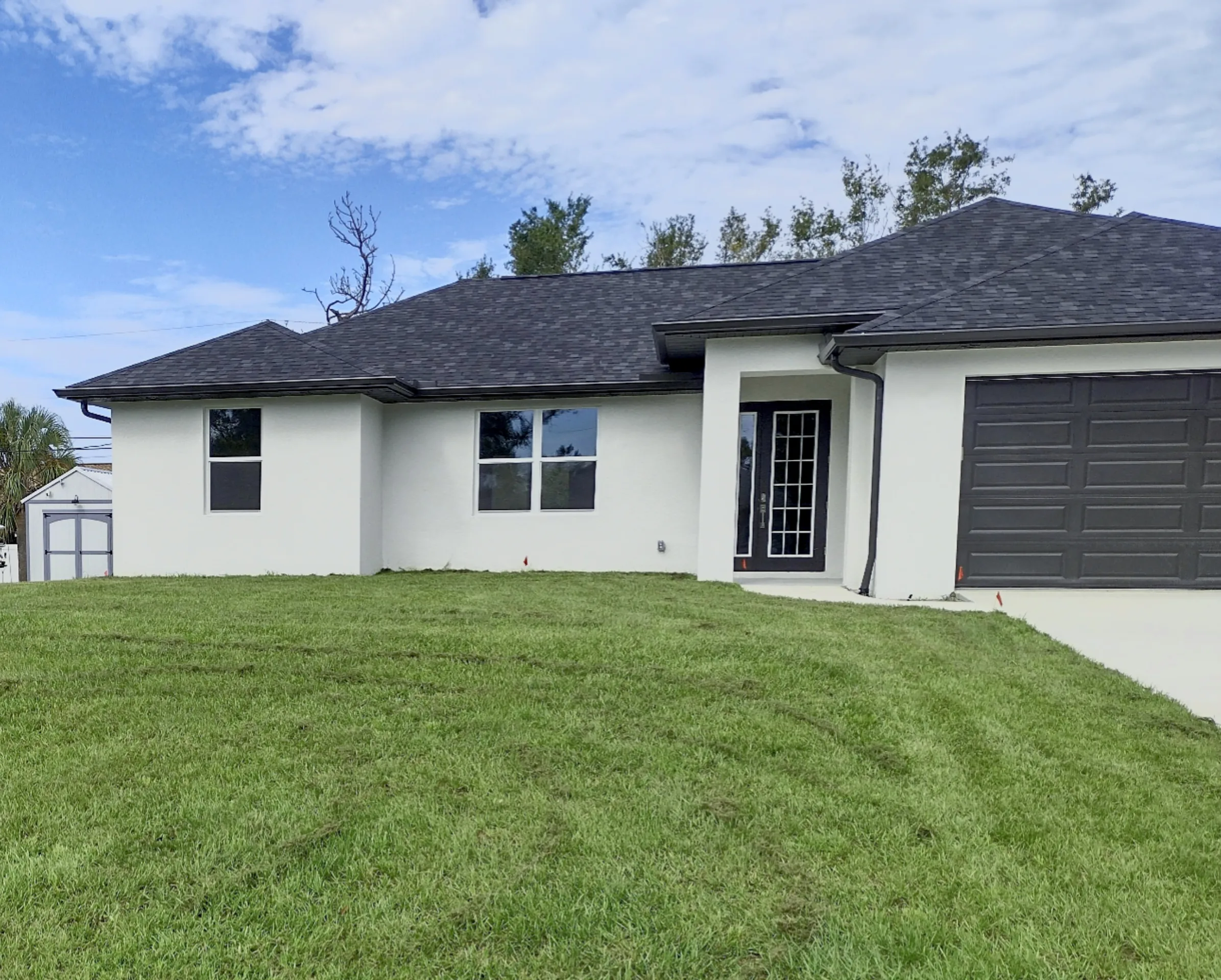
St. Augustine grass pallets in Southwest Florida cost about $130 to $250 each at the farm, and one pallet covers roughly 400 to 500 square feet of yard. That's the number you came for. It's also the number least likely to match what you actually spend.
We lay St. Augustine every week in North Port, Venice, Port Charlotte and Englewood. Dennis started Epic Horizons in 2022, and he still measures every sod job himself before we order a single pallet. The reason is simple. Order one pallet short and you pay a second delivery fee for 40 square feet of grass. Order two too many and you watch $400 of sod turn yellow on your driveway. Get the ground wrong under it and the whole order is dead by August.
Below is every question people type into Google about St. Augustine pallets, answered with the number first and the Florida details after. Prices are 2026 Southwest Florida figures. If you're in Texas or Louisiana, your farm prices will be different, but the coverage math works the same anywhere.
One pallet: $130–$250 for the grass. Floratam runs $130–$200.
Coverage: 400–500 sq ft. Plan on 450.
What's on it: about 165–176 slabs, each roughly 16 × 24 inches.
Installed: about $0.90–$2.50 per sq ft, all-in.
Shelf life: lay it within 24 hours of delivery. Same day in summer.
Start with the per-foot price, because every quote you get, from a farm or from a crew, eventually boils down to it.
how much is st augustine grass sod
St. Augustine grass sod costs about $0.30 to $0.60 per square foot as material from a Florida sod farm, which works out to roughly $130 to $250 per pallet. Installed by a crew, with the old grass removed, the ground graded, and the sod rolled and watered in, it runs about $0.90 to $2.50 per square foot.
There are three ways to buy it, and the price per foot changes a lot depending on which one you pick.
| How you buy it | What you get | Typical cost | Makes sense for |
|---|---|---|---|
| Single slabs at a garden center | Pieces about 16 × 24 in (2.67 sq ft) | A few dollars a slab, usually over $1 per sq ft | Patching a dead spot or a dog path |
| Full pallet, you pick it up | 400–500 sq ft of slabs | $130–$250 per pallet | DIYers with a trailer rated for 3,000 lbs |
| Full pallet, delivered | Same pallet, dropped by the supplier | Pallet price plus a delivery fee | DIY areas bigger than a patch |
| Installed by a crew | Removal, grading, laying, rolling, watering-in | $0.90–$2.50 per sq ft | Most full-yard and half-yard jobs |
The garden-center slab looks cheap because it's a few bucks. Divide that by 2.67 square feet and it's often the most expensive way to buy grass. It's the right call for a 30-square-foot patch and the wrong call for anything you'd measure in pallets.
On the installed side, the spread from $0.90 to $2.50 is almost all prep. A clean, flat lot with easy access sits at the bottom. A yard with dead grass to strip, a slope running toward the house and a narrow side gate sits at the top. Most North Port yards we quote land between $1.00 and $1.85 per square foot, and our North Port sod installation cost breakdown shows where that money goes.
The per-foot number is good for budgeting. But nobody at a sod farm sells by the foot. They sell by the pallet, and the pallet price swings more than people expect depending on one word printed on the tag.
how much is st augustine grass per pallet
St. Augustine grass costs about $130 to $250 per pallet in Southwest Florida in 2026. Floratam, the standard full-sun variety, sits at the low end at roughly $130 to $200. Shade-tolerant and premium varieties like Palmetto, Seville, CitraBlue and ProVista run about $180 to $280 per pallet. Delivery is extra.
That one word on the tag is the variety. St. Augustine is a species with a long list of named varieties, and farms price them very differently.
| Variety | Pallet price (SW Florida) | Sun it needs | Why you'd pay for it |
|---|---|---|---|
| Floratam | $130–$200 | Full sun, 6+ hours | The Florida default. Coarse blade, spreads fast, thins out in shade. |
| Palmetto | $180–$280 | Sun to moderate shade | Finer blade. Handles shade and cold snaps better than Floratam. |
| Seville | $180–$280 | Sun to partial shade | Dwarf variety. Dense, and mowed lower, around 2.5 inches. |
| CitraBlue | $180–$280 | Sun to moderate shade | Newer University of Florida release. Good shade tolerance, blue-green color. |
| ProVista | $180–$280 | Full sun to light shade | Grows slowly, so you mow less. Licensed grass with limited supply. |
For a sunny yard in North Port or Port Charlotte, Floratam is the practical pick and keeps the St. Augustine grass pallet price at the bottom of the range. If a live oak shades half the front yard, paying $50 more per pallet for Palmetto or CitraBlue is cheaper than re-sodding Floratam that thins out under the canopy a year later.
Prices move with the calendar too. Spring and early summer are peak demand here, when everyone wants a green lawn before the rainy season, and pallet prices climb. They ease in the cooler months. And if you searched "san augustine grass pallet," it's the same grass. San Augustine is what a lot of people in Texas call it.
So now you know the tag price. The tag price isn't what leaves your bank account when one pallet lands in your driveway, though.
how much is a pallet of st augustine grass
A pallet of St. Augustine grass costs about $130 to $250 for the grass alone. What you pay out the door is usually more. Most farms and supply yards add a delivery fee, some charge a refundable deposit on the wooden pallet, and some set a minimum order before they'll deliver. Always ask for the delivered price.
When you call around for a St. Augustine grass pallet price, ask these four questions before you hand over a card number:
- Is the delivery fee per trip or per pallet? Most charge per trip. One pallet carries the whole fee. Six pallets split it.
- Is there a delivery minimum? Some farms won't send a truck for one pallet.
- Is there a pallet deposit? If there is, find out how to return the pallet and get it back.
- When was it cut? You want sod cut that morning or the day before. Sod that has sat in a supply yard for two days is already stressed before it touches your soil.
Picking it up yourself saves the delivery fee, but check your truck first. A loaded pallet can weigh more than a lot of half-ton pickups are rated to carry in the bed. Most people who try it end up borrowing a trailer.
A delivery truck with a piggyback forklift will drive right onto your lawn if you let it. Tell the driver where your sprinkler heads, valve boxes and septic drainfield are. A lot of homes in North Port and Port Charlotte are on septic, and a loaded forklift has no business on a drainfield. Have the pallet set on the driveway or another hard surface, as close to the work as you can get it.
One pallet sounds like plenty of grass. Then it comes off the truck and you start counting what's actually on it.
how much st augustine grass is on a pallet
A standard Florida pallet holds about 400 to 500 square feet of St. Augustine grass. That's usually 165 to 176 slabs, each cut roughly 16 by 24 inches, or about 2.67 square feet per slab. A loaded pallet weighs around 2,000 to 3,000 pounds, depending on how wet the soil on the slabs is.
St. Augustine in Florida almost always comes in slabs, not long rolls. Big rolls exist for commercial jobs with special equipment, but a residential order shows up as slabs stacked flat on a wooden pallet. Each slab carries a thin layer of the farm's soil on the bottom, and that's where most of the weight comes from.
Pallet size isn't standardized. One farm stacks 400 square feet, the next stacks 500. That's a 25 percent difference in what you get for the same "one pallet," so ask the supplier for square feet per pallet, not just a price. If two farms quote $180 and $200, the $200 pallet can be the better deal when it's the bigger one.
The other thing on that pallet is heat. Fresh-cut grass keeps living on the stack, and the middle of the pile warms up fast. In July, the center slabs can start yellowing within a day. That's why the 24-hour rule exists, and why we don't order pallets until the ground is ready for them.
Knowing what's on the pallet is half the math. The other half is how much of your yard it will actually cover once it's cut around beds, curbing and sprinkler heads.
how much area does a pallet of st augustine grass cover
One pallet of St. Augustine grass covers about 400 to 500 square feet. Plan on 450 square feet per pallet, then add 5 to 10 percent for cuts around beds, curves and sprinkler heads. A 2,000-square-foot lawn needs about 5 pallets. A 1,000-square-foot backyard needs about 3.
Pallets needed = (square feet ÷ 450) × 1.05 to 1.10, rounded up.
Use 1.05 for simple rectangles. Use 1.10 if you have curved beds, trees or a lot of sprinkler heads to cut around. Many farms only sell full pallets, so round up and keep the extra slabs for patches.
To get your square footage, break the lawn into rectangles, multiply length by width for each one, and add them up. Leave out the beds, the driveway and the house. Or plug your measurements into our sod calculator and it does the pallet count for you.
Two things people forget to measure in our area:
- The swale. In North Port and much of Port Charlotte, the drainage swale between your yard and the street is usually grass the homeowner mows. If it's dead too, it counts. It's also the strip most likely to wash out in a summer storm, so it needs good soil contact.
- The shade. If a corner sits under an oak all day, don't count it in your Floratam order. That square footage needs a shade variety or it needs to become a bed. Sod that never gets sun is money you spend twice.
A typical front yard here works out to somewhere around 3 to 6 pallets. But plenty of people searching aren't sodding a whole yard. They're pricing two or three pallets for a strip behind a new pool or a patch that died, and that's where the per-pallet math gets strange.
how much is two pallets of st augustine grass
Two pallets of St. Augustine grass cost about $260 to $500 for the grass in Southwest Florida and cover 800 to 1,000 square feet. Add the supplier's delivery fee if you aren't hauling it yourself. Installed by a crew, a two-pallet job usually lands around $800 to $2,300, depending on how much removal and grading the area needs.
Small jobs cost more per square foot. The delivery fee is the same whether the truck brings two pallets or eight. A crew still has to load equipment, drive out, set up and haul off the old grass. On a two-pallet job, those fixed costs get split across 900 square feet instead of 4,000.
The two-pallet calls we get usually look like one of these:
- The strip around a new pool, after the pool builder's equipment tore up the yard.
- A side yard the irrigation never reached, where the grass finally gave up.
- A dead patch where a tree came down in a storm and took the lawn with it.
"Epic Horizons Landscape came and laid some sod for us after our pool was complete and did a fantastic job. Great communication! Would highly recommend their service. Thank you for all your hard work."
— Patty Havenhill, Google ReviewThe pool strip is where small sod orders go wrong most often. Pool construction compacts the soil and changes the grade around the deck. Lay two pallets straight onto that and water runs off instead of soaking in. We regrade the strip so it drains away from the deck before any sod goes down.
Two pallets is where fixed costs hurt the most. Add one more and the math starts working in your favor.
how much is 3 pallets of st augustine grass
Three pallets of St. Augustine grass cost about $390 to $750 for the grass in Southwest Florida and cover roughly 1,200 to 1,500 square feet. Installed, with the old grass removed and the ground graded, a three-pallet job typically runs about $1,200 to $3,400, depending on prep and access.
Here's how the numbers scale as the order grows:
| Pallets | Coverage | Grass only | Installed (approx.) |
|---|---|---|---|
| 1 | 400–500 sq ft | $130–$250 | Usually a small-job minimum |
| 2 | 800–1,000 sq ft | $260–$500 | $800–$2,300 |
| 3 | 1,200–1,500 sq ft | $390–$750 | $1,200–$3,400 |
| 5 | 2,000–2,500 sq ft | $650–$1,250 | $2,000–$5,600 |
| 10 | 4,000–5,000 sq ft | $1,300–$2,500 | $4,000–$11,300 |
Grass-only prices use $130–$250 per pallet, before delivery. Installed ranges use 450 sq ft per pallet at $0.90–$2.50 per sq ft.
Look at the installed column. On every row, the gap between the low and high number is bigger than the whole cost of the grass. That gap is prep: stripping the old lawn, hauling it off, and grading so water moves away from the house. The grass is the cheap part. The ground under it is where the money goes, and it's where the lawn lives or dies.
Which raises the question that decides whether those three pallets are money well spent: what has to happen to your ground before the first slab goes down.
how to plant st augustine grass sod
To plant St. Augustine grass sod, strip out the old grass and weeds, grade the soil so water drains away from the house, test your sprinklers, wet the ground, then lay the slabs within 24 hours of delivery. St. Augustine isn't really grown from seed. Homeowners plant it as sod, or as plugs for slow fill-in.
- Match the variety to the light. Floratam for full sun. Palmetto, Seville or CitraBlue where there's shade. Get this wrong and nothing else on this list matters.
- Strip the old lawn completely. Laying new sod over dead grass, weeds or old sod is the shortcut we see fail most. The new roots sit on a mat of old thatch instead of soil. A rented sod cutter handles a small area. On bigger yards we use a skid steer.
- Grade it. The ground should slope gently away from the foundation and toward the swale or drain. We cut down the high spots, fill the low ones and level it so there's nowhere for water to sit. In North Port this matters more than anywhere we work. A lot of lots sit on spodosol, a sandy soil with a hard layer roughly 18 to 24 inches down that water can't get through quickly. Rain that isn't moving sideways just sits there.
- Test every irrigation zone. Run each zone and walk it. Fix broken heads and adjust anything spraying the house or the street before sod covers the ground. Once the grass is down, your sprinklers are its only lifeline for a month.
- Order the pallets last. Schedule delivery for the morning you're ready to lay. Not the day before.
- Wet the soil first. Lay sod on damp ground, not dry, crusted sand. Dry sand pulls the moisture right out of the slab.
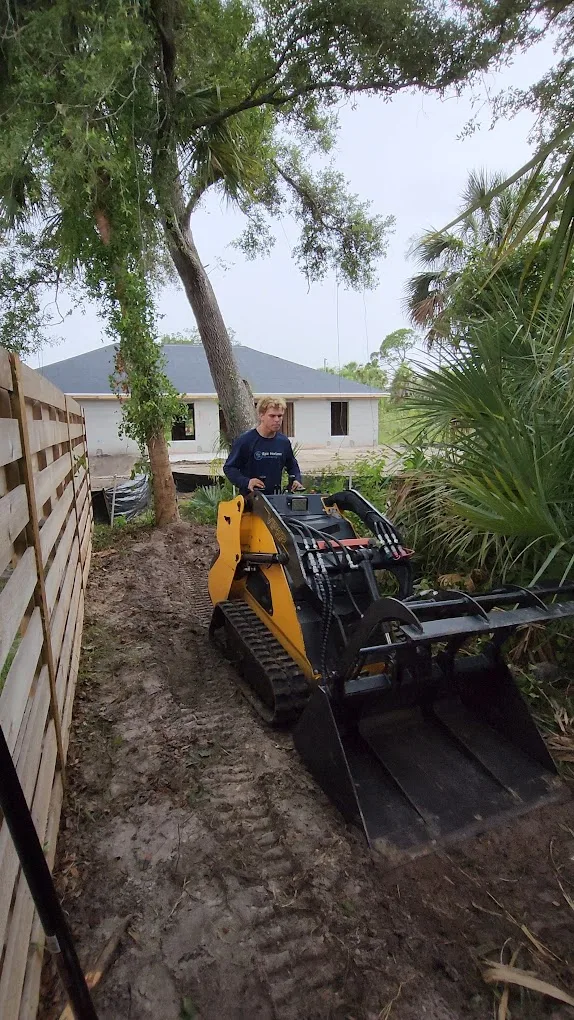
Timing matters too. St. Augustine can go in year-round here, but it roots fastest from spring through early fall, when it's actively growing. Sod laid in the dry season, November through April, gets no help from afternoon storms, so the sprinklers carry the whole load. Sod laid in peak rainy season, July through September, gets plenty of water, but any grading mistake shows up within a week as a puddle.
Prep decides most of the outcome. The rest comes down to how the slabs go down, and that's usually where a DIY lawn gives itself away.
how to lay st augustine grass sod
Lay St. Augustine grass sod in a staggered brick pattern, starting along a straight edge like a driveway or sidewalk. Push each slab tight against the last without stretching or overlapping it, cut pieces to fit with a sharp knife or flat spade, roll the whole area, then water until the soil under the slabs is soaked.
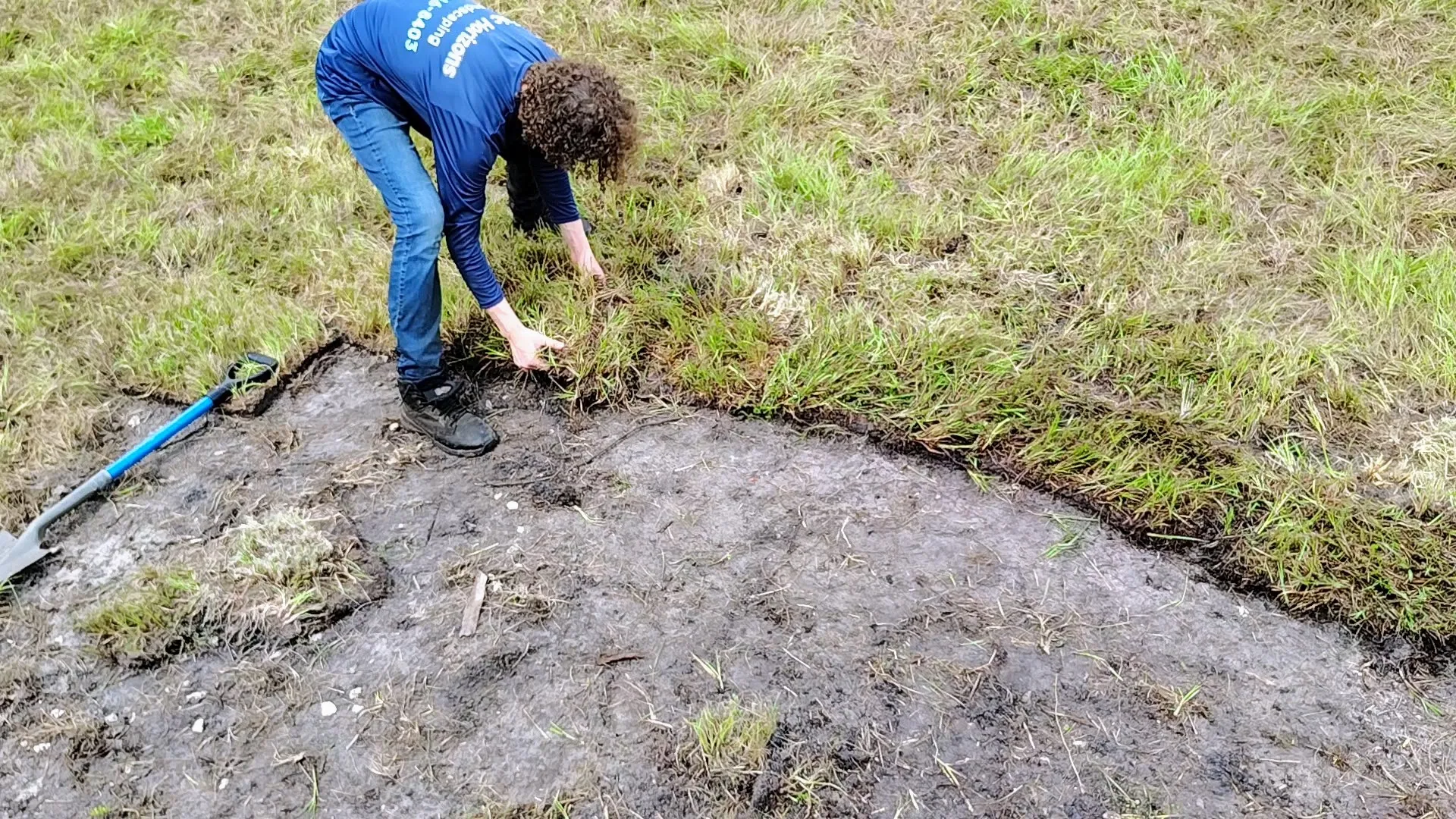
The details that separate a seamless lawn from a checkerboard:
- Stagger the seams. Offset each row by half a slab, like brick. Lined-up seams make long gaps that dry out and show for months.
- Push tight, don't stretch. Butt each edge against the last one and press it in. Stretched sod shrinks as it dries and opens gaps. Overlapped edges sit high, dry out and die.
- No slivers on the edges. Small pieces at the border dry out first. Put full slabs at the edges and do your cutting in the middle of a run.
- Lay across slopes. On a swale bank or any slope, run the rows across it, not up and down. On steep spots, pin the slabs with sod staples so a July downpour doesn't move them.
- Stay off it. Kneel on a board or a sheet of plywood, not on fresh sod. Knees and boots leave dents that turn into dry spots.
- Roll it. Run a lawn roller over the whole area to press the roots into the soil. Air gaps under the slab are where new sod dies, even when it's watered right.
- Water as you go. On a hot day, don't wait to finish the whole yard. Water each section within about 30 minutes of laying it.
A hard edge helps. Laying against concrete curbing gives you a straight line to start from, and it keeps mulch and rock from creeping into the new lawn.
Once the last slab is rolled, the work is barely started. The next 30 days of water decide whether you paid for a lawn or for a very expensive pile of hay.
how often to water st augustine grass sod
Water new St. Augustine grass sod twice a day for the first two weeks, morning and late afternoon, keeping the soil moist two to three inches down. In weeks three and four, water once a day in the morning. After about 30 days, once the sod won't lift with a gentle tug, taper toward a normal schedule.
| When | How often | Run time per zone | What to check |
|---|---|---|---|
| Install day | Right after rolling | Until the soil under the slab is soaked | Lift a corner. The soil should be wet, not just the grass. |
| Days 2–14 | Twice daily, morning and after 4 p.m. | 15–20 minutes | Soil moist 2–3 inches down all day |
| Days 15–30 | Once daily, morning | 20–25 minutes | Try the tug test around day 14 to 21 |
| Days 31–60 | Up to 3 days a week | Longer, less often | Slabs hold when tugged, no lifting edges |
| After day 60 | Your county's regular schedule | About ½ to ¾ inch per watering | Water when blades fold or footprints stay |
Rotor zones and spray zones put out water at very different rates, so treat those run times as a starting point. The real test is your finger. Push it into the soil between two slabs. If it's dry an inch down before the day is over, run another cycle. If it's still wet, skip one.
The Southwest Florida Water Management District, which covers Sarasota and Charlotte counties, gives new sod a 60-day establishment period with extra watering: any day of the week for days 1 to 30, and up to three days a week for days 31 to 60. After install day, new sod can only be watered before 10 a.m. or after 4 p.m. Your county or city can add its own rules, so check the current schedule before you program the timer.
If water is still standing 30 minutes after a cycle ends, you're overwatering. Soil that stays soaked invites fungus and root rot. We see it in North Port every summer, when the afternoon storm already soaked the yard and the timer runs anyway. Florida law has required a working rain sensor on automatic sprinkler systems installed since 1991. If yours is broken, your system will water right through a thunderstorm.
Hold off mowing until the sod passes the tug test, usually around week three. Then mow at your mower's highest setting, about 3.5 to 4 inches for Floratam, and never take more than a third of the blade at once. Our piece on why new St. Augustine sod dies in its first summer covers the mistakes that kill it in this window.
That's the whole job, from pallet to rooted lawn. Which leaves the real question for your yard: is this a weekend project, or a phone call?
St. Augustine grass pallets: lay them yourself or hire a crew?
Buying St. Augustine grass pallets and laying them yourself saves real money on a small, simple area. It costs more than hiring a crew when the job needs removal, grading or drainage work, because the sod fails and you end up buying it twice. Here's how the two compare on a typical half-yard job.
DIY makes sense when the ground is already clean and level, the area is two pallets or less, the truck can drop the pallet close, and you can lay all of it the morning it arrives. Call a crew when the old lawn has to come out, water sits anywhere on the property, the yard slopes toward the house, or your HOA has given you a deadline. That last one comes up all the time in North Port, where a lot of neighborhoods have an HOA and a dead front lawn earns a letter. Our St. Augustine sod installation page lays out the guarantee and our full process.
"Dennis was polite and very informative. Told me prices right up front did a great job. Will be back again next year. Thanks again guys."
— Ron Hoffman, Google ReviewThat's how Dennis quotes sod. He walks the yard, measures it, checks which way the water runs and tells you straight what it costs. If your patch is small enough to handle yourself with a couple of pallets, he'll say so. Call him at (941) 946-8403 or request a free estimate. We install St. Augustine across North Port, Venice, Port Charlotte and Englewood.
Frequently Asked Questions
How much is a pallet of St. Augustine sod?
About $130 to $250 in Southwest Florida in 2026, depending on variety, supplier and season. Floratam is the cheapest at roughly $130 to $200. Palmetto, Seville, CitraBlue and ProVista run about $180 to $280. That's the grass only. Delivery is usually a separate fee.
What is the St. Augustine sod pallet cost with delivery?
Add the supplier's delivery fee to the $130 to $250 pallet price. Most suppliers charge per trip, not per pallet, so the fee hurts most on a one-pallet order and matters less as the order grows. Ask about pallet deposits and delivery minimums before you order.
How much does a pallet of St. Augustine sod cost installed?
One pallet covers about 450 square feet, and installed St. Augustine runs about $0.90 to $2.50 per square foot in Southwest Florida. That puts one pallet's worth of installed sod at roughly $400 to $1,100, though most crews have a minimum for small jobs. The price covers removal, grading, laying, rolling and watering-in.
How many St. Augustine grass sod pallets do I need for a 5,000 square foot yard?
About 12. Divide 5,000 by 450 to get 11.1, add 5 percent for cuts, and round up. If the yard has a lot of curved beds or trees to work around, order 13. Our sod calculator does the math for any size.
Is San Augustine grass the same as St. Augustine grass?
Yes. San Augustine is a common name for St. Augustine grass, especially in Texas. A San Augustine grass pallet is the same product: slabs of St. Augustine, usually 400 to 500 square feet per pallet.
How long can a pallet of St. Augustine sod sit before it's laid?
Lay it within 24 hours of delivery, and the same day in summer. Fresh-cut sod heats up in the middle of the stack, and the center slabs can start yellowing within a day. If you're delayed, keep the pallet in the shade, but don't count on more than a few extra hours.
Can you lay St. Augustine sod during the rainy season?
Yes, and the rain helps with watering. The catch is the grading. In July and August a low spot fills with water within days, and sod sitting in standing water rots. We grade first so the afternoon storms drain off instead of pooling.
Do you install St. Augustine sod in North Port, Venice, Port Charlotte and Englewood?
Yes. We install St. Augustine sod across all four cities, including the removal and grading work that decides whether it survives. Call Dennis at (941) 946-8403 for a free estimate, or see our sod pages for North Port, Venice, Port Charlotte and Englewood.