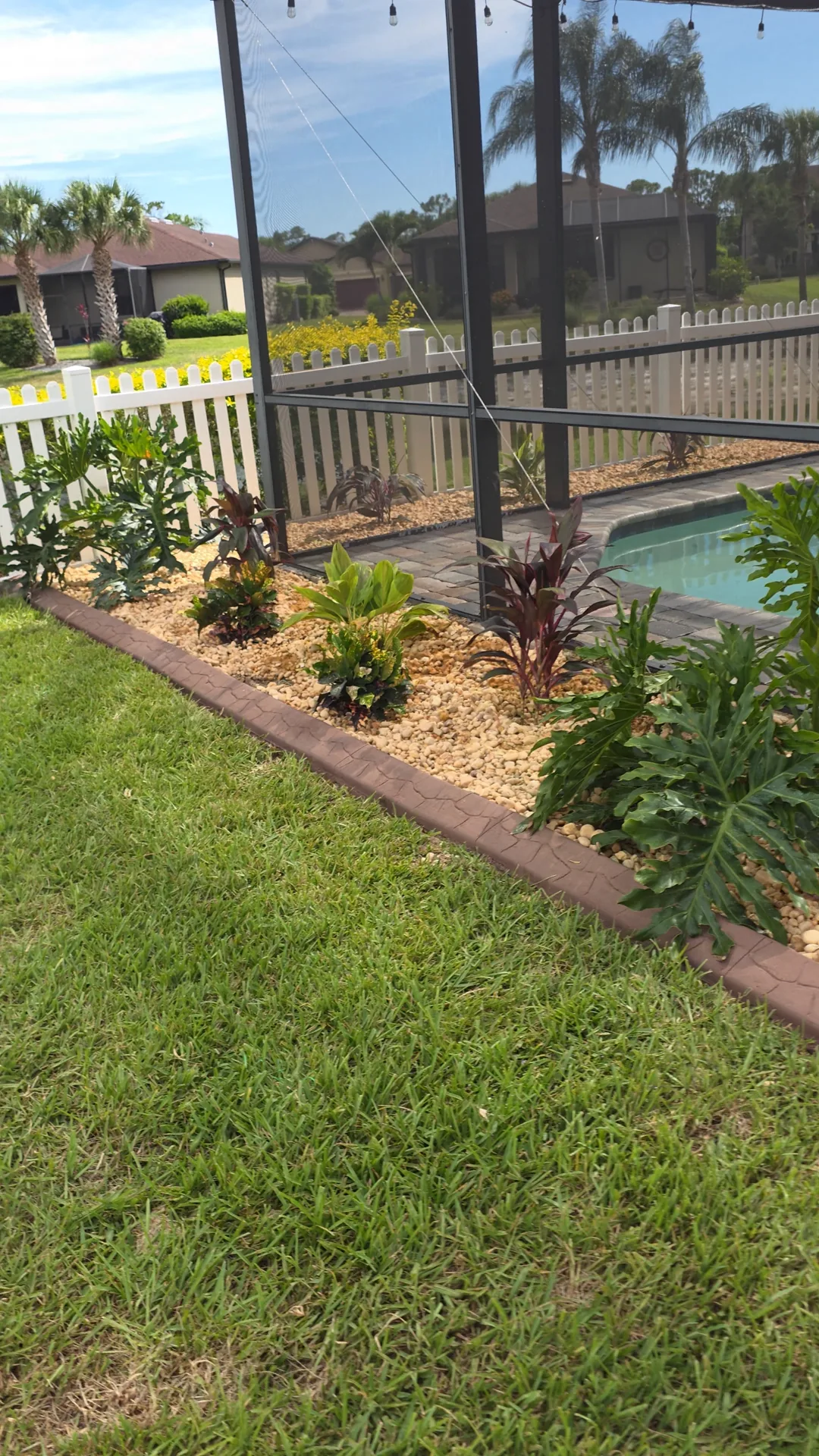
Why Edging Matters More Than You Think
Landscape edging is one of those things nobody thinks about until it fails. When it works, it keeps mulch in beds, grass out of walkways, and gives your whole yard clean lines that make everything look intentional. When it doesn't work — and in Florida, a lot of edging doesn't — you end up with mulch washing into the driveway, St. Augustine runners invading your plant beds, and a yard that looks neglected six months after you paid good money to have it installed.
We work across North Port, Venice, Port Charlotte, and Englewood, and the one thing all these areas share is conditions that punish cheap materials. Sandy soil that shifts. Summer storms that dump three inches of rain in an hour. UV exposure that would bleach a truck dashboard in a season. Whatever you put along your beds and borders has to survive all of that, year after year.
So when homeowners ask us whether they should go with concrete curbing or plastic edging, we don't give them a canned answer. It depends on the yard, the budget, and what you're actually trying to accomplish. But we're going to be straight with you about what we see happen to both options over time, because we're the ones who get called back when things fail.
The Truth About Plastic Edging in Florida
Plastic landscape edging — the black, flexible strips you see stacked at every big box store — is the most common edging material in the country. It's cheap, it's light, and any homeowner with a trenching shovel can install it on a Saturday afternoon. That accessibility is both its biggest selling point and its biggest problem.
How It Holds Up
In moderate climates with clay-based soil, plastic edging can do its job for several years. In SW Florida, the story is different. Here's what we see regularly:
- UV degradation: Most plastic edging is made from high-density polyethylene (HDPE). Even the "UV-stabilized" versions get brittle after two to three years of direct Florida sun. They crack, they split at stake holes, and they lose the flexibility that lets them hold a curve.
- Heaving and shifting: Our sandy soil doesn't grip plastic stakes the way clay or loam does. After a few heavy rain events, stakes loosen, sections pop up above grade, and the whole run starts to wander. We've pulled up plastic edging that's migrated four inches from where it was installed just one rainy season prior.
- Mower damage: Any edge that sits above grade is going to get clipped by mower decks and string trimmers. One hit from a commercial mower and that section is cracked or knocked loose. Now you've got an ugly gap that collects debris and lets grass push through.
- Root pressure: St. Augustine grass is aggressive. Its runners will push under, over, and through plastic edging. It's a speed bump, not a wall.
Realistic Lifespan in SW Florida
Budget plastic edging: 1–3 years before it looks bad and starts failing. Commercial-grade plastic or aluminum-core edging: 3–5 years with proper installation. Either way, you're looking at replacement or significant repair within the first five years — and in Florida conditions, that timeline often gets compressed.
Watch out for "professional grade" marketing. A lot of box-store plastic edging is labeled "professional" or "commercial grade" but is the same 4-inch HDPE strip with a slightly thicker gauge. Real commercial edging is typically aluminum or steel-core — and costs three to four times more. If it bends easily in your hands and costs under $1 per linear foot, it's going to disappoint you in Florida.
What Concrete Curbing Brings to the Table
Concrete landscape curbing — sometimes called continuous curbing or extruded curbing — is poured or extruded in place as a continuous border. There are no joints, no seams, and no stakes. It's a solid, monolithic edge that sits at or slightly above grade and locks your landscape borders in permanently.
How It Holds Up
Concrete curbing is an entirely different animal than plastic edging, and in Florida, the performance gap is massive:
- UV resistance: Concrete doesn't degrade under UV exposure. Period. It can fade if it's been color-stamped or sealed with a low-quality sealer, but the material itself isn't breaking down the way polymers do.
- Anchoring: Because it's poured directly into a prepared trench, concrete curbing bonds with the sub-grade. It doesn't shift, pop up, or migrate. Even in our sandy soils, a properly installed curb stays put because its own weight and continuous footprint hold it in place.
- Root barrier: A concrete curb that extends 3–4 inches below grade is a real barrier to grass runners. St. Augustine can't push through concrete. It's that simple.
- Storm performance: Heavy rain washes out stakes and floats lightweight edging. Concrete curbing sits there and does its job. We actually use curbing as part of drainage management on some properties — it can direct sheet flow away from beds and toward planned drainage paths.
- Mowing clearance: A concrete curb gives mowers a clean edge to follow. No string trimming along beds, no accidental damage. This saves time on every single mow.
Realistic Lifespan in SW Florida
Properly installed concrete curbing: 15–25+ years. We've seen curbing from the early 2000s in Port Charlotte that's still performing fine with minor cosmetic wear. Cracks can develop — Florida's sandy soil does settle — but even cracked curbing usually continues to function as an effective border. And cracks are repairable without replacing the whole run.
"Dennis and his team did an outstanding job on our landscaping. They were on time, professional, and the attention to detail was incredible. Our yard looks better than we ever imagined."
— Mike T.
Head-to-Head Comparison
Here's the no-fluff comparison. We're basing this on what we actually see in the field across Charlotte and Sarasota counties, not manufacturer claims from a test lab in Ohio.
| Factor | Plastic Edging | Concrete Curbing |
|---|---|---|
| Upfront Cost (per linear ft) | $1 – $4 installed | $6 – $12 installed |
| Realistic Lifespan (SW FL) | 1 – 5 years | 15 – 25+ years |
| Cost Over 15 Years (100 ft run) | $300 – $1,200+ (3–5 replacements) | $600 – $1,200 (one install) |
| UV Resistance | Poor — degrades in 2–3 years | Excellent — no structural degradation |
| Holds Against St. Augustine | Weak — runners push through | Strong — solid root barrier |
| Storm / Flood Performance | Stakes loosen, sections float | No movement — weight holds it |
| Sandy Soil Performance | Poor stake grip, heaving common | Excellent — poured into sub-grade |
| Curb Appeal | Minimal — utilitarian look | High — clean, finished appearance |
| Profile Options | One — flat strip | Many — slant, mower, square, stamped |
| Repairability | Replace entire sections | Patch cracks, spot repair |
| DIY Friendly | Yes | No — requires equipment and experience |
Look at that "Cost Over 15 Years" row. That's the number that matters. By the time you've replaced plastic edging three or four times — and paid someone to rip out the old stuff each time — you've spent as much or more than you would have on concrete curbing that's still going strong.
A note on aluminum edging: If plastic is your preference, consider commercial aluminum edging as a middle-ground option. It won't degrade under UV, it holds a better edge than HDPE, and it lasts 8–12 years in Florida conditions. It costs more than plastic but less than concrete curbing. We can install it — just ask.
When Plastic Edging Actually Makes Sense
We're not here to tell you plastic edging is garbage and you should never use it. There are situations where it's the right call:
- Temporary landscaping: If you're renting, staging a house for sale, or planning a full landscape renovation in the next year or two, cheap plastic edging can hold things together in the meantime.
- Hidden borders: Between a bed and a fence line, or along the back of a property where nobody sees it — plastic edging can serve as a functional grass barrier without needing to look nice.
- Tight budget with short timeline: If you're doing a yard project in phases and edging is the lowest priority, plastic buys you time. Just know you'll be replacing it.
- Complex curves in non-critical areas: Plastic bends tighter than curbing equipment can extrude. For intricate garden bed shapes in low-traffic zones, it can work — though concrete curbing handles most curves just fine.
Outside of those scenarios? In SW Florida, concrete curbing wins on every metric that matters for a permanent installation. It's not even close.
How We Handle Curbing and Edging Jobs
When you call us for a curbing estimate, here's what happens. Dennis comes out, walks the property with you, and talks through what you're trying to accomplish. We look at the soil conditions, the existing landscaping, the grade and drainage patterns, and the relationship between your beds, hardscaping, and turf areas.
Prep Work Matters
The biggest reason curbing fails isn't the concrete — it's bad prep. If you pour curbing over loose fill, organic material, or uncompacted sand, it's going to crack and settle unevenly. Our process includes:
- Trenching to proper depth (typically 3–4 inches below grade)
- Removing organic debris and roots from the trench line
- Compacting the sub-grade so the curbing has a stable foundation
- Setting string lines for straight runs and marking curves for consistent profile
We also think about how curbing interacts with your drainage. If water pools along a bed after storms, we're not just going to drop curbing on top of the problem. We'll talk to you about grading adjustments or adding a drainage solution so you're not trapping water against your plants.
Profile and Finish Options
Concrete curbing isn't one-size-fits-all. We offer several profiles:
- Mower edge (flat/slant): The most popular in SW Florida. Lets mower wheels ride along the curb for a clean cut with zero trimming.
- Square/colonial: A more defined, upright border for a traditional look.
- Stamped patterns: Brick, stone, or custom textures for higher-end installs.
- Color integration: We can add integral color to the mix so the shade goes all the way through — not just surface-deep like paint.
"Very professional and honest. Dennis went above and beyond for our project. The workers were respectful and the yard turned out beautiful. Would recommend them to anyone."
— Renee Davis
What About Existing Edging?
If you've got old plastic edging that's failing, we rip it out as part of the curbing install. No extra trip, no extra headache. We've done plenty of jobs in Venice and North Port where the whole scope was removing deteriorated plastic edging and replacing it with concrete curbing — and the transformation is dramatic. Clean lines instantly make a yard look maintained and intentional.
We also pair curbing with other services. A lot of our curbing jobs happen alongside plant installations, rock installations, or full landscape renovations. When you're already updating beds, that's the ideal time to put in permanent borders. Do it once, do it right, don't think about it again for 20 years.
Frequently Asked Questions
Does concrete curbing crack in Florida?
It can. Sandy soil settles, tree roots grow, and Florida's wet/dry cycles put stress on any rigid material. But cracks in curbing are cosmetic and repairable — a cracked section still holds back mulch, blocks grass runners, and maintains the border. It's nothing like cracked plastic edging, which completely fails at its job once it splits.
How long does a concrete curbing installation take?
For a typical residential property — say 150 to 300 linear feet of curbing — we're usually in and out in one day. Larger properties or complex layouts with lots of curves and tie-ins to hardscaping might take two days. The curbing itself needs 24–48 hours to fully cure before you should run a mower along it.
Can I install concrete curbing myself?
Technically, yes — you can rent an extrusion machine. Practically, no. The machines require experience to operate at a consistent speed and pressure. Inconsistent extrusion leads to voids, thin spots, and curbing that cracks prematurely. This is one of those jobs where the equipment cost, learning curve, and risk of a bad result make it worth hiring a crew that does it regularly.
Is concrete curbing worth it on a rental property?
Depends on the rental. If you're managing a long-term rental and want to minimize maintenance calls and lawn care costs, curbing pays for itself by eliminating trimming time and edging repairs. If it's a short-term vacation rental, the curb appeal boost can genuinely affect booking rates — first impressions matter in listing photos. For a property you plan to sell within a year, it might be over-investing.
Can you match curbing color to my pavers or house?
Yes. We use integral color mixed into the concrete, and we can match or complement most paver and exterior paint tones. We'll bring samples during the estimate so you can see options against your existing materials in natural light — not under fluorescent store lighting.
What's the maintenance on concrete curbing?
Almost nothing. Blow off debris, hit it with a hose or pressure washer once or twice a year if you want it to look fresh. If you went with a sealed or stamped finish, resealing every 3–5 years keeps the color vibrant. That's it. Compare that to re-staking, replacing, and re-trenching plastic edging every couple of years.