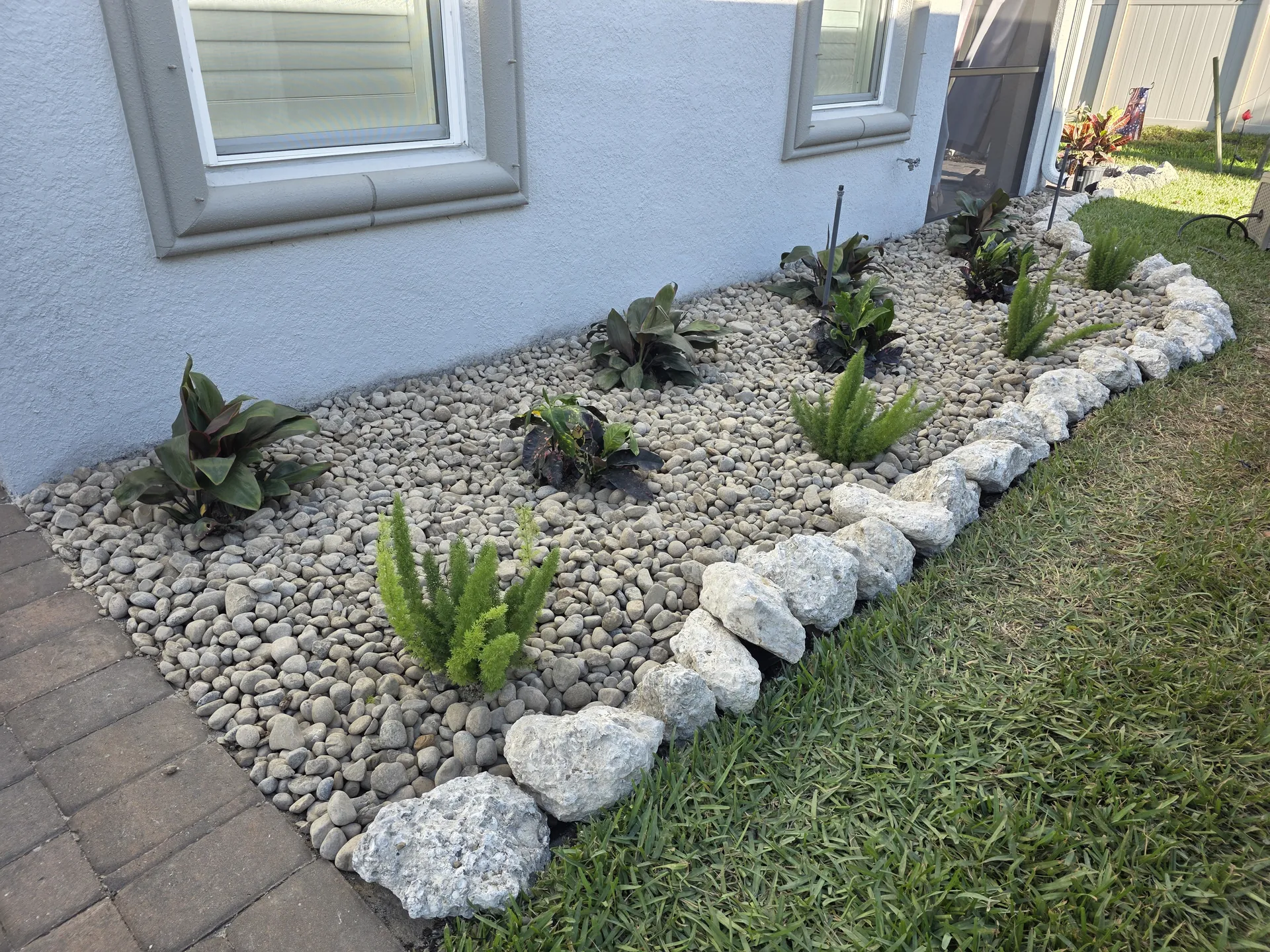
"Low maintenance" in landscaping means different things depending on where you live. In the Midwest, it might mean a simple lawn. In Florida — specifically in Sarasota and Charlotte County — it means something completely different, because our climate, soil, and water restrictions create a completely different set of rules.
I've been installing and renovating landscapes in North Port, Venice, Port Charlotte, and Englewood since 2022. Here's what I've actually seen work — and, further down, photographs of real yards we've built so you can see it rather than take my word for it.
Easy Upkeep Landscaping: What the Phrase Actually Means Here
Most people searching for easy upkeep landscaping are really asking one of two questions: how do I spend fewer weekends on this yard, or how do I stop paying someone to fix the same problems every year. Those are different problems with a lot of overlap.
In practice, almost all recurring yard work in Southwest Florida comes from four sources:
- Mowing and edging turf. St. Augustine grows fast from roughly May through October. Every square foot of lawn is a square foot you or someone else is cutting every week for half the year.
- Replacing bed material. Organic mulch breaks down, floats, and blows out. It's an annual purchase, forever.
- Trimming plants that outgrew their spot. Almost always a spacing problem from the original install, not a plant problem.
- Replacing plants that died. Nearly always a plant-choice problem or an irrigation problem.
An easy upkeep landscape isn't one with fewer plants. It's one where each of those four sources has been designed out. Shrink the turf, use a bed material that doesn't decompose, space plants for their mature size, and pick species that survive our dry season without hand-watering. Do those four and the yard stops generating work.
That's also why national "low maintenance" lists tend to be useless here. They're written for climates where the growing season stops in October. Ours doesn't.
The #1 Mistake That Creates High-Maintenance Yards
It's not choosing the wrong plants (though that matters). It's using organic mulch.
Organic mulch — pine bark, shredded wood, cypress — decomposes in Florida's heat within 6–12 months. It blows away in the first tropical storm. It hosts termites. It floats during heavy rain and ends up on your driveway. And then you have to buy and install it all over again, every single year.
The single highest-impact change I make on landscape renovations is replacing organic mulch with inorganic rock: river rock, marble chip, or pea gravel. Rock doesn't decompose. It doesn't blow away. It doesn't attract termites. It gets rinsed clean by every rain. You install it once and it stays.
The upfront cost is higher than mulch, but rock is bought once and mulch is bought every year, so the two lines cross. Where they cross depends on bed size and what you're paying for mulch — I'll walk the beds and give you the actual comparison for your yard rather than a number from an article. We cover the trade-offs in more depth in rock vs. mulch for Florida landscaping.
Pictures of Low-Maintenance Landscaping in Real SW Florida Yards
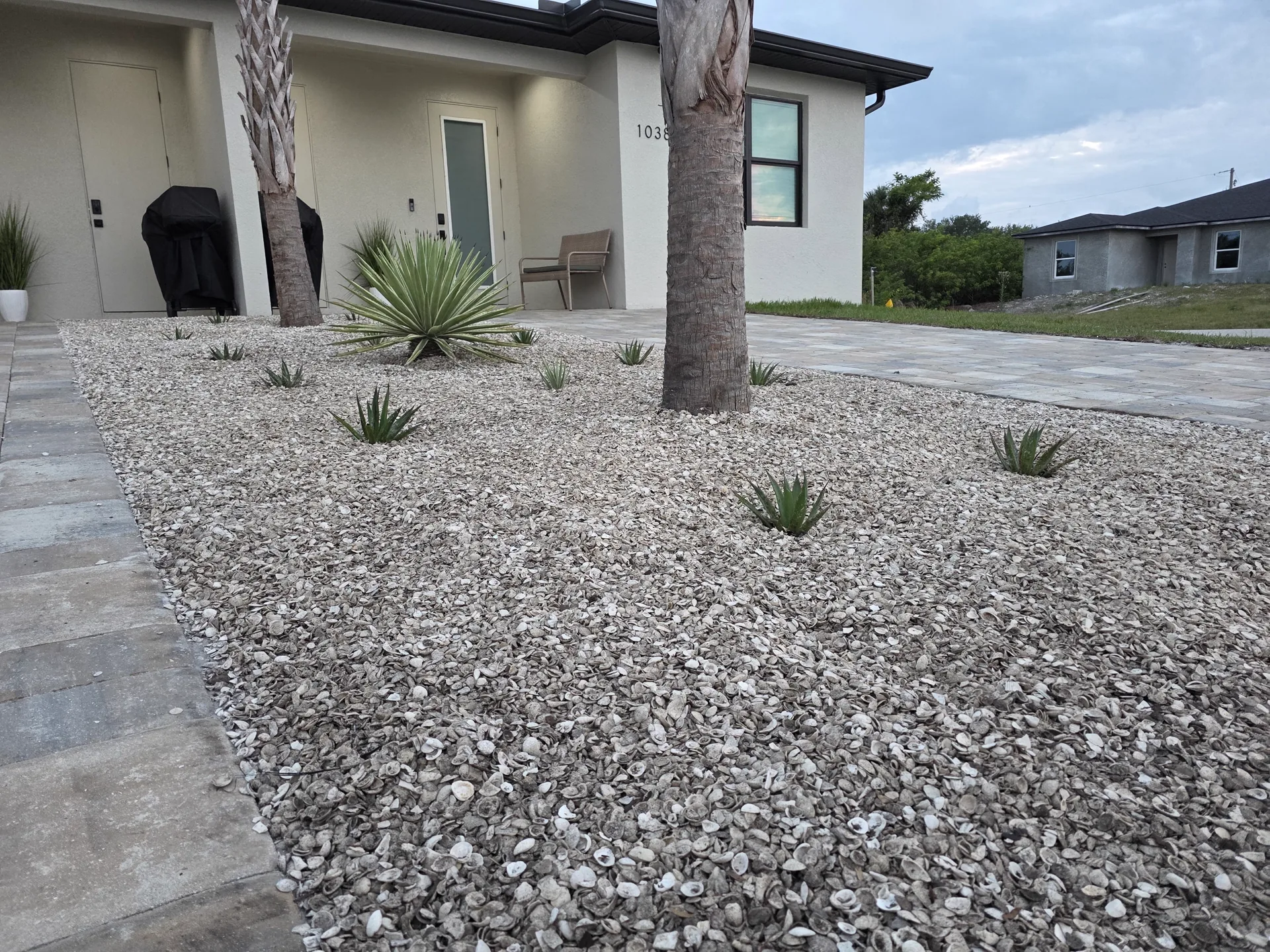
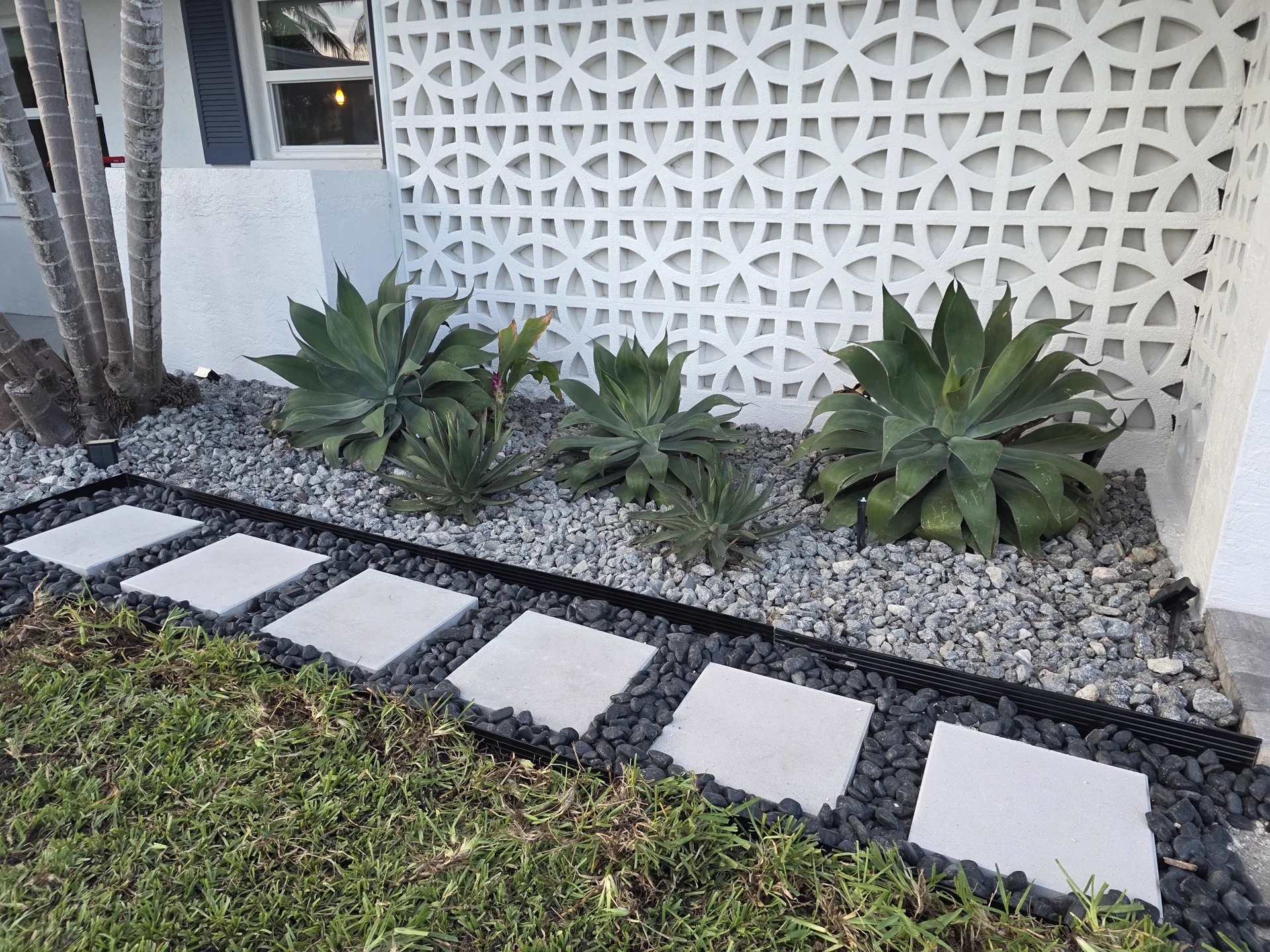
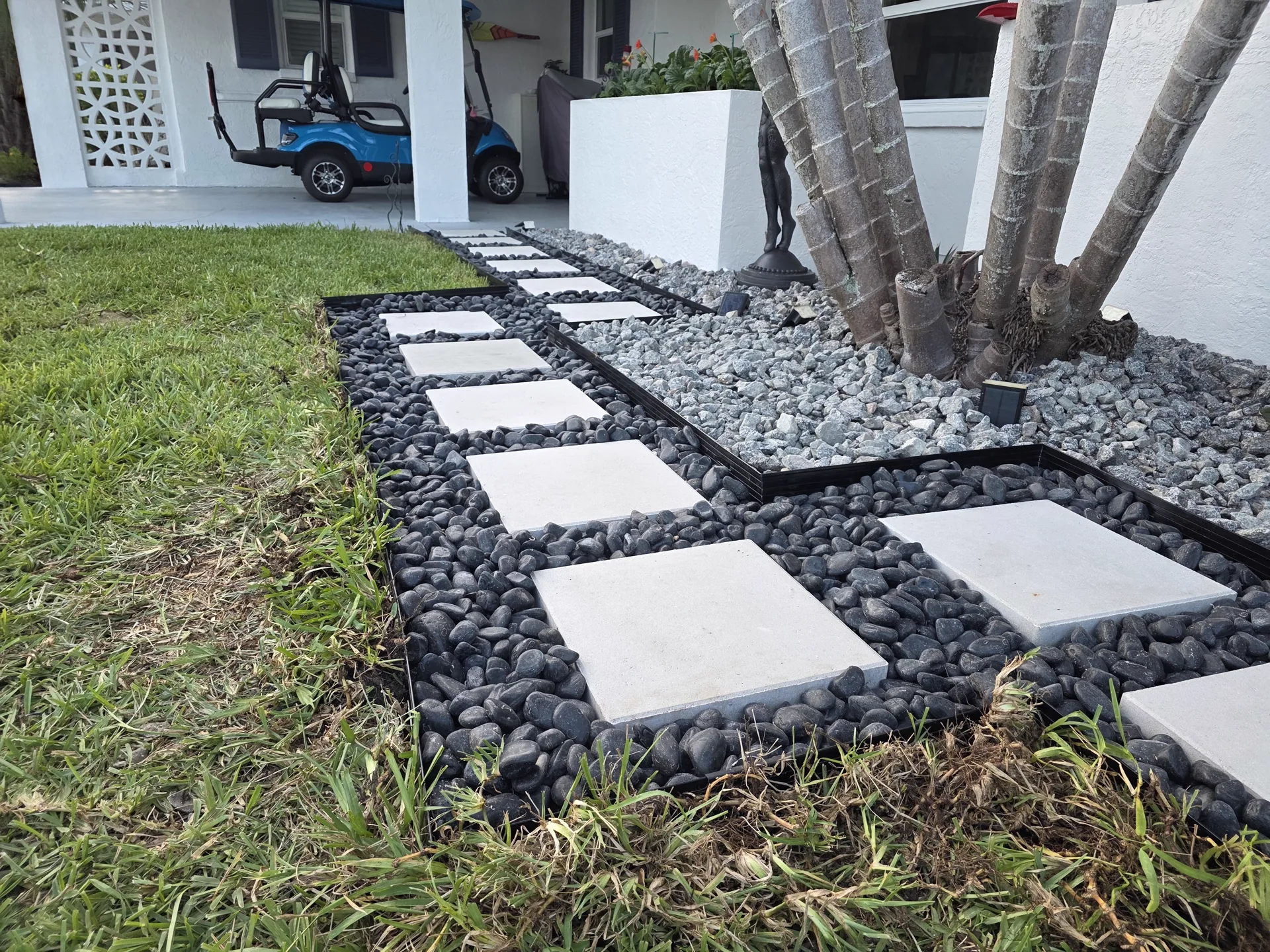
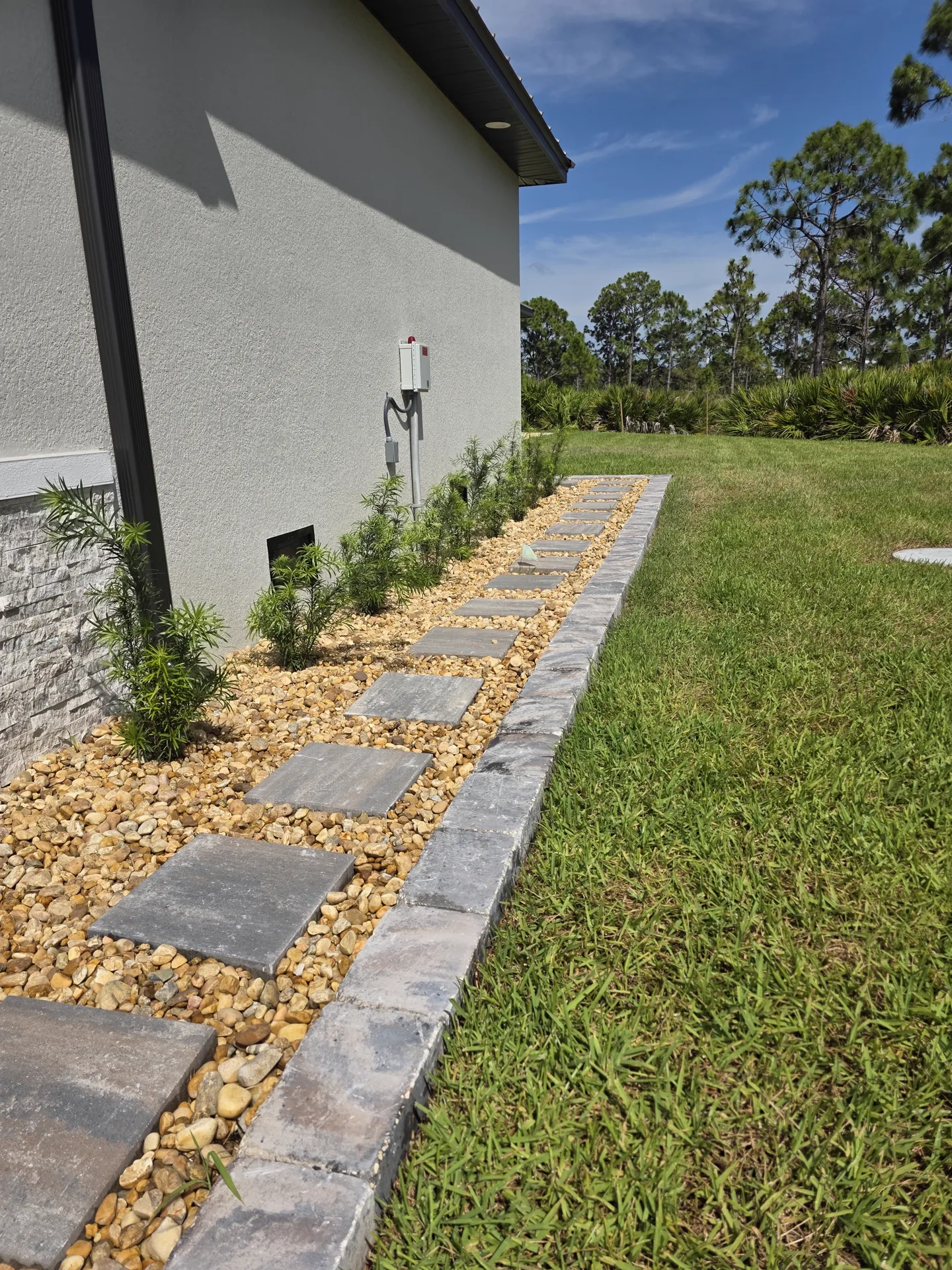
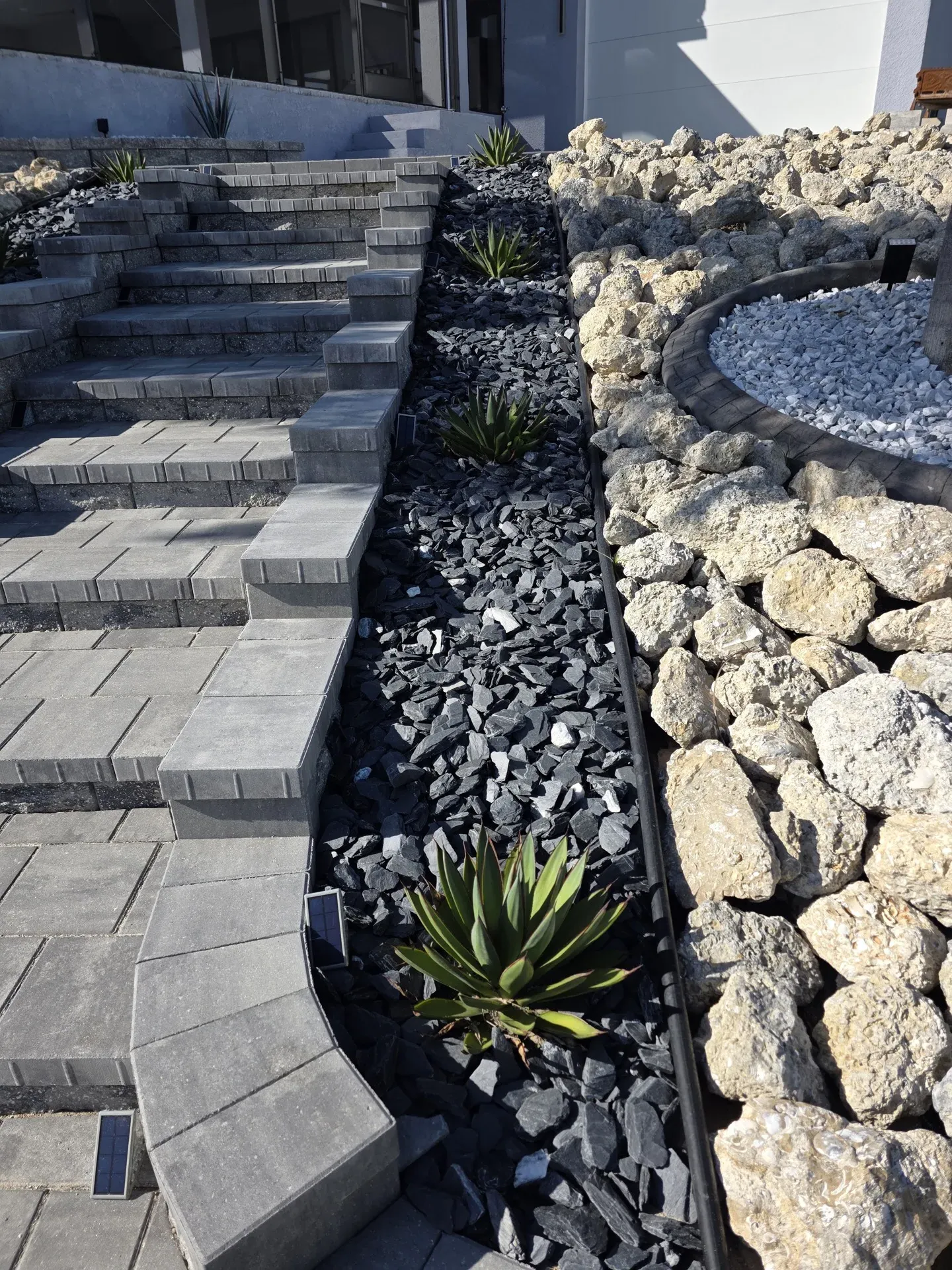
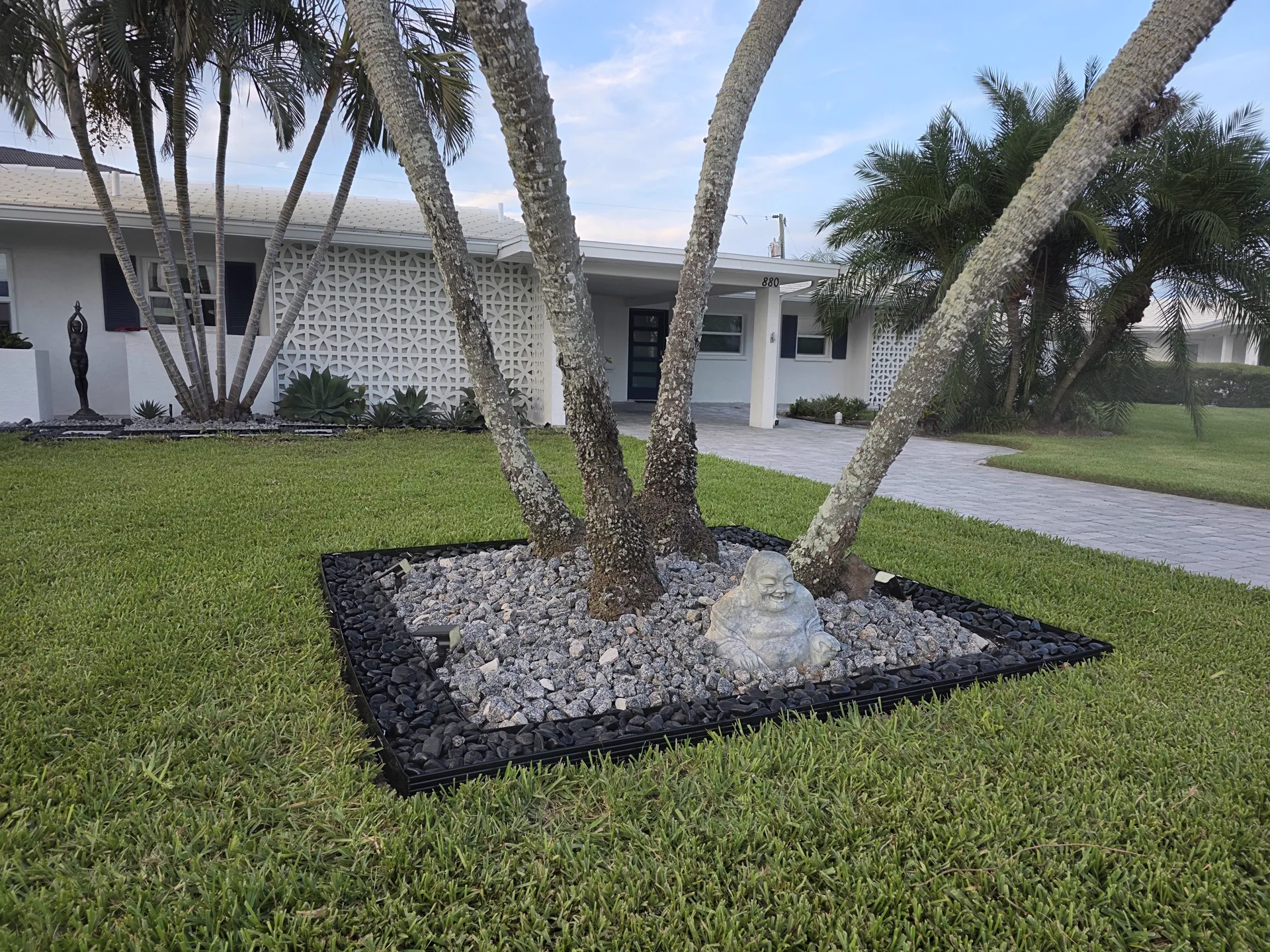
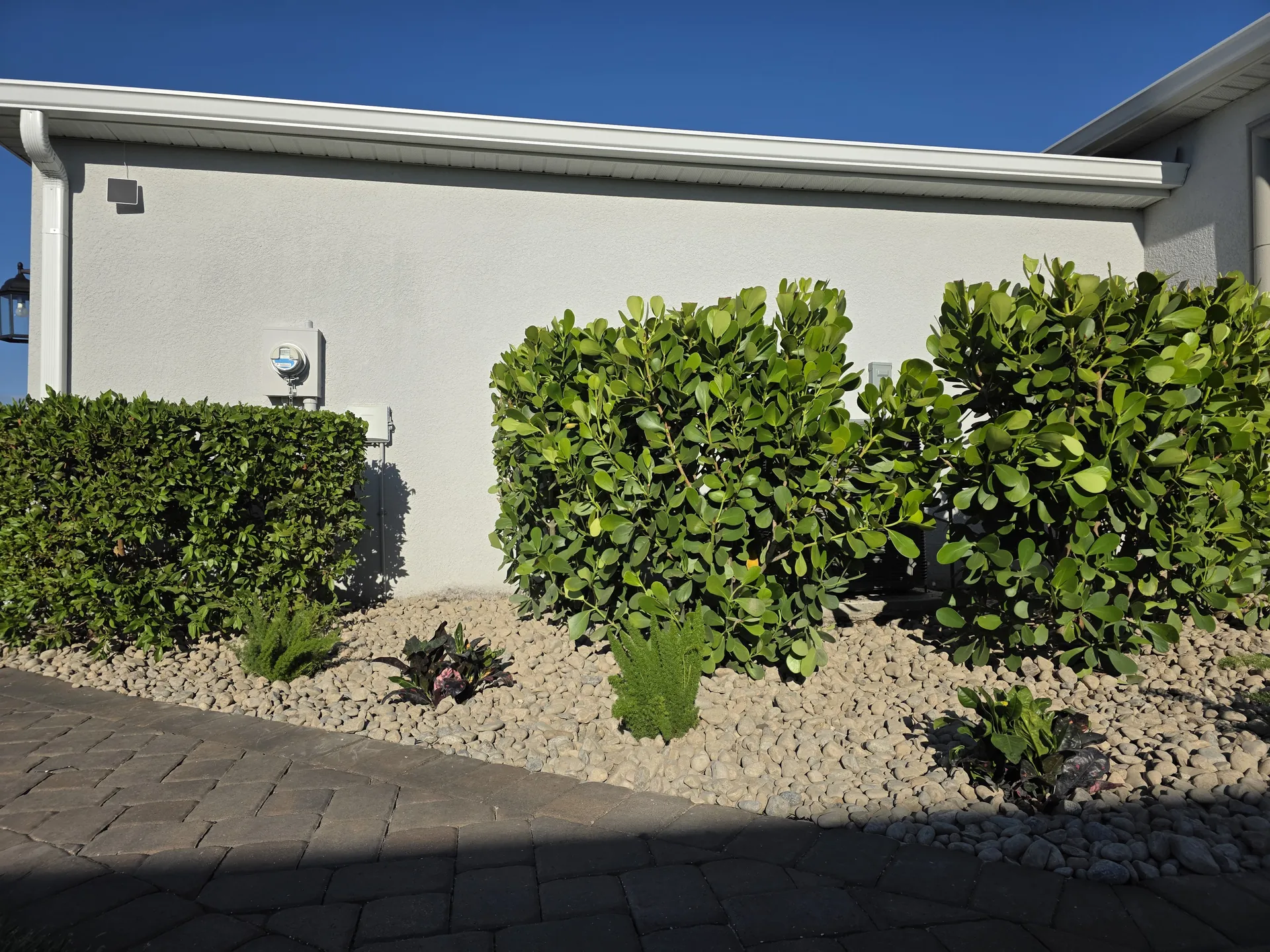
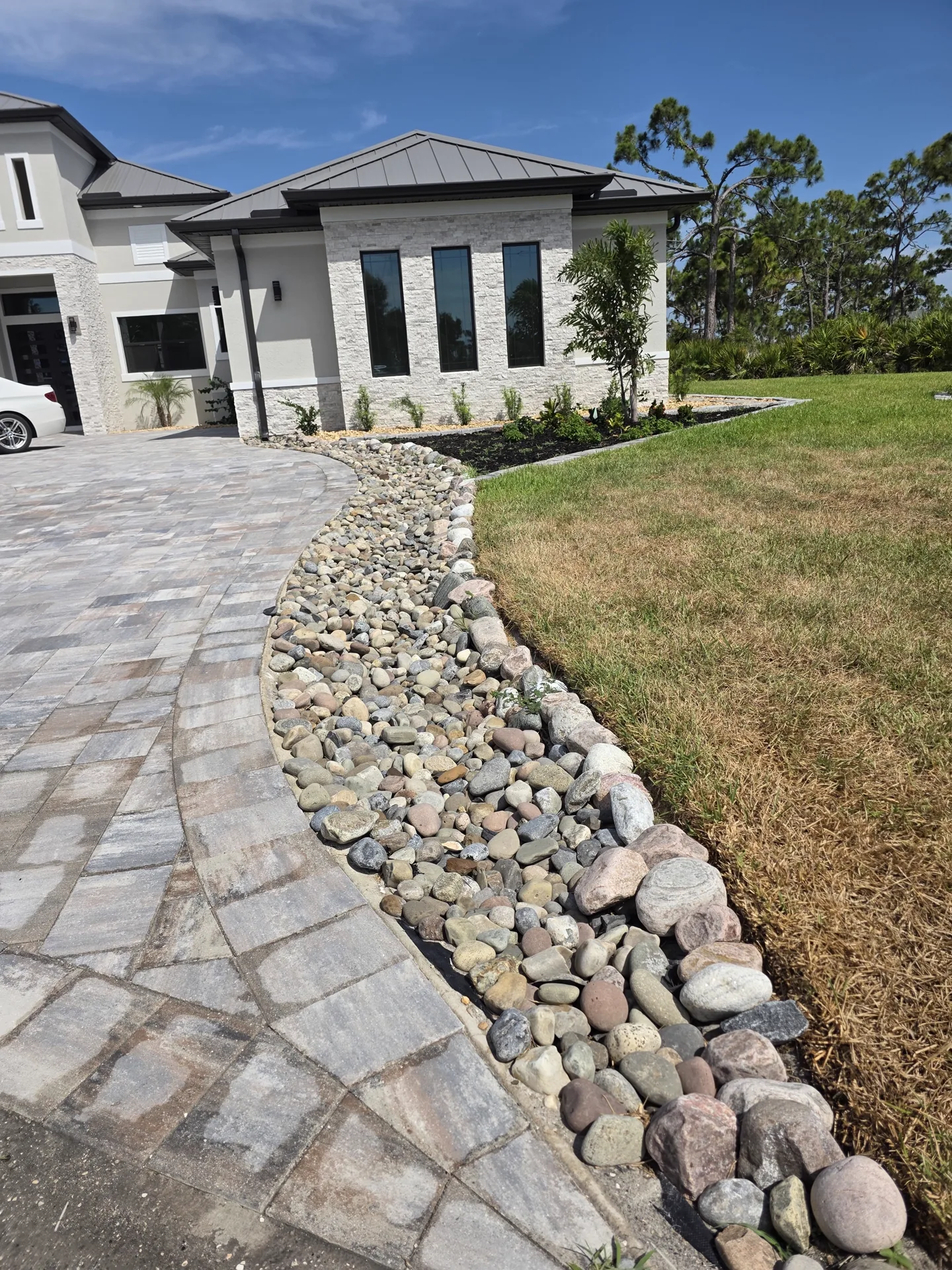
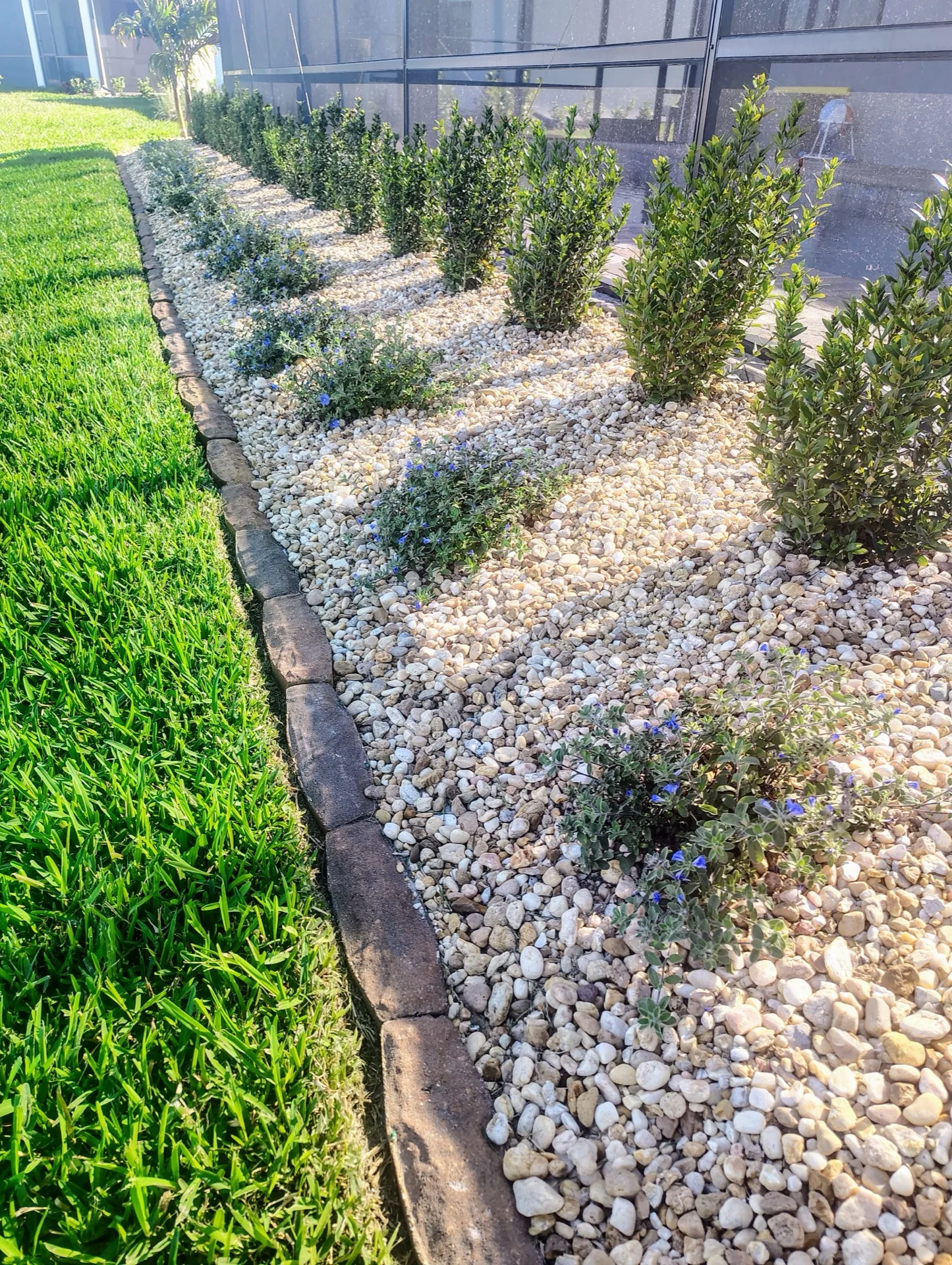
These are all Epic Horizons installs in Charlotte and Sarasota County — not stock photography, not renderings. Look at what the ground plane is doing in each one: rock, stone, or hardscape carries the design, and plants are used as accents rather than as wall-to-wall coverage. That's the whole strategy in one image, repeated eight ways.
Low-Maintenance Landscaping Ideas for the Backyard
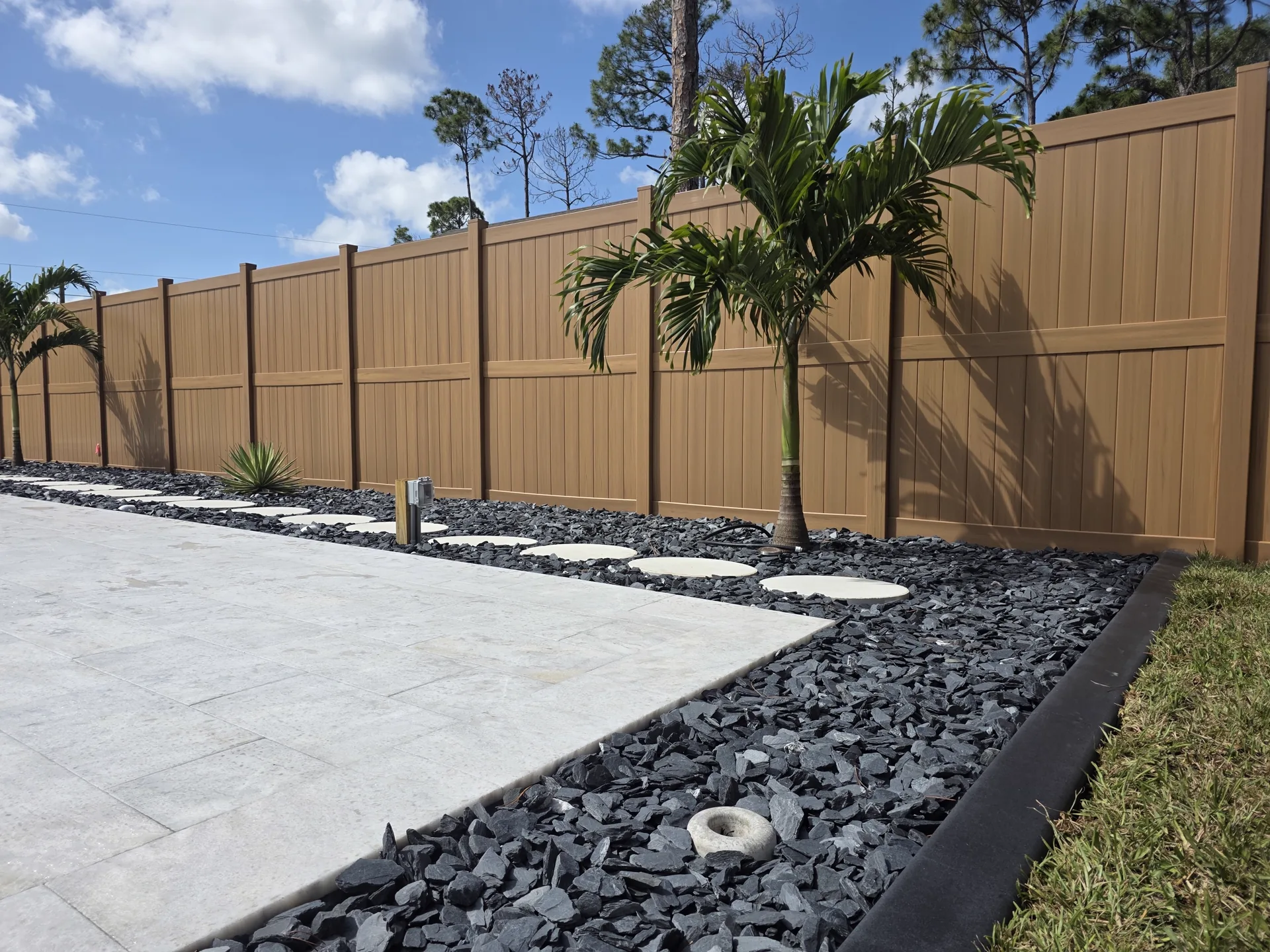
Backyards get treated differently from front yards, and they should be. Front yards are seen from the street and often governed by an HOA. Backyards are seen by you, usually from a lanai or a pool deck, at close range — which means detail matters more and total coverage matters less.
The pattern that works best behind SW Florida houses is a deep planted band around the perimeter, rock through the band, and whatever turf survives in the middle. You get a green view from every seat inside the cage, and the part of the yard nobody walks on stops being lawn.
A few backyard specifics worth planning around:
- Keep beds off the screen enclosure. Plants pressed against a pool cage abrade the screen and trap moisture on the frame. Leave a rock margin you can walk in.
- Don't run spray heads toward the cage or the pool. Overspray leaves mineral staining on the screen and the deck. Beds behind the house are the easiest place in the whole yard to convert to drip.
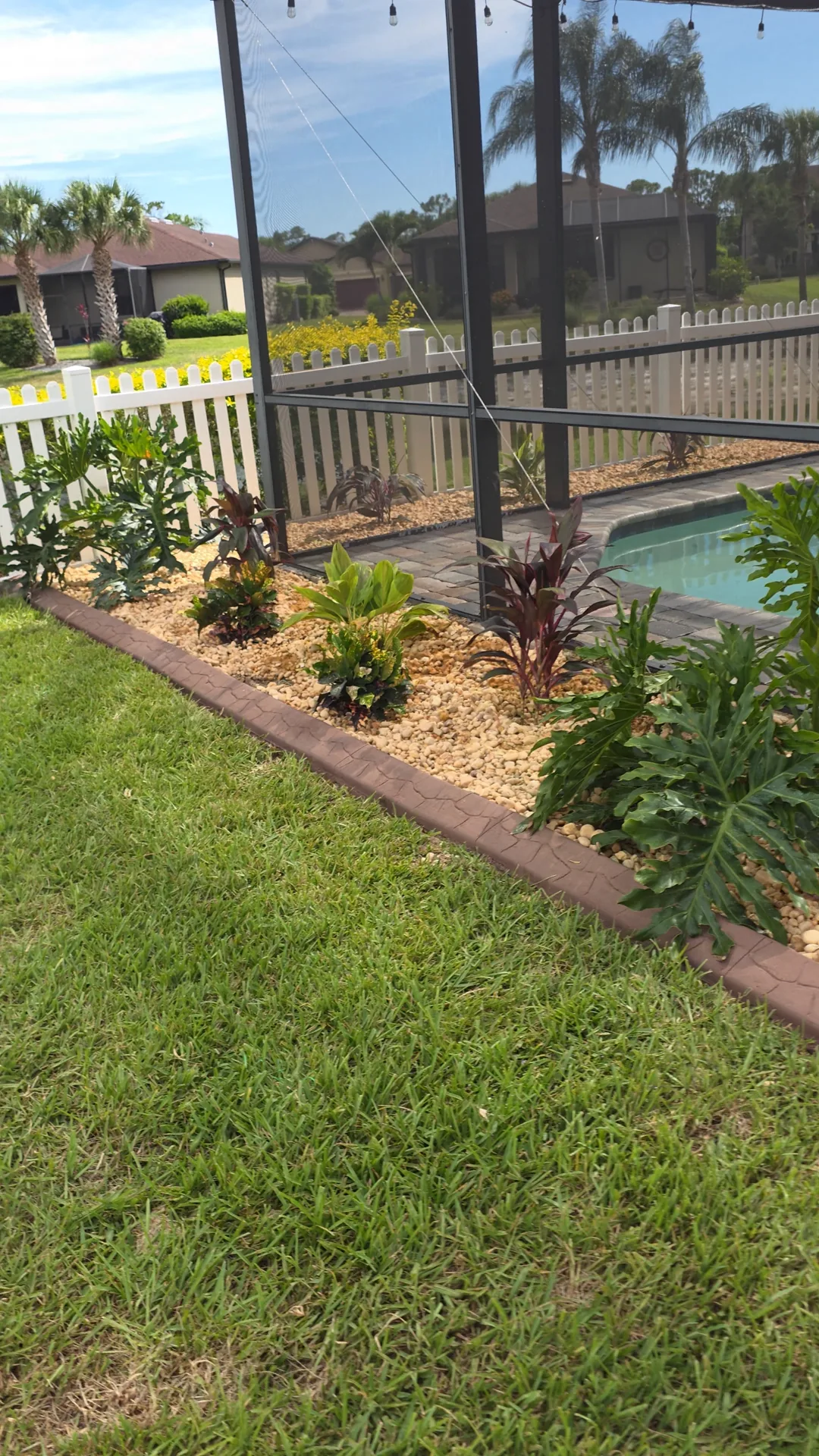
- Use bold foliage rather than flowers. Crotons, cordylines and philodendrons hold colour and shape year-round. Flowering annuals in a backyard bed are a standing appointment you didn't mean to make.
- Pick a stepping-stone route to the equipment. Pool pump, irrigation valves, A/C pad, cleanout. If there's no path, you'll wear one into the grass anyway.
- Mind the drip line. Beds directly under a roof edge with no gutter take a concentrated water column in every storm. Rock handles that; mulch is gone by August.
The Best Low-Maintenance Plants for SW Florida
These are plants I personally install and maintain for clients in Sarasota and Charlotte County. They're selected for three qualities: they survive with minimal irrigation once established, they hold up to Florida's occasional salt air and sandy soil, and they don't require constant trimming to look presentable.
Plant comparison table for USDA zones 9b–10a
Everything below is suited to our zone range and is a plant we actually install. "Water" means what it needs after establishment — every one of these still needs regular water for the first several weeks. Mature size is the size it wants to be, which is the number that decides your spacing and therefore your future trimming.
| Plant | Water (established) | Mature size | Salt tolerance | Sun |
|---|---|---|---|---|
| Coontie Zamia integrifolia — native |
Low | 2–3 ft tall, 3–4 ft wide | Moderate | Full sun to part shade |
| Saw palmetto Serenoa repens — native |
Very low | 5–8 ft tall and wide | High | Full sun to part shade |
| Muhly grass Muhlenbergia capillaris — native |
Low | 2–3 ft, taller in bloom | High | Full sun |
| Dwarf fakahatchee grass Tripsacum floridanum — native |
Low | 2–3 ft tall and wide | Moderate | Full sun to part shade |
| Simpson's stopper Myrcianthes fragrans — native |
Low | 8–15 ft as a shrub; taller if left as a tree | High | Full sun to part shade |
| Sea grape Coccoloba uvifera — native |
Low | 15–25 ft; hedgeable | Very high | Full sun |
| Green buttonwood Conocarpus erectus — native |
Low | 20–30 ft tree; often kept as a hedge | High | Full sun |
| Small-leaf clusia Clusia guttifera |
Low to moderate | 6–10 ft as a maintained hedge | High | Full sun to part shade |
| Podocarpus Podocarpus macrophyllus |
Low to moderate | 8–15 ft as a hedge; much taller unclipped | Moderate | Full sun to part shade |
| Agave Agave desmettiana |
Very low | 2–3 ft tall, 3–4 ft wide | Moderate | Full sun to part shade |
| Croton Codiaeum variegatum |
Moderate | 3–6 ft, varies widely by cultivar | Low — keep back from direct coastal exposure | Full sun to part shade |
Two things to read off that table. First, the native column and the water column line up almost perfectly — that isn't a coincidence, it's what "native to a place with a five-month dry season" means. Second, look at the mature sizes before you decide how many plants you want. A bed that looks sparse on install day and correct in three years is a low-maintenance bed. A bed that looks full on install day is a trimming schedule.
If you want these put in properly — right spacing, right depth, amended backfill in our sand — that's our plant installation service.
Plants to Avoid (High Maintenance in Florida)
These are plants that show up on national "low maintenance" lists but fail in SW Florida conditions or create far more work than expected:
- Impatiens: Die instantly in direct Florida sun. Require constant replanting, constant watering, constant fungicide. Avoid entirely.
- Ferns (Boston, Asparagus): Require high humidity and consistent moisture. In Florida's dry season they look dead. In rainy season they overgrow everything. High trimming frequency.
- Ixora: Popular but requires iron supplementation in our alkaline soil or turns chronically yellow. Also needs protection from cold snaps (yes, we get them).
- Bougainvillea near structures: Beautiful, extremely low water needs — but thorns puncture irrigation lines, hands, and occasionally screens. Keep them away from pool cages and walkways.
- Any annual: By definition requires replanting every season. No annual is low-maintenance in Florida.
Easy Upkeep Landscaping Ideas, Zone by Zone
Rather than redesigning a whole property at once, it's usually more useful to go zone by zone and ask "what is this area costing me each month?" Here's how the areas of a typical SW Florida lot rank, roughly worst to best return on effort.
The side yard
Almost always the first thing I convert. Side yards are narrow, partly shaded by the house, awkward for a mower, and usually watered by whichever spray head happens to reach. Grass there is thin or bare most of the year. A rock field with a stepping-stone route and a few upright shrubs — podocarpus works well — turns the worst-performing part of the lot into the tidiest.
The driveway and walkway edges
Concrete and pavers hold heat and shed water, so the grass strip beside them is under stress from both sides. A rock band along the edge solves the appearance problem and the runoff problem in one move, and gets rid of the fiddliest edging on the property.
Around trees and palms
String-trimming around trunks damages bark and, on palms, cuts into the trunk permanently — the scars never grow out. Rock rings with a hard edge take five minutes of design and remove a recurring job.
The pool and lanai perimeter
Shade, splash-out and restricted mower access make this the second-worst turf zone on most lots. It's also the area you look at most, which makes it the best place to spend on foliage.
The front lawn
Usually the last zone to touch, and often the one to keep. A front lawn is what most HOAs expect, it's the cheapest surface per square foot, and a healthy St. Augustine lawn in the one part of the yard that gets full sun and even irrigation isn't especially hard to keep. The move is to shrink it to the part that performs, not to eliminate it — and if the existing turf is patchy sand, replacing it once with good sod on a corrected grade costs less over five years than fighting it.
The Rock Bed Strategy
This is the single most impactful landscape upgrade I've seen for low maintenance. Replace all your planted beds with this system:
- Remove existing mulch and weeds completely. Don't just put rock on top — the weeds will grow through in 6 months.
- Install commercial-grade weed fabric. Not the cheap stuff from the home improvement store — it fails in 2–3 years. Professional-grade woven fabric lasts far longer.
- Add river rock or marble chip, 2–3 inches deep. River rock (gray) is the most neutral and most popular in SW Florida HOA communities. Marble chip (white) creates a high-contrast look that photographs beautifully.
- Plant low-maintenance species through the fabric using a utility knife to cut holes. Space correctly for mature size — don't overcrowd.
- Add drip irrigation directly to plant roots through the fabric. This eliminates over-surface watering that wastes water and promotes weed growth.
A properly installed rock bed with good plants and drip irrigation will be essentially maintenance-free for 3–4 years. The only maintenance: occasional weeding at the fabric seams (once or twice a year) and trimming the plants (1–2 times per year depending on species).
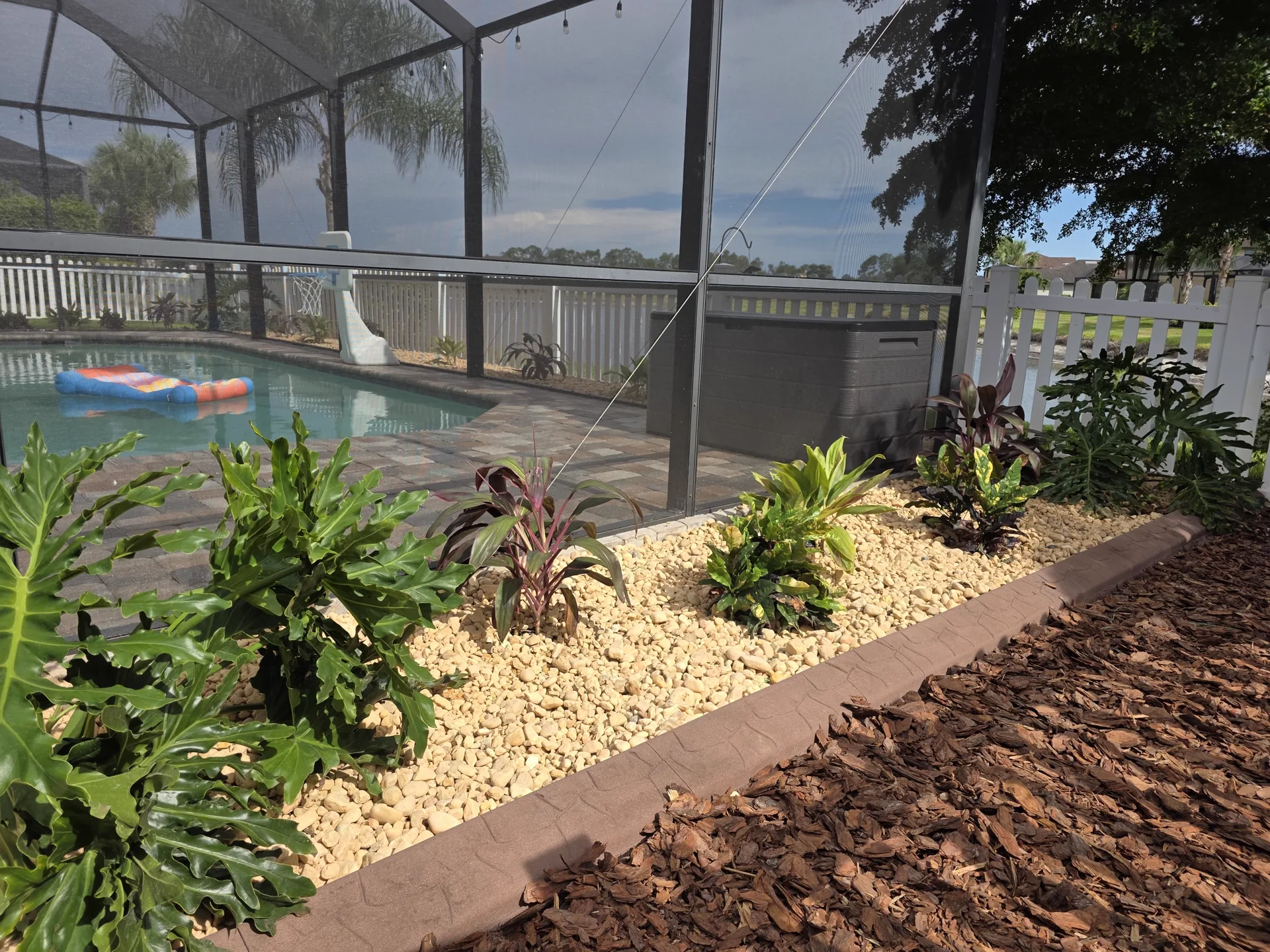
One thing worth saying plainly: rock is not automatically low-maintenance. Rock installed over bare soil with no fabric, or spread an inch thin, or laid without an edge to contain it, will be full of weeds and half in the lawn within two seasons. The system is what works, not the material. That's what our rock installation service actually is — the prep, not the stone.
Smart Irrigation Makes Everything Easier
You can have the perfect plants in the perfect rock beds, and they will all fail in their first Florida dry season if you don't have irrigation dialed in.
The upgrade that most transforms maintenance workload: replace a timer-based system with a weather-based smart controller (Rachio or Rain Bird). These controllers connect to local weather data and automatically skip watering cycles when it rained — which in North Port's rainy season means your system may not run at all for weeks, automatically. A fixed timer, by contrast, will happily run its cycle in the middle of a thunderstorm.
We also recommend running drip zones to all planted beds and reserving spray heads for turf only. Overhead spray on plant beds wastes water, promotes fungal issues in Florida's humidity, and wets surfaces that then attract weeds. If your system predates the beds you have now, an irrigation audit and rezone is usually the cheapest single fix on the property.
Concrete Curbing: The Hidden Maintenance Saver
Here's a landscaping feature most homeowners don't think about: concrete curbing around all planted beds. This creates a permanent, clean edge that separates turf from beds, eliminates the need for edge trimming between grass and rock/mulch, and gives your landscape a consistently sharp look regardless of when it was last maintained.
Without curbing, you're re-edging every 2–4 weeks during the growing season. With curbing, you're essentially never edging — the mower rides against the curb and the line is clean automatically.
It also solves a problem people don't anticipate: rock migration. Loose stone with no edge slowly works its way into the lawn, where it finds mower blades. A curb, a paver soldier course or steel edging all fix this; a shovel-cut trench does not.
What a Low-Maintenance Yard Still Asks of You
No landscape is zero-maintenance, and anyone telling you otherwise is selling something. What changes is which jobs remain and how often they come around. On a yard built the way I've described, the recurring list is short:
- Mow the remaining turf. Weekly through the growing season, roughly every other week in winter. The variable is how much turf you kept, not the frequency.
- Spot-weed the bed seams. Once or twice a year. Weeds in a proper rock bed come from seed landing on top, not from below, so they pull out easily.
- Trim shrubs and hedges. Once or twice a year for the species in the table above — more only if something was planted too close to something else.
- Cut back ornamental grasses. Once a year, late winter.
- Check the irrigation. Once a year, ideally before the dry season. Broken heads and a drifted schedule are what actually kill established plants.
- Top up rock. Occasionally, in traffic areas and at bed edges. This is a bucket, not a delivery.
Compare that to the conventional alternative — mow and edge weekly, re-mulch annually, replace failed annuals seasonally, hand-water beds through the dry season — and the difference isn't a percentage. It's a category change in how often you have to think about the yard at all.
Inorganic rock beds over commercial-grade weed fabric, planted with drought-tolerant natives and salt-tolerant tropicals at correct mature spacing, with drip irrigation to the beds and a hard edge — concrete curbing, paver edging or steel — between beds and lawn. Turf is kept only where it gets full sun and even irrigation. That combination removes the four recurring jobs that generate most yard work here.
For maintenance, yes — rock doesn't decompose, float away in storms, or need replacing every year, and organic mulch in our heat and rainfall does all three. The trade-off is that rock doesn't feed the soil, it costs more up front, and it holds heat, so it's a poor choice right against plants that resent hot roots. For most SW Florida beds the maintenance advantage wins clearly.
Physically yes — we've done full front yards in shell rock and gravel with no turf at all. The constraint is usually your HOA or deed restrictions, which in many Charlotte and Sarasota County communities specify a minimum percentage of living ground cover or require design approval for hardscape changes. Check your documents before committing, and expect to submit a plan. If you're not sure, we can look at your bed layout and tell you what's likely to pass.
Yes, during establishment. "Drought-tolerant" describes a mature plant with a developed root system. A new install in our sand has a root ball the size of the pot it came in and drains fast, so it needs regular water for the first several weeks regardless of species. The most common way a low-maintenance planting fails is being treated as low-maintenance from day one.
Hardscape and rock work can go in any time of year. Planting is easiest heading into the rainy season, because natural rainfall carries much of the establishment watering for you. Planting at the start of the dry season isn't a problem either — it just means the irrigation has to be right and running before the plants go in the ground.
The Low-Maintenance Formula for SW Florida
If I were designing a yard from scratch for maximum low-maintenance, here's the framework:
- All turf: St. Augustine Floratam (tolerates shade, established drought resistance, doesn't require frequent mowing in winter)
- All planted beds: inorganic rock over professional weed fabric
- Plant selection: 80% natives and salt-tolerant tropicals, 20% ornamental accent
- Irrigation: smart controller with drip to beds, spray to turf
- Edging: concrete curbing on all bed perimeters
- Trees: only Florida-native or well-acclimated species — no species that drop constant debris
This framework reduces regular maintenance to: mowing (weekly May–October, biweekly November–April), plant trimming (2–3 times per year), and irrigation system check (once a year). For most homeowners, that's half the time or less compared to a conventional planted landscape.
If you'd like to see what this would look like on your lot, that's what our landscaping and landscape renovation work covers across North Port, Venice, Port Charlotte and Englewood. Every photograph on this page is a yard within about thirty minutes of here.