Every summer in Southwest Florida, the same story plays out: afternoon storms roll in off the Gulf, drop 2–3 inches in an hour, and half the yards in North Port, Port Charlotte, and Venice turn into temporary ponds. For most homeowners, the instinct is to call someone and say "I need drainage." The problem is that "drainage" means two very different things depending on where your water is coming from and where it needs to go.
French drains and channel drains are both legitimate drainage solutions — but they solve different problems. Using the wrong one is an expensive mistake. This article lays out exactly how each works, which situations call for which, and what to expect in terms of cost and installation in our part of Florida.
How Each System Actually Works
The French Drain
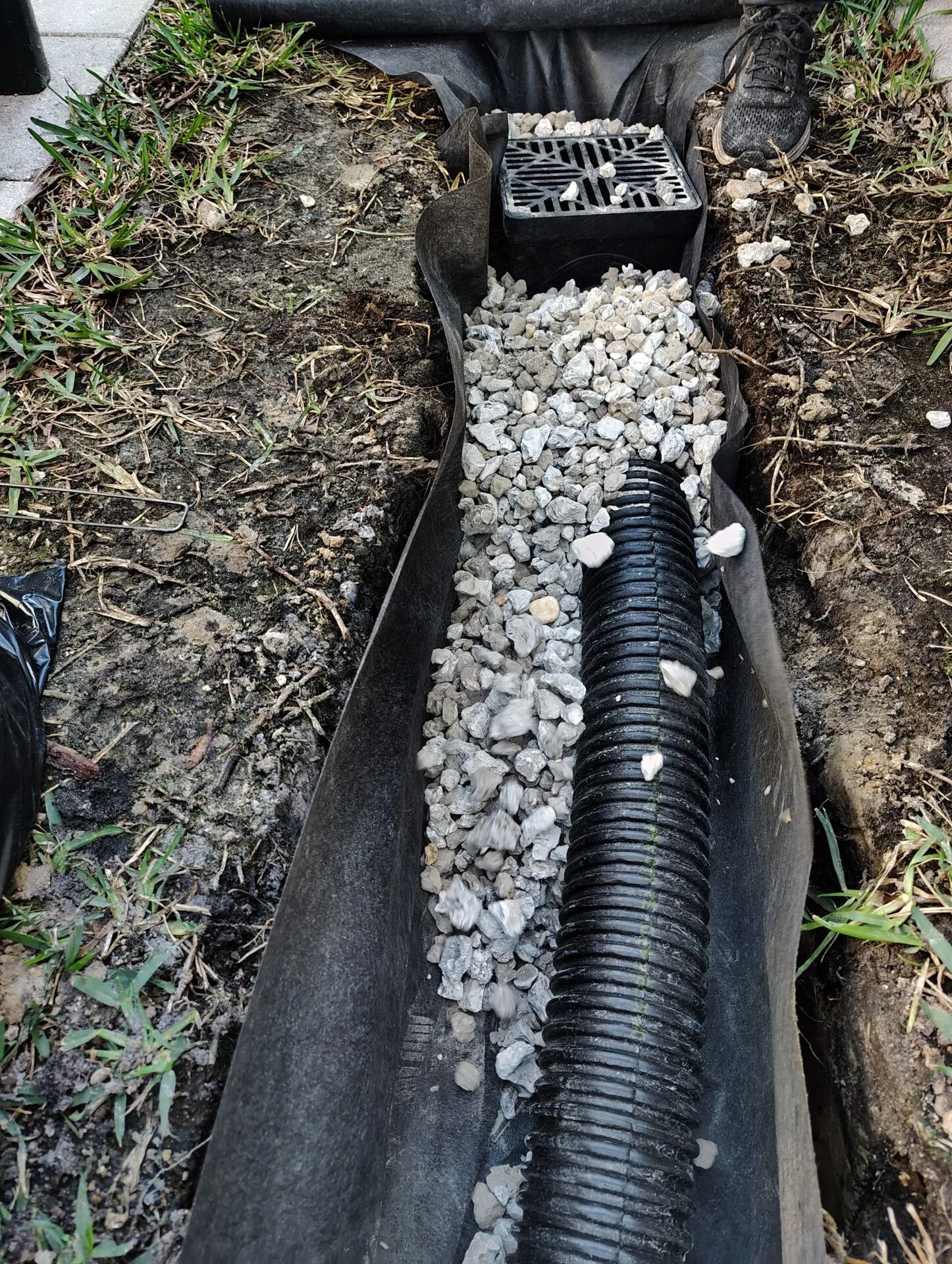
A French drain is a subsurface drainage system. The installation involves digging a trench — typically 12 to 24 inches deep and 8 to 12 inches wide — filling it with washed stone aggregate, and running a perforated pipe through the middle. The pipe is wrapped in filter fabric (a "sock") to keep sand out.
Water enters from the sides and top of the trench as it saturates the ground around the pipe. The pipe captures it and carries it to a discharge point — typically daylight at the edge of a property, a street-side swale, a retention pond, or a pop-up emitter in a low-lying area that can handle overflow.
The key is that a French drain is passive and underground. There's no grate visible from the surface — just gravel, or sometimes grass grown back over the top. It's designed to intercept water that's moving through the soil or sheeting slowly across turf, not fast-moving surface water on hard surfaces.
The Channel Drain (Trench Drain)
A channel drain — also called a trench drain or slot drain — sits at grade level. It's a narrow trough, usually made of plastic or polymer concrete, set flush into a hard surface like a driveway, pool deck, or concrete patio. A grate covers the opening. Water flows across the surface, drops into the channel, and is routed through a pipe to a discharge point.
Channel drains are fast-flow systems. They're designed to capture large volumes of surface water quickly — the kind of runoff that happens when rain hits a 2,000-square-foot concrete driveway and has nowhere to go except toward your garage door.
Side by Side: The Key Differences
| Feature | French Drain | Channel Drain |
|---|---|---|
| Location | Underground / subsurface | Surface level, flush with grade |
| Best for | Lawn and landscaping areas, soil saturation | Driveways, patios, pool decks, concrete areas |
| Water type | Groundwater, slow sheet flow through soil | Fast surface runoff on hard surfaces |
| Visibility | Mostly invisible (gravel top or grass) | Visible grate at surface |
| Installation complexity | Higher (deep trench, precise slope needed) | Moderate (set in concrete or compacted base) |
| Maintenance | Low (flush every few years) | Low-moderate (clean grate, flush channel) |
| Typical cost (FL) | $25–$50 per linear foot | $30–$60 per linear foot installed |
| Failure mode | Sand clogging, no outlet | Grate clogging, improper slope |
Which One Does Your Property Need?
The fastest diagnostic is to watch where water sits during a storm and where it goes after. Those two moments tell very different stories.
Water pools in your lawn or landscaped beds, even in areas without hard surfaces nearby
If your turf holds water for hours or days after rain — if the ground is spongy and soft long after the storm passes — the problem is that water is saturating the soil and has nowhere to percolate or drain. This is a subsurface problem. A French drain intercepts that groundwater, collects it, and routes it to an outlet. No surface grate will help here.
Water runs fast across your driveway, patio, or pool deck and collects at a low point or near the house
If you watch water flow in sheets during a storm — visibly running across a hard surface toward your garage, foundation, or a low corner — that's a surface runoff problem. A French drain won't capture fast-moving surface water effectively. You need a channel drain set at the low point to intercept the flow before it reaches the structure.
Water comes from multiple directions and collects in several spots
Many SW Florida properties have both problems simultaneously: the lawn saturates (French drain territory) and the driveway sheet-flows toward the garage (channel drain territory). In these cases, the right solution is a combination system — often with both drains discharging to the same outlet or to a shared swale. This is common in older neighborhoods in North Port and Port Charlotte where original grading wasn't designed with today's storm intensity in mind.
Why SW Florida Is Harder Than Most Places
Installing drainage in Southwest Florida presents challenges that don't exist in most of the country:
The water table is close to the surface
In many parts of North Port, Port Charlotte, and Venice, the water table during wet season sits only 18–36 inches below grade. This means a French drain can become saturated itself during sustained heavy rain — it can't drain faster than the water table rises. Properly designed systems account for this by using larger aggregate, wider trenches, and multiple discharge points to keep the system flowing under pressure.
Sandy soils migrate into pipes
Florida's sandy soil is great for drainage until it isn't. Loose sand particles migrate through gravel and into perforated pipe over time, gradually reducing flow capacity. This is why filter fabric (drain sock) around the pipe is non-negotiable here — not optional. Systems installed without proper sock wrapping typically fail within 5–8 years.
Summer storm intensity vs. irrigation-season water table
The dry season (December–April) in SW Florida can drop the water table significantly, making drainage issues disappear. The same yard that drained fine through winter may flood every afternoon in July. Any drainage solution needs to be sized for peak wet-season conditions, not average annual rainfall.
Discharge options are limited
Unlike northern climates where discharge to a street is standard, many SW Florida municipalities have stormwater regulations about where residential drainage can be directed. In some areas, you can daylight to the street swale. In others, you must retain water on-site or discharge to a designated retention area. Always verify local discharge requirements before designing a system.
What It Costs in SW Florida
French Drain Cost Breakdown
| Component | Details | Cost Range |
|---|---|---|
| Trench excavation | Per linear foot, 18–24" deep | $8–$15/ft |
| Washed stone aggregate | #57 or pea gravel, delivered | $3–$6/ft |
| Sock-wrapped perforated pipe | 4" or 6" HDPE with filter fabric | $2–$4/ft |
| Discharge / outlet | Pop-up emitter or daylight outlet | $80–$250 per outlet |
| Cleanout installation | Access port every 50–75 ft | $60–$120 each |
| Backfill and surface restoration | Sod repair or gravel cap | $2–$5/ft |
| Total installed (50 ft) | Basic system with one outlet | $1,500–$2,800 |
Channel Drain Cost Breakdown
| Component | Details | Cost Range |
|---|---|---|
| Channel body | NDS or polymer concrete, per foot | $15–$35/ft |
| Concrete setting | Collar pour to hold channel flush | $8–$15/ft |
| Outlet pipe and fittings | 4" or 6" solid pipe to discharge | $3–$6/ft |
| Discharge outlet | Pop-up or curb outlet | $80–$250 |
| Cutting existing concrete | If installed in existing slab | $10–$18/ft |
| Total installed (20 ft) | Single channel across driveway | $1,200–$2,400 |
These ranges reflect typical residential installations in North Port, Port Charlotte, and Venice as of 2026. Complex projects — multiple runs, long discharge lines, high water table excavation, or retaining pond connections — will cost more. Always get a written scope and a proper on-site assessment before committing to a number.
The Mistakes That Make Drainage Systems Fail
We've been called to troubleshoot drainage installs that failed within a year or two. The causes are almost always the same:
1. No real outlet
This is the single most common failure. A French drain that terminates in a buried dry well, a gravel pit, or simply "in the yard somewhere" has nowhere for water to go during a heavy storm. Once the dry well fills and the surrounding soil saturates, water backs up through the pipe and the problem is exactly as bad as before. Every drainage system needs a real daylight discharge — a pop-up emitter in a low area, a swale, a retention pond, or the street. If someone quotes you a French drain without discussing the outlet, ask where the water is going.
2. Insufficient slope on the pipe
A perforated drain pipe needs to slope consistently toward the outlet — typically 1% minimum (about 1 inch per 8 feet). In flat areas of SW Florida where the elevation change from one end of a property to the other may only be 6 inches, hitting this minimum requires careful surveying. Pipe installed without proper slope won't drain; it just holds water.
3. Wrong aggregate
Fine gravel or crushed limestone screenings might seem like they'd work fine. They don't — fine material compacts, holds sediment, and dramatically slows water flow. Use washed #57 stone (or larger). The angular shape and consistent sizing create void space for water to move through quickly. Don't substitute pea gravel or screenings to save money.
4. Skipping the filter fabric
In sandy Florida soils especially, filter fabric is not optional. Without it, sand particles migrate into the gravel and pipe within a few wet seasons, reducing capacity by 50–80%. The fabric adds minimal cost and extends system life dramatically. Any contractor skipping this step is cutting corners.
5. Installing a channel drain where the problem is subsurface
A channel drain sitting in a lawn that's saturated with groundwater will collect some surface water, but it won't solve the actual problem. Homeowners sometimes see a channel drain as a simpler, faster fix — but if the soil around it is already full of water, there's nowhere for it to drain to, and the system backs up. Diagnose first, then install.
If water sits in your lawn for hours after rain — French drain. If water runs across a hard surface toward your home — channel drain. If both are happening — you need both, and the system needs a real outlet to function.
The investment in proper drainage pays back quickly: healthier turf, no foundation moisture intrusion, and yard space you can actually use in summer. Done right, a drainage system lasts 20–30 years with minimal maintenance.
When to Call a Pro vs. DIY
French drain installation is technically DIY-able for a motivated homeowner with a trenching tool and a weekend. But in SW Florida, several factors make professional installation worth considering:
- Locating underground utilities — call 811 before any digging. Utilities are shallower here than you think.
- Hitting the right slope — in flat terrain, getting consistent 1% slope across a 75-foot run requires a transit level or laser, not eyeballing.
- Discharge compliance — a professional knows the local stormwater rules and won't connect you to something that generates a code violation.
- Diagnosing the real problem — if you're not certain whether it's a drainage problem, a grading problem, or both, an on-site assessment is worth the time before you spend $2,000 on the wrong fix.
If you're in North Port, Venice, Port Charlotte, or Englewood and dealing with drainage problems that have persisted for more than one wet season, our grading and drainage service covers full system design and installation — including site assessment, slope verification, and proper outlet installation.
Frequently Asked Questions
Can I install a French drain myself in Florida?
Yes, but it requires more precision than most people expect. The key challenges are hitting proper pipe slope in flat terrain, using the right materials (washed aggregate, not screenings; sock-wrapped pipe), and connecting to a legal discharge point. If you get these right, a DIY French drain can last decades. If you don't, it'll fail within a few wet seasons.
Do French drains work in clay soil?
Fortunately, clay soil is rare in SW Florida — most of our soils are sandy. French drains work well in sandy conditions because water moves through sand relatively freely. If you're in an area with higher clay content (some parts of inland Charlotte County), a deeper trench with more aggressive aggregate sizing is needed to overcome the lower permeability.
How long does a French drain last in Florida?
A properly installed French drain with sock-wrapped pipe and washed aggregate can last 25–40 years. The biggest enemy is fine sediment migration, which is controlled by filter fabric. Flushing the system every 5–7 years with a garden hose or pressure washer through the cleanout ports extends life significantly.
Can I add a channel drain to an existing concrete driveway?
Yes — it requires saw-cutting the existing concrete, excavating the channel bed, setting and leveling the drain, and pouring concrete collars to hold it flush. It's disruptive but very doable. Plan for the adjacent concrete to look patched unless you seal-coat the entire driveway after, which many homeowners choose to do.