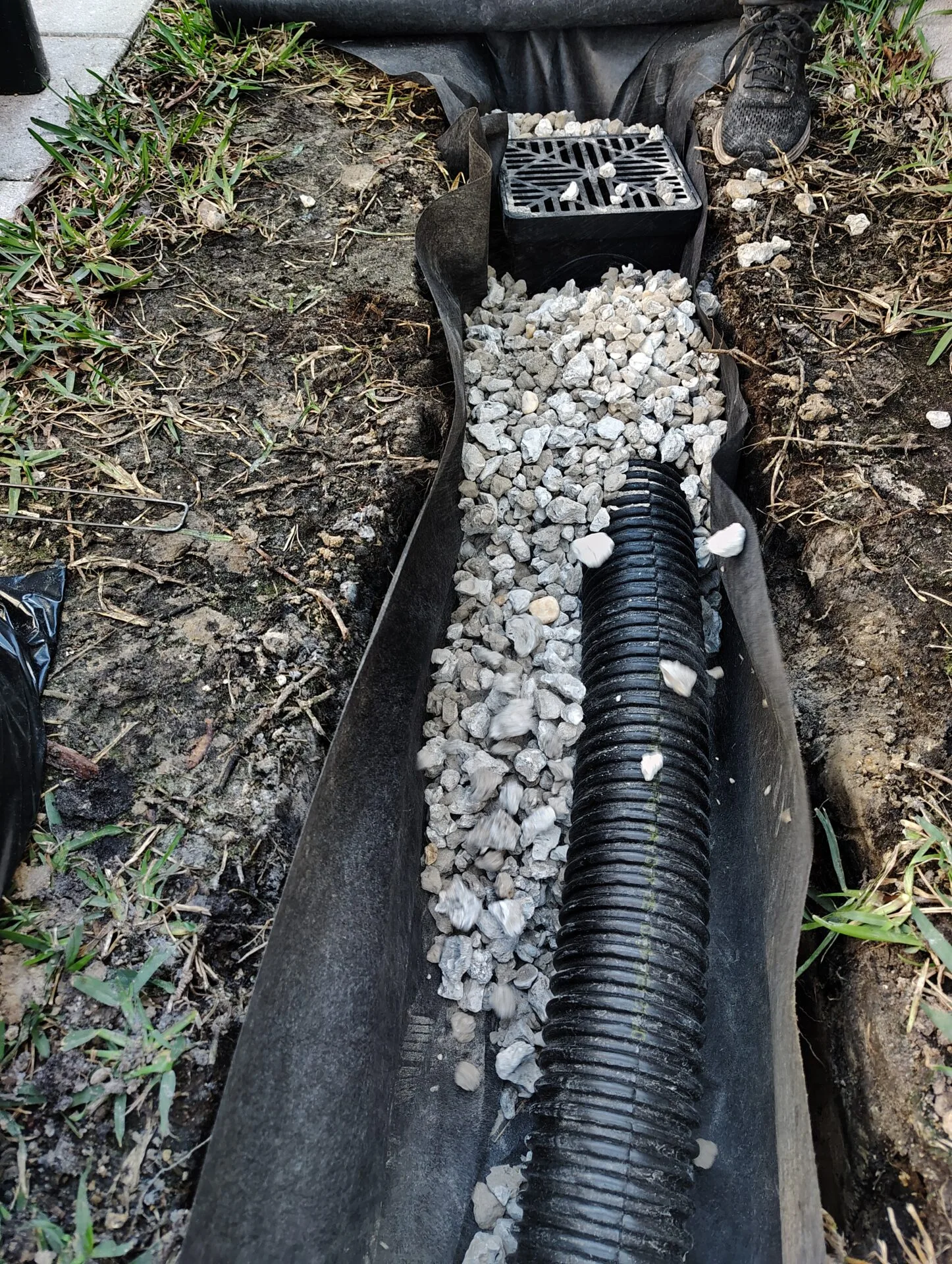
What is a French drain? The short answer
A French drain is a trench dug into your yard, lined with filter fabric, filled with washed stone, and usually fitted with a perforated pipe that carries water downhill to a spot where it can leave. Water always takes the easiest path. Loose stone is a far easier path than packed sand, so water in the soggy ground around the trench moves into it, drops to the pipe, and rides the pipe out.
That's the whole machine. No pump, no power, no moving parts. Gravity does the work, which means the end of the pipe has to sit lower than the spot you're trying to dry out.
If you want the full layer-by-layer build, where the name comes from, and what our hardpan does to trench depth, we covered all of that in What Is French Drainage? This piece picks up where that one stops. Is there already a French drain in your yard? Is the thing on your quote actually a French drain? And what does putting one in do to your yard for a couple of days?
Those questions matter more in Southwest Florida than most places. Around North Port, Venice, Port Charlotte and Englewood, lots are flat, the sand is fine, and the water table climbs close to the surface every rainy season. A drain that would last decades on a hillside up north can quit in three summers here if it's built the lazy way. And once the sod goes back down, the lazy version looks almost exactly like the real one.
So the first thing worth knowing is how to tell what's already in the ground.
How to tell if your yard already has a French drain
Plenty of homeowners call Dennis about standing water and find out during the walk-through that there's already a drain in the yard. A previous owner put it in, the builder put it in, or it's been under the sod so long nobody remembers. Before you pay for a new one, walk the yard and look for these:
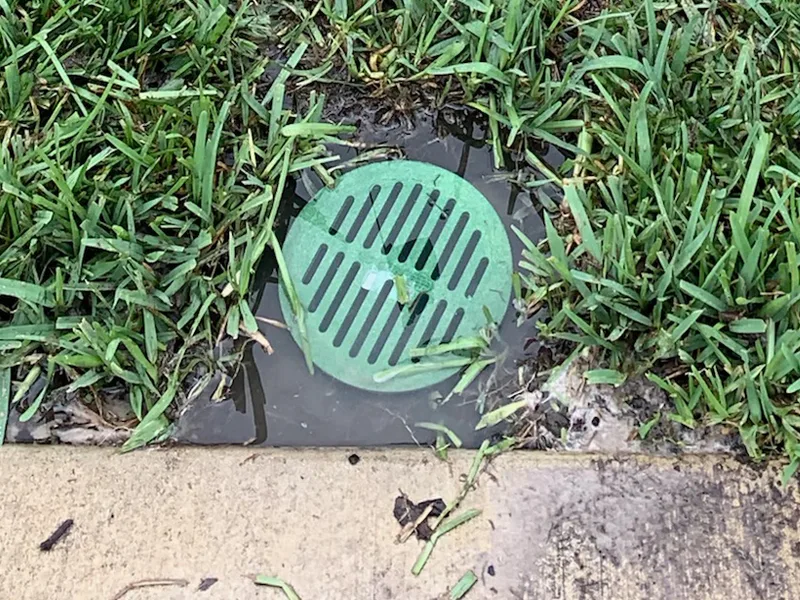
- A pop-up emitter. A round green or black cap, a few inches across, sitting flush with the lawn. You'll usually find it near the street swale, at the back of the lot, or in a low corner. It lifts open when the pipe behind it fills. If you find one, there's a pipe feeding it.
- A cleanout cap. A capped pipe end sticking an inch or two out of the ground at the high end of a run. It's there so someone can flush the line.
- A round grate in the lawn. That's a yard inlet or catch basin. It's often tied into a French drain or a solid pipe headed the same direction.
- A straight stripe in the grass. A line of sod that browns before the rest of the lawn in a dry spell can mark a trench of stone underneath. Stone holds less water than sand, so the grass over it dries out first in April and May.
- A pipe end at the swale or canal bank. On canal lots in Port Charlotte and Englewood, walk the bank. A round 4-inch pipe coming out of the ground there is usually a drain outlet.
Tip from Dennis: Found an emitter or a cleanout? Run a garden hose into the cleanout for ten minutes. If the emitter pops and water comes out, the line is open. If water backs up out of the cleanout, or the emitter never moves, the pipe is crushed, packed with sand, or the emitter is buried under grass. Film it either way and show me at the estimate. A drain that's already in the ground and just clogged is sometimes a repair job, not a new install.
Not finding anything doesn't settle it, though. Some of what gets installed and called a French drain around here wouldn't pass for one if you dug it up.
Five things sold as a French drain that aren't
The words "French drain" get stretched. All five of these show up on quotes and in yards across Sarasota and Charlotte counties. A few are honest fixes for a different problem. A couple are a pile of rock with an invoice.
| What's in the ground | What it really is | Does it dry out soggy ground? |
|---|---|---|
| River rock laid on top of the dirt along a wet strip | A decorative rock bed or dry creek look | No. Graded to fall, a rock-lined swale can carry surface water. Laid flat, it just hides the puddle under rock. |
| A trench of stone with no fabric | A French drain with a short life | At first. Fine sand washes into the stone with every storm until the gaps fill and it stops working. |
| Solid pipe from a downspout to a pop-up emitter | A downspout drain line | No, and it isn't meant to. It moves roof water away from the house. Good fix, different job. |
| A grated channel set in concrete or pavers | A channel drain, also called a trench drain | No. It catches water running across a hard surface like a driveway or pool deck. |
| Perforated pipe buried in a hole with no outlet | A pipe to nowhere | No. With no lower spot to empty into, it fills during the first storm and stays full. |
The channel drain question comes up often enough that we wrote a full comparison: French drain vs. channel drain in SW Florida.
The downspout line deserves a second look, because it's the honest fix that gets mislabeled most. A lot of soggy side yards in North Port aren't a groundwater problem at all. They're a roof problem. An inch of rain on 1,000 square feet of roof is roughly 620 gallons, and a summer afternoon storm here can drop that inch fast. When all of it lands in one narrow side yard, putting the downspouts underground in solid pipe and carrying the water to a lower spot can fix it without a French drain at all.
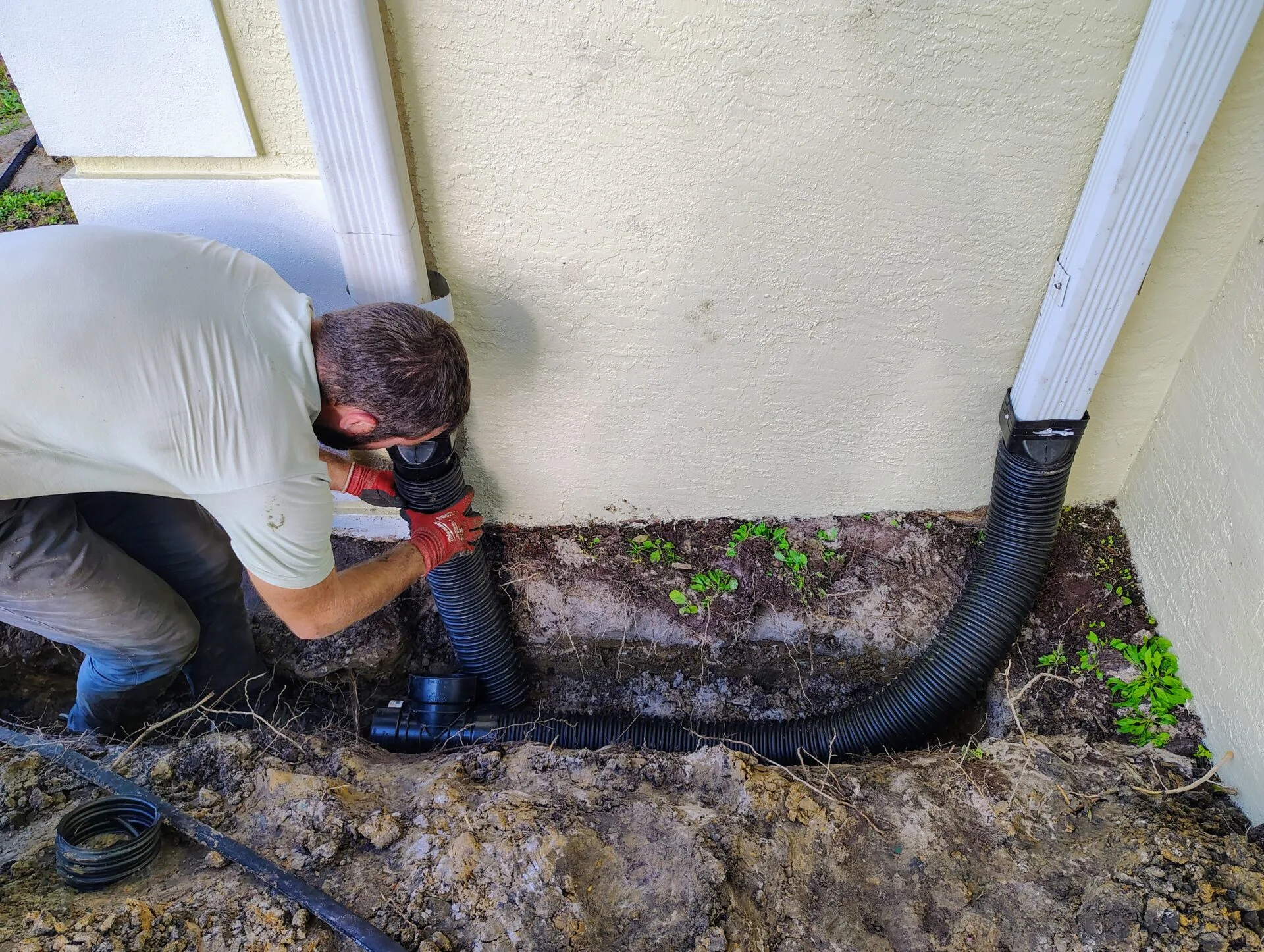
One customer whose downspouts we put underground wrote this afterward:
"was able to ground down spouts into the ground properly! did everything with exact specifications and precision. I only will use dennis from now on for all my landscaping needs."
Certified Reviews, Google review
Watch for this: If your quote says "French drain" and nothing else, ask three questions before you sign. Is there filter fabric around the stone? What kind of stone? Where does the water come out? If the answer to the last one is "it just soaks in," be careful. In our sand, a drain that only soaks in can work fine in March and fail in August, when the water table is already near the surface.
Say the quote checks out and it is a real French drain. There's still one choice that changes how well it works, and most homeowners never get asked about it.
Rock on top or sod on top? The choice nobody asks you about
Every French drain gets finished one of two ways at the surface. Which one you get should depend on where your water comes from.
Stone to the surface
The stone runs all the way up, or a strip of river rock sits over the fabric at grade. Water running across the yard drops straight into it. This is the right finish when your problem is surface water: runoff sheeting off a neighbor's lot, a strip along the fence that turns into a creek in a storm, the low side of a pool deck. The trade-off is a visible line of rock, and it needs a rake now and then so clippings and sand don't seal the top. If you'd rather it look planned than patched, it can be shaped into a bed with landscape rock around it.
Sod on top
The fabric folds over the stone, sand from the trench goes back on top, and sod goes over that. You can mow straight across it and barely tell where it runs. This works when the ground itself stays soggy, the squishy-for-three-days-after-rain kind of wet. It's slower on surface water, because the water has to soak down through grass and sand before it reaches the stone.
Both at once
A lot of SW Florida yards have both problems, so the fix is a sod-finished drain with surface inlets. Round grates sit at the lowest spots and tie into the same pipe. Water pooling on top drops through the grate. Water in the soil finds the stone. The lawn stays mowable.
There's a North Port wrinkle here too. Under a lot of yards in town there's a hardpan layer a foot or two down that water barely passes through. On those lots the stone trench has a second job: it gives water sitting on top of that layer a sideways way out. It's one reason Dennis wants to see your yard in person before he quotes a trench depth. A standard number from a phone call can put the pipe in the wrong place.
Picking the finish is one thing. What your yard looks like while the drain goes in is what most people actually worry about.
What a French drain install looks like in your yard
Most backyard French drains are a one- or two-day job once they're on the schedule. Long runs, tight side yards, or a lot of downspouts to tie in can stretch that. Here's the order things happen in, so nothing on the day surprises you.
- Approvals. If you live in an HOA, and in Heron Creek, the West Villages and much of Venice most people do, the architectural committee usually wants to see drainage work before it starts. Most North Port homes drain to a roadside swale, and any pipe headed into that swale or the city right-of-way is worth clearing with the city first. On a Port Charlotte canal lot, check with the county before you send water toward the canal.
- Locates. Florida law requires a Sunshine 811 locate request at least two full business days before digging. 811 only marks public lines. Sprinkler pipe, landscape lighting wire and the water line from the meter to your house are private, and nobody flags them. We do irrigation work too, so if a sprinkler line crosses the route, we can reroute it as part of the same job.
- Marking and sod. The route gets painted and checked for fall from end to end, then the sod along it gets cut. Expect a strip of yard about a foot wide to be open.
- Trench, fabric, stone, pipe. The trench gets dug to depth, lined with non-woven fabric, and bedded with washed stone. The perforated pipe goes in with steady fall the whole way, at least an inch of drop every 8 feet. More stone goes around and over the pipe, and the fabric wraps the top.
- Outlet and cleanout. The low end gets its emitter, inlet, or open outlet. The high end gets a cleanout so the line can be flushed later.
- Close-up. Stone-finished drains get their top layer of rock. Sod-finished drains get backfilled with the trench sand and fresh sod laid over the strip. Extra spoil gets hauled off or spread, and the yard gets cleaned up.
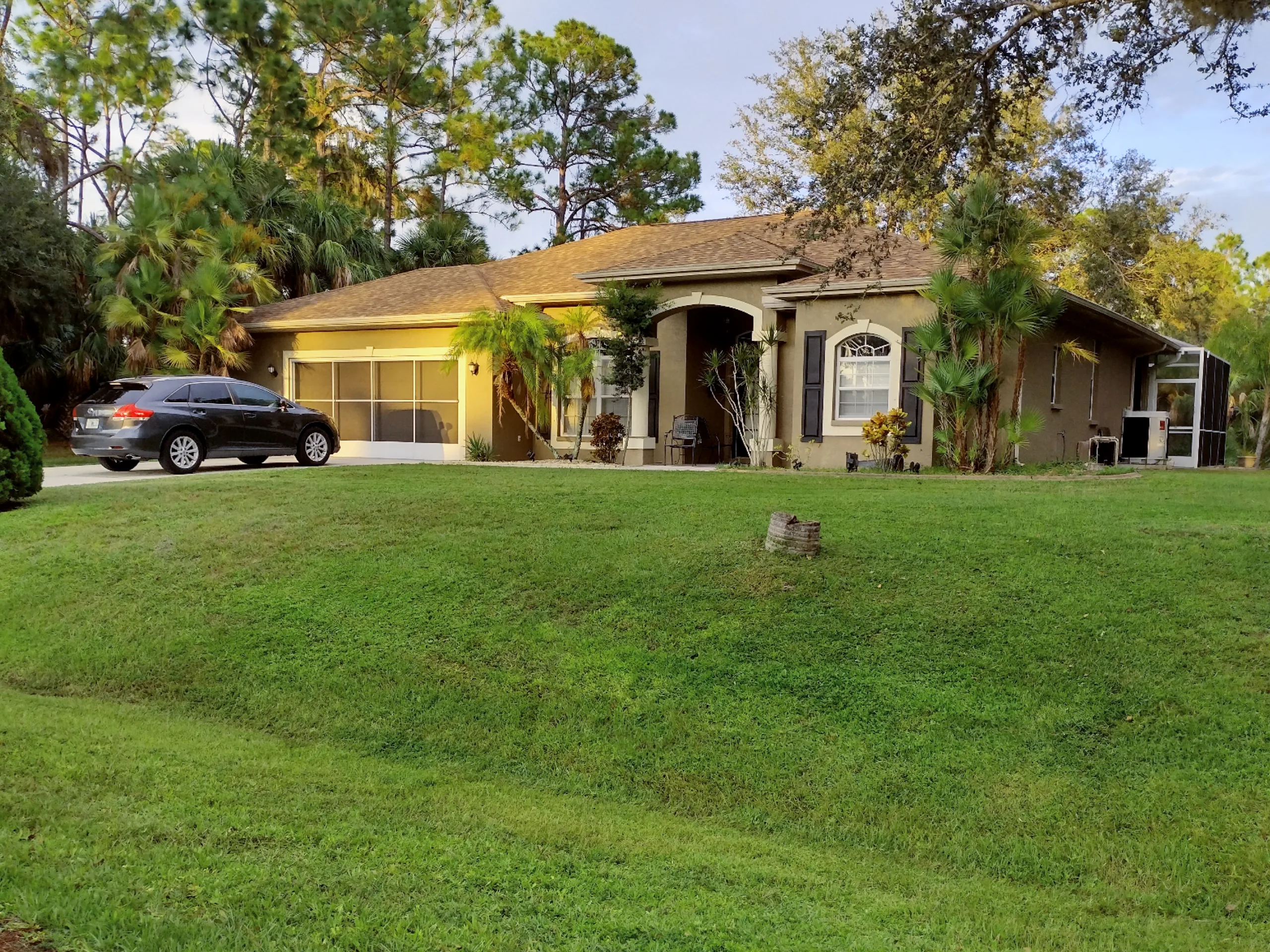
Then it rains, and that's the real test. A drain built right shows it in the first hard storm. The emitter lifts, and the low spot clears in hours instead of days. If yours doesn't, something is off with the fall or the outlet, and you want to find that out in the first season, not the third.
Every one of those steps costs time and material. That's exactly why the cheapest quote usually skips a few.
What belongs on a French drain quote
French drains get priced a few ways around here: by the linear foot, by the job, or folded into a bigger landscape project. The total matters less than what's listed under it. Two quotes for "80 feet of French drain" can describe two completely different drains.
| Corner-cut quote | Quote for a drain built for SW Florida |
|---|---|
| "French drain, 80 ft" and a total | Length, trench depth and width written out |
| "Gravel" | Washed stone named by size, like #57, with no fines mixed in |
| No mention of fabric | Non-woven filter fabric wrapping the stone |
| Outlet never mentioned | Outlet type and location named: emitter, inlet, swale, or open outlet |
| Nothing about slope | Fall checked along the whole run, at least 1/8 inch per foot |
| No cleanout | A cleanout at the high end for flushing |
| Sod "touched up" | Sod replaced over the trench and the yard cleaned up |
If a quote is missing three or more of those, ask about them. A good contractor answers each one in a sentence. The one to worry about is the contractor who gets vague about the outlet, because the outlet decides whether everything else works.
Sometimes the honest line on the quote is that you don't need a French drain. A yard that holds water because it was graded flat, or graded toward the house, usually needs regrading first. A drain can't fix a yard that slopes the wrong way. If you're not sure which one you're dealing with, our piece on reading standing water walks through how to tell. Dennis will also tell you straight at the estimate, even when the answer is the smaller job. You can see the full range of fixes on our grading and drainage page.
Still have a question about your own yard? These are the ones we hear most.
Frequently asked questions
Is a French drain the same as a swale?
No. A swale is a shallow, grassy ditch shaped into the ground to carry surface water. Most North Port streets have one running along the front of every lot. A French drain is buried and handles water in the soil. The two often work together, with the French drain emptying into the swale.
Can a French drain stop water coming from my neighbor's yard?
Often, yes. A drain along the property line catches water before it crosses your yard and carries it to the street or another outlet. It has to stay on your side of the line, and in an HOA you'll usually need approval. If the neighbor's lot sits higher than yours, which happens when a new home goes in next to an older one, a drain plus some regrading on your side is usually the fix.
Does a French drain need a pump?
No. It runs on gravity alone. If there's no spot on or near your lot lower than the wet area, a French drain by itself can't work, and you're looking at a different kind of system.
Will I see the trench line in my lawn afterward?
With a sod finish, you'll see the seams of the new strip for a few weeks until it knits into the lawn around it. It takes longer in the cooler months. After that it's hard to find. With a stone finish, you'll see a strip of rock, and that's on purpose.
How do I know if my French drain is clogged?
Water sitting over the trench line after rain, an emitter that never pops, or water backing out of the cleanout when you run a hose into it. In our fine sand, clogs usually come from missing fabric, an emitter buried under grass, or roots.
Can I just put rock over the wet spot myself?
You can, and it will look tidier. It won't drain anything. Rock on top of sand with no trench, no fabric and no outlet gives the puddle a place to hide. Next storm, the water sits in the rock instead of on the grass.
Do you install French drains in North Port, Venice, Port Charlotte and Englewood?
Yes. French drains, downspout lines, catch basins and regrading are all part of our drainage work in North Port, Venice, Port Charlotte and Englewood. Call Dennis at (941) 946-8403 for a free estimate. He'll walk the yard with you and tell you whether it needs a French drain, a regrade, or something simpler.