.webp)
Why agave in Florida landscaping earns its spot
Agave in Florida landscaping does one job better than almost anything else we plant: it looks the same in a bone-dry April as it does after a week of August storms, and it asks almost nothing from you in between. That's why it goes into so many of the beds we build across North Port, Venice, Port Charlotte, and Englewood. If you've been reading up on low maintenance Florida landscape plants, agave is probably already on your list.
Here's what it actually does for a SW Florida yard:
- It gets through the dry season on rain alone once it's rooted. From November through April we can go weeks without a real rain. Established agave doesn't care.
- It holds its shape. No shearing every six weeks, no deadheading, no hedge that creeps over the walkway and earns you an HOA letter.
- It loves full sun and reflected heat. West-facing stucco walls, driveway edges, and rock beds that cook most shrubs are where agave looks its best.
- Most types handle salt air. That matters on Port Charlotte canal lots and anywhere the wind comes off Lemon Bay or the Gulf.
- It reads as finished. One agave in a clean rock bed looks intentional. A struggling hibiscus never does.
When a homeowner tells Dennis they're done spending Saturdays on the yard, agave is one of the first plants he sketches into the plan. But it has one weakness in our part of Florida, and it's the opposite of what most people expect. Agave almost never dies from drought here. It dies from water. Before we get to that, you need to know which agave you're actually buying, because they are not interchangeable.
Which agave grows best in SW Florida, and which to skip
Walk into any garden center in Sarasota or Charlotte County and you'll find four or five kinds of agave on the bench. In a 3-gallon pot they look like cousins. Five years later they're completely different plants, and one of them shouldn't be in your yard at all.
| Agave | Mature size (approx.) | Spines | Cold | Salt air | Our take |
|---|---|---|---|---|---|
| Smooth agave Agave desmettiana, incl. variegated | 3–4 ft tall and wide | Smooth leaf edges, sharp tip | Frost marks it; a hard freeze can hurt it | Good | Our go-to. Right size for most front beds. |
| Century plant Agave americana | 4–6 ft tall, 6–10 ft wide | Hooked teeth on every edge, long tip spine | Toughest of the group | Very good | Big open spaces only, far from paths. |
| Foxtail agave Agave attenuata | 3–4 ft wide, short trunk with age | None | Most tender; one frost night can turn it to mush | Fair | Good near pool decks. Cover it when frost is forecast. |
| False sisal Agave decipiens | 3–5 ft rosette, short trunk over time | Toothed edges, sharp tip | Handles our winters | Very good | Florida native. A natural fit for coastal yards. |
| Sisal Agave sisalana | 4–6 ft | Mostly smooth edges, sharp tip | Fair | Good | We don't plant it. It's on Florida's invasive plant list. |
Most of the agave we install is smooth agave. It stays a manageable size, it doesn't have hooks along the leaf edges to snag your arm, and it fills a bed on its own because it throws pups. The variegated form, with cream stripes down each leaf, brightens up a dark rock bed better than almost any shrub.
Century plant is a stunning plant on a big lot and a bad one next to a front walk. That cute 3-gallon turns into an 8-foot-wide plant with teeth on every leaf, and it's not something you move easily once it's established. If you love the blue-gray look but don't have the room, ask about smaller blue types and plan the spot around their full size.
Picking the right species is half the job. The other half is where it sits when the rainy season shows up, and that's where most agave in North Port and Port Charlotte gets lost.
Why agave rots in Florida yards: wet feet
Agave comes from places where rain drains away in minutes. Our yards get roughly 52 to 58 inches of rain a year depending on the city, and most of it lands between June and September. When an agave's roots and crown sit in wet ground for days at a time, it rots from the base. You usually don't see it coming. The plant looks fine, then one morning the center leaves pull out with a gentle tug and the base is soft and brown.
The spots that kill agave are the ones that look harmless in November:
- Low spots in a flat bed. If water sits there for a day after a storm now, it'll sit there for a week in August.
- Under a gutter outlet or downspout. A whole roof's worth of water dumped on one crown is a slow death.
- Inside the throw of a lawn spray head. A grass zone running through the rainy season keeps the crown wet almost constantly.
- Buried in mulch. Mulch piled against the base holds moisture right where agave can least handle it.
Watch for this: If the center of an agave pulls loose or the base turns mushy, you can't save that plant where it is. Pull it out and check whether the spot holds water after the next rain. Fix the drainage before anything else goes back in that hole, or you'll be buying the same plant twice.
North Port: hardpan under the sand
A lot of North Port lots have a spodosol hardpan layer 18 to 24 inches down. Rain soaks the sand on top, hits that layer, and stops. That's why North Port yards hold standing water after summer storms, and it's why we don't plant agave flat on grade there. It goes on a raised berm or in a rock bed built up above the ground around it. If a bed floods, the fix starts with the grading and drainage, not the plant. Most of our landscaping in North Port FL starts by figuring out where the water goes after a storm.
Port Charlotte: canal lots and low sides
Canal-front lots are common in Port Charlotte, and the low side of those lots often stays wet long after a storm passes. Agave does great on the high side of the lot and poorly in the swale. If you're planning landscaping in Port Charlotte, walk the yard after a good rain and note where the puddles sit before you pick a single plant.
Venice: shell and alkaline soil
Shell in Venice soil pushes the pH up, and plenty of popular shrubs turn yellow in it. Agave doesn't mind alkaline ground at all, and Venice's sandy, shell-heavy soil drains better than North Port hardpan. That makes agave one of the easier plants to grow there. Close to the Gulf on Venice Island, lean toward the salt-tough types like century plant and false sisal. More on local beds on our Venice plant installation page.
Englewood: salt, wind, and blowing sand
Coastal sand drains fast, and salt rides the wind off Lemon Bay and Manasota Key. That's agave country. False sisal grows wild along Florida's coast and fits right in. The bigger issue in Englewood is sand blowing into rock beds and burying the surface, so plan on refreshing the top layer now and then. See our Englewood plant installation page for coastal bed work.
So what does a bed that keeps agave dry actually look like? Almost every time, it's a rock bed. There's a reason for that beyond looks.
Agave and rock: the low maintenance landscaping idea we build most
If you've been collecting low maintenance landscaping ideas, an agave-and-rock bed is the one we put in more than any other. Rock does three things for agave that mulch can't. It drains right away, so the crown dries out within hours of a storm. It doesn't break down and pile up against the base. And it doesn't need topping off every spring. Our rock vs. mulch guide covers the full tradeoff.
Here's how we build one:
- Set the grade first. The bed should shed water away from the house and sit a little higher than the lawn around it. On hardpan lots that sometimes means building the bed up.
- Edge it. Concrete curbing keeps the rock out of the grass and the mower out of the bed. Our curbing vs. plastic edging breakdown explains why plastic tends to heave and wander.
- Fabric, then rock. Landscape fabric keeps the rock from sinking into the sand and cuts down on weeds pushing through.
- Plant high. We cut the fabric, set the agave so the top of the root ball sits slightly above the surrounding grade, and keep rock around the base instead of packed against the leaves.
- Get it off the lawn sprinklers. Spray heads that hit the bed get capped or redirected, or the bed goes on its own drip zone. That's part of our irrigation work, and our drip vs. spray guide explains why it matters.

Rock color changes the look more than people expect. White rock and shell stay cooler and give the yard a bright coastal feel. Black slate and dark river rock make blue-green agave pop, but they run hot in July. The agave handles that heat fine. Your bare feet won't. Browse our rock installation page to see the options side by side.
Shell is a strong match for agave, too. It drains well and suits the coastal style a lot of our customers want. One customer had us run shells around their whole lanai:
“Epic did a great job landscaping my front yard and put in a new border with shells around my entire lanai area. Fantastic work!”
Janet Murphy, Google review
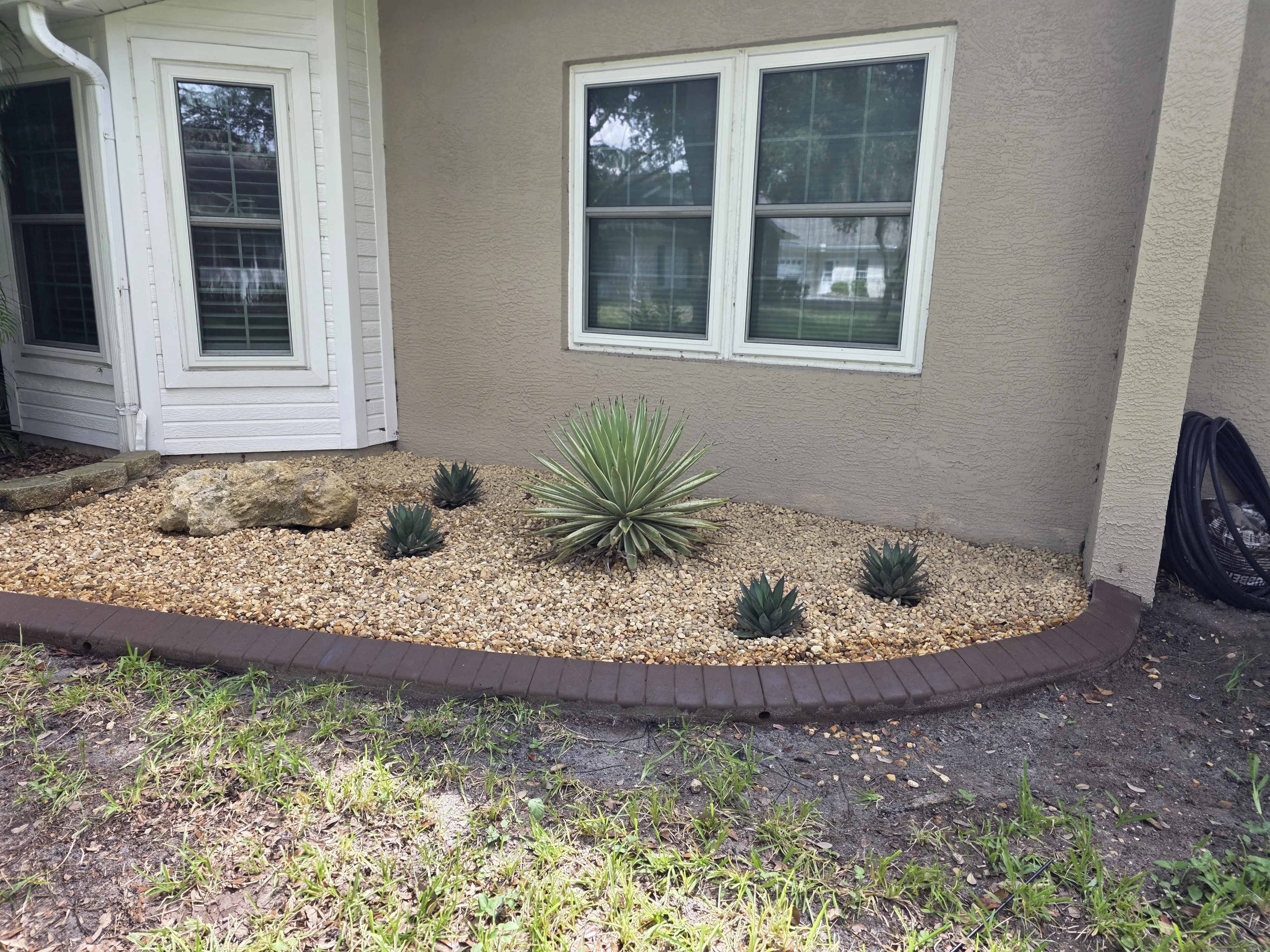
Get the bed right and the agave will look sharp for years. Get the spacing wrong and you'll be fighting it within three.
Where to plant agave: sun, spacing, spines, and blooms
Agave wants at least six hours of direct sun. In shade it stretches toward the light, leans, goes pale and soft, and rots more easily. The hot, open, south- and west-facing parts of your yard are where it belongs.
Space for the plant it's going to be, not the pot it came in. Smooth agave needs about 3 to 4 feet between centers. Century plant needs 6 feet or more, plus clearance from anything you walk past.
Tip from Dennis: Before you pick a spot, stretch a tape measure out 2 feet in every direction from where a smooth agave will go. That 4-foot circle is the plant in a few years. If it crosses your walkway, a window, or a neighbor plant, move the spot now. Moving a pot takes ten seconds. Moving an established agave takes a shovel, gloves, and a bad afternoon.
Spines are the other half of placement. Keep spiny types at least 3 feet back from walkways, pool decks, the side of the driveway where car doors swing open, and anywhere kids play. A century plant's tip spine will go through jeans. The sap can irritate skin, too, so wear gloves and long sleeves any time you trim one. For a pool deck, spineless foxtail agave is the safer choice.
That's why we set every potted plant out on the bed before anything goes in the ground. Dennis works out placement with you while the plants are still in pots, so the spacing and sightlines are right on day one.

The bloom is a goodbye
Agave flowers once, and then the main plant dies. Smooth agave usually blooms after several years. Century plant takes 10 years or more, not the hundred its name suggests. Either way, it sends up a flower stalk that can top 10 feet on a smooth agave and pass 20 feet on a century plant. Smooth agave covers its stalk in hundreds of little plantlets called bulbils that drop and root wherever they land.
Two things to do when it happens. Cut the stalk once the flowers finish, especially during hurricane season, because a tall, top-heavy stalk can snap and come down in a storm. Then keep one or two pups to take the mother's place. The bed fills itself back in for free.
Which brings up the part that surprises people. Once agave is established, the most common care mistake is doing too much.
Agave care after we leave: less is more
New agave needs a little help to root in. After that, rain does nearly all the work. Here's the watering we leave our customers with:
- Planting day: one deep soak.
- Weeks 1–3: a deep watering two or three times a week if it hasn't rained.
- Weeks 4–8: once a week.
- After that: rain is enough. In a long dry stretch, one deep soak every few weeks is plenty.
Right now, the dry season, is the best time of year to plant agave here. It roots in on dry ground and is established before the first summer storm. Just keep an eye on the forecast in January and February. If frost is coming, throw a sheet or frost cloth over foxtail agave for the night and pull it off in the morning.
The rest of the care list is short. Twice a year, cut the dried lower leaves off at the base. Pull pups you don't want while they're small and easy. Skip heavy feeding, because it pushes soft, floppy growth that rots more easily. That's it.
One more thing worth knowing. The agave snout weevil is a real problem in Florida, and a mature agave that suddenly collapses isn't always a water problem. That's a homeowner issue to handle separately, because we don't do pest control of any kind. If you suspect it, call a licensed pest control company or your county's UF/IFAS Extension office. What we can do is replant the bed afterward and fix the drainage if water turns out to be part of it.
If you'd rather have it done right the first time, that's what our plant installation work is for. Dennis maps the bed, matches each agave to its spot, and sets up watering that fits the plants. For the rest of the plant list, our drought-tolerant plants guide and low-maintenance landscaping guide pick up where this one stops. Here are the agave questions we hear most.
Frequently asked questions
Is agave one of the best low maintenance Florida landscape plants?
Yes, as long as it's planted where it drains. Established agave needs no regular watering, no shaping, and no trimming beyond a few dead lower leaves a year. The catch is the rainy season. Put it in a low spot or a spray zone and it rots, which is about as high-maintenance as a plant gets.
Which agave grows best in SW Florida?
Of all the SW Florida plants we install, smooth agave (Agave desmettiana) is the easiest agave to live with. It stays around 3 to 4 feet, has smooth leaf edges, and handles our heat and sandy soil well. For coastal yards in Englewood or on Venice Island, false sisal is a salt-tough Florida native. Skip sisal, which is on the state's invasive list.
Does agave need full sun in Florida?
Yes. Agave is one of the toughest Florida plants for sun we use, and it needs at least six hours of direct light a day. In shade it stretches, leans, and gets soft. A west-facing wall or an open rock bed in full sun is ideal.
What landscape plants for Florida pair well with agave?
Pair agave with plants that want the same dry, sunny conditions: muhly grass, coontie, firebush, sabal or Bismarck palms, and beach sunflower near the coast. Don't mix agave into a bed with thirsty tropicals like ixora or ti plant. One of them will always get the wrong amount of water.
What happens when an agave blooms?
The main plant sends up a tall flower stalk, finishes blooming, and dies. It's normal, not a sign you did something wrong. Cut the stalk once it's done, remove the old plant, and let one of its pups take over the spot.
Is agave safe around kids, dogs, and pool decks?
Spiny types aren't. Keep them at least 3 feet from paths, pool decks, and play areas. The sap can irritate skin and upset a pet's stomach if chewed. For high-traffic spots, foxtail agave has no spines, though it's the most frost-tender of the group.
Do you install agave beds for landscaping in North Port FL and Port Charlotte?
Yes. We install agave and rock beds across North Port, Venice, Port Charlotte, and Englewood. Dennis comes out, checks where water sits on your lot, and gives you a free estimate. Call him directly at (941) 946-8403.
Does this agave advice apply to landscaping in Davenport, FL?
Davenport is up near Orlando, outside our service area, so we don't do landscaping in Davenport, FL. The same rules apply there, though: drainage first, full sun, and the right species. Central Florida winters get colder than the coast, so foxtail and smooth agave take more frost damage there. Century plant is the safer bet.