The short answer: spray for grass, drip for everything else
Sprinkler irrigation is still the right way to water a St. Augustine lawn in Southwest Florida, and drip is the right way to water almost everything else in your yard. Beds, palms, hedges, narrow side strips, and plants in rock all do better on drip. Most yards we look at in North Port, Venice, Port Charlotte, and Englewood need both, on separate zones.
That sounds simple. The trouble is that most systems around here weren't built that way. Somebody ran spray heads everywhere, beds included, because spray heads are cheap and one valve covers a lot of ground. That's how you end up with a soaked stucco wall, orange stains on the pavers, mulch washed onto the sidewalk, and a hedge that still looks thirsty.
This dry season it matters more than usual. Right now, Sarasota County and parts of Charlotte County are under a water shortage order that limits lawn watering to one day a week. Drip zones are treated differently under that order, and the difference can keep your plants alive until the rain comes back. We'll get to the rules in a minute. First you need to know what each system actually does when the valve opens.
How sprinkler irrigation and drip actually put water down
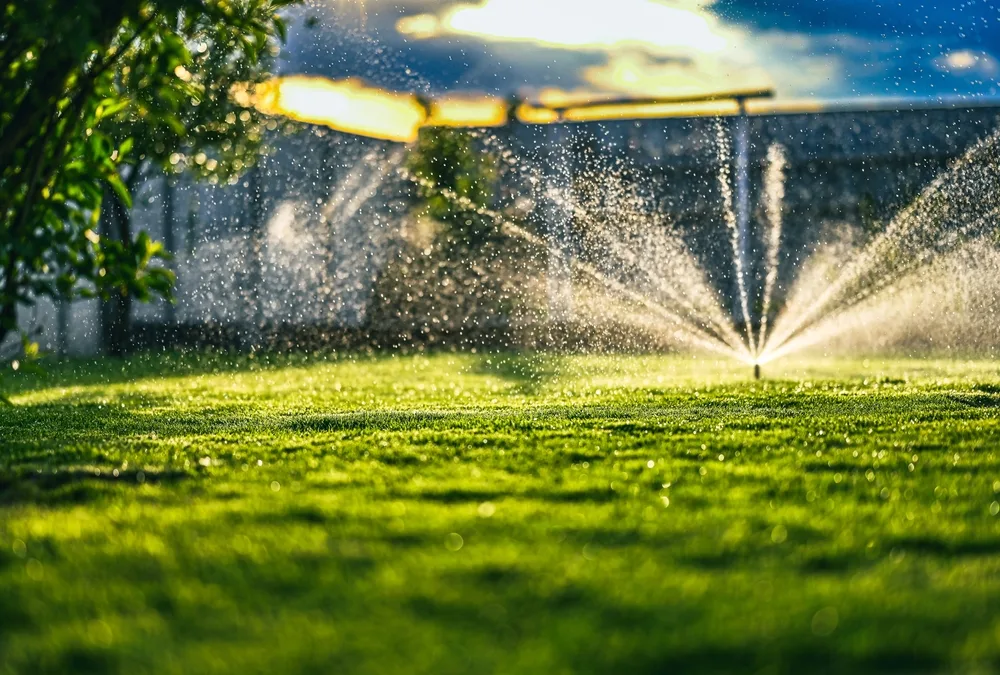
A spray head pops up and throws water through the air in a fan. Fixed spray heads put down around an inch and a half of water per hour, sometimes more. Rotors, the heads that sweep a single stream back and forth, are slower, roughly half an inch to an inch per hour, and they throw farther. Both are built to cover open ground evenly. That's exactly what a lawn needs.
Drip works at the other end of the scale. Emitters release water at the base of a plant, and their output is measured in gallons per hour, not inches. Nothing goes in the air, and very little lands where there are no roots. Federal efficiency guidance puts drip at 20 to 50 percent less water than conventional sprinklers watering the same plants.
Our sandy soil changes how drip behaves. In clay, water from an emitter spreads sideways into a wide circle. In SW Florida sand, it mostly drops straight down. The wet spot under each emitter is narrow, so emitters have to sit closer together and closer to the root ball than a box-store kit's instructions suggest. A drip line laid a foot and a half from a new shrub in sand may never reach its roots.
| Spray and rotor heads | Drip and micro-irrigation | |
|---|---|---|
| Best for | Lawns and open turf | Beds, palms, hedges, rock beds, narrow strips |
| Where water lands | Through the air, across a wide arc | At the root zone, at ground level |
| Application rate | About 0.5 to 1.5+ inches per hour | Gallons per hour, per emitter |
| Loss to wind | High on breezy, coastal lots | Close to none |
| Overspray on walls, pavers, curbing | Common once plants grow or heads shift | None when it's laid right |
| Wet leaves | Every cycle | No |
| Needs a filter and pressure regulator | No | Yes, on every drip zone |
| How it fails | Loudly: a geyser or a dry circle | Quietly: one plant slowly declines |
| Under the current shortage order | One day a week, overnight windows | Any day, before 8 a.m. or after 6 p.m. |
That last row is the one most homeowners haven't heard about. It's also the one that can get you a fine.
Drip and the once-a-week watering rule
The Southwest Florida Water Management District has a Modified Phase III water shortage order in effect. In September it was extended through March 31, 2027. It covers all of Sarasota County, which takes in North Port and Venice, and parts of Charlotte County. Under that order:
- Lawn and landscape watering is limited to one day a week, during overnight windows of 12:01 a.m. to 4 a.m. or 8 p.m. to 11:59 p.m. Properties under an acre can use only one of those windows.
- Low-volume watering of plants and shrubs, meaning drip, micro-irrigation, soaker hoses, and hand watering, is allowed any day, before 8 a.m. or after 6 p.m.
Read that second line again. If your shrubs, palms, and new plantings are on spray heads, they live on the lawn schedule: one night a week, in the dry season, in sand that drains fast. If they're on a real drip zone, they can get water on the days they actually need it, and you're still inside the rules.
The City of North Port has been authorized to write citations with fines, without a warning first, since April. This isn't a technicality you can ignore.
Watch for this: Your watering day depends on your address, and the District can change the order as conditions change. Check the current schedule with the Southwest Florida Water Management District or your city or county utility before you reprogram anything. And a spray zone doesn't become drip because it's pointed at shrubs. If a pop-up head throws water through the air, it's on the lawn schedule.
So should you rip out every spray head and go all drip? No. Your lawn still needs spray, and there's a good reason for it.
Where spray still wins: your St. Augustine lawn
A lawn is a solid mat of roots across every square foot. To stay even, it needs water across every square foot, and that's what spray and rotor heads do when they're laid out head to head, meaning each head throws far enough to reach the next one. Leave gaps and you get the classic Florida pattern: green circles around each head and brown crescents in between.
Drip under turf does exist. It's buried tubing on a tight grid. In our sand, under St. Augustine, it's hard to get even coverage, it's easy to slice with an edger, and when an emitter clogs under the grass, you won't find out until a dead patch shows up. For a home lawn here, it's rarely worth the trouble.
A lawn spray zone that works has a few things in common:
- Head-to-head coverage, so every spot gets water from more than one direction.
- Spray heads and rotors on separate zones. They put down water at very different rates, so mixing them on one valve means part of that zone is always over- or under-watered.
- Heads set level with the grade and aimed at grass, not the driveway or the street.
- Pressure that matches the nozzles. Too high and spray heads mist and drift away. Too low and they fall short.
If you're getting new sod, that's the cheapest time to fix the layout, because the trenching happens before the sod goes down. Our sprinkler system cost breakdown covers what that runs, and our irrigation service page covers how we lay it out.
The lawn is the easy part, though. The wasted water and the dead plants are usually in the beds.
Where drip wins: beds, palms, and SW Florida plants
Most SW Florida plants you'll find in a front bed, things like ixora, clusia, crotons, podocarpus, and Christmas palms, want water at the root ball and dry leaves. Overhead spray gives them the opposite. Here's what we see when beds are on spray heads.
- The house gets watered. A spray head aimed at a foundation bed hits the stucco every cycle. If your irrigation runs off a well, the iron in that water leaves orange stains on walls, pavers, and curbing.
- Plants block the heads. A spray head that worked when the shrub was a 3-gallon pot is buried once the shrub fills in. The plant in front gets soaked and the ones behind it get almost nothing.
- Beds wash out. Spray along the edges kicks mulch and sand onto sidewalks and over concrete curbing.
- Leaves stay wet all night. With lawn watering pushed into overnight windows, overhead water sits on foliage for hours, and constantly wet leaves are an invitation for fungus.
- Narrow strips can't be hit cleanly. The two-foot gap between the AC pad and the fence, or between the driveway and the property line, can't be sprayed without watering concrete.
Drip fixes all of that. Each plant gets its own emitter, or two or three for bigger shrubs and palms, sized to what that plant needs. The water goes into the root ball, under the mulch or rock, and nowhere else.
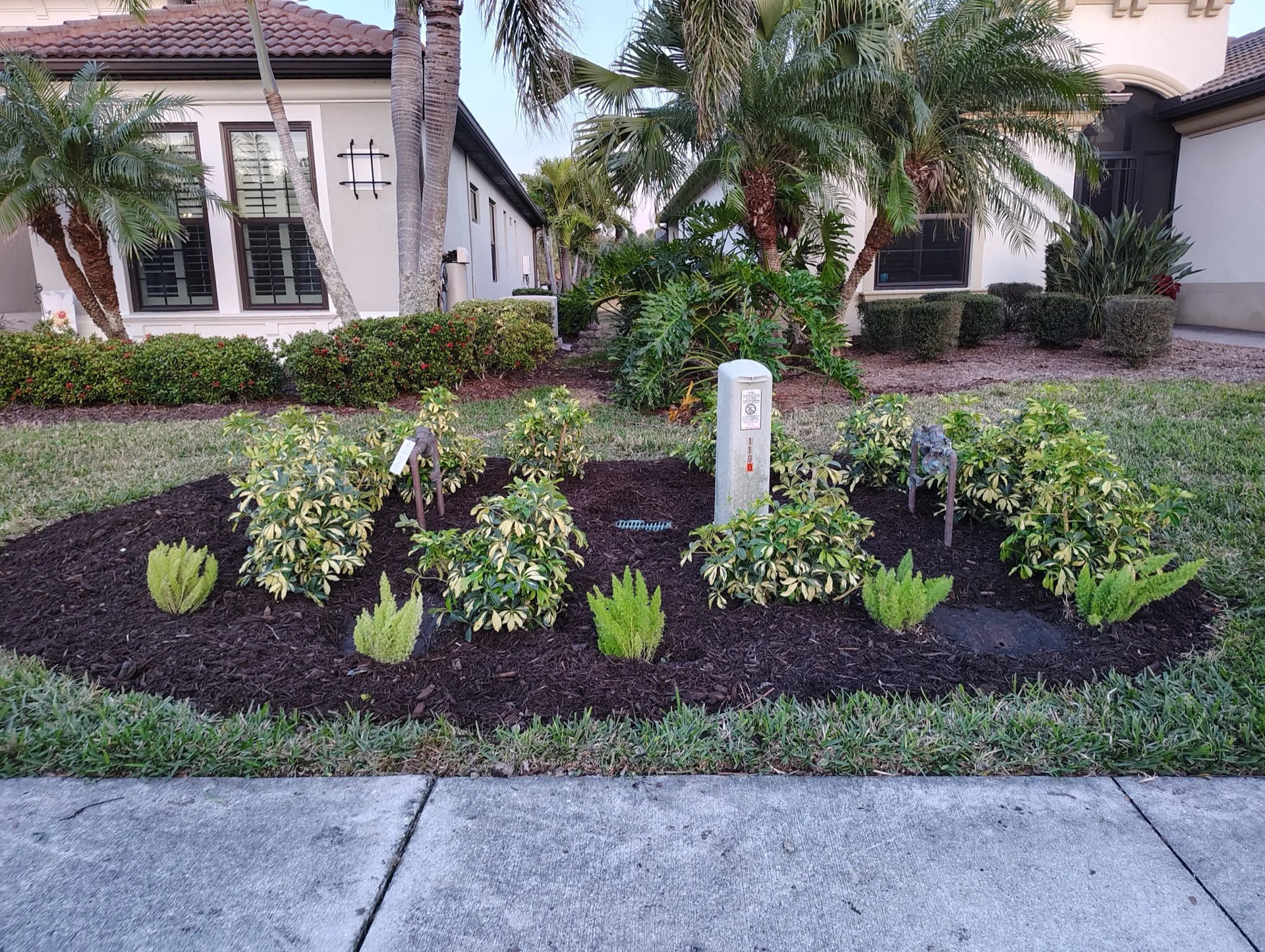
That's the part people miss. Drip only works if the emitters sit where the roots are, so the layout of the plants and the layout of the water have to be planned together. On a new plant installation, placement comes first. One customer wrote this about a planting job with us:
“Dennis was great to work with and so helpful with placement and mapping the install of the plants.”
Jess Rose, Google review
The catch with drip is that it fails quietly. A broken spray head makes a geyser you can see from the street. A clogged emitter just stops, and the plant it was feeding fades over a few weeks. That quiet failure is behind the most common mistake we find in SW Florida systems.
The mistake we see constantly: beds and grass on one zone
A valve can only run for one length of time. If a zone has lawn spray heads and shrub beds on it, the controller has to choose. Run long enough for the grass and the shrubs drown. Run short for the shrubs and the grass browns out. Something on that zone always loses.
It gets worse when someone tries to fix it by swapping a few bed heads for drip on the same valve. Spray is measured in inches per hour and drip in gallons per hour. A 20-minute run that's right for the lawn barely wets the drip line, and a run long enough for the drip floods the lawn.
The fix is a dedicated drip zone for the beds. Before we suggest changing anything, we run each zone and watch where the water actually lands. A lot of the time the beds are already on their own valve, just with the wrong heads, and converting that zone is a much smaller job than adding a new one.
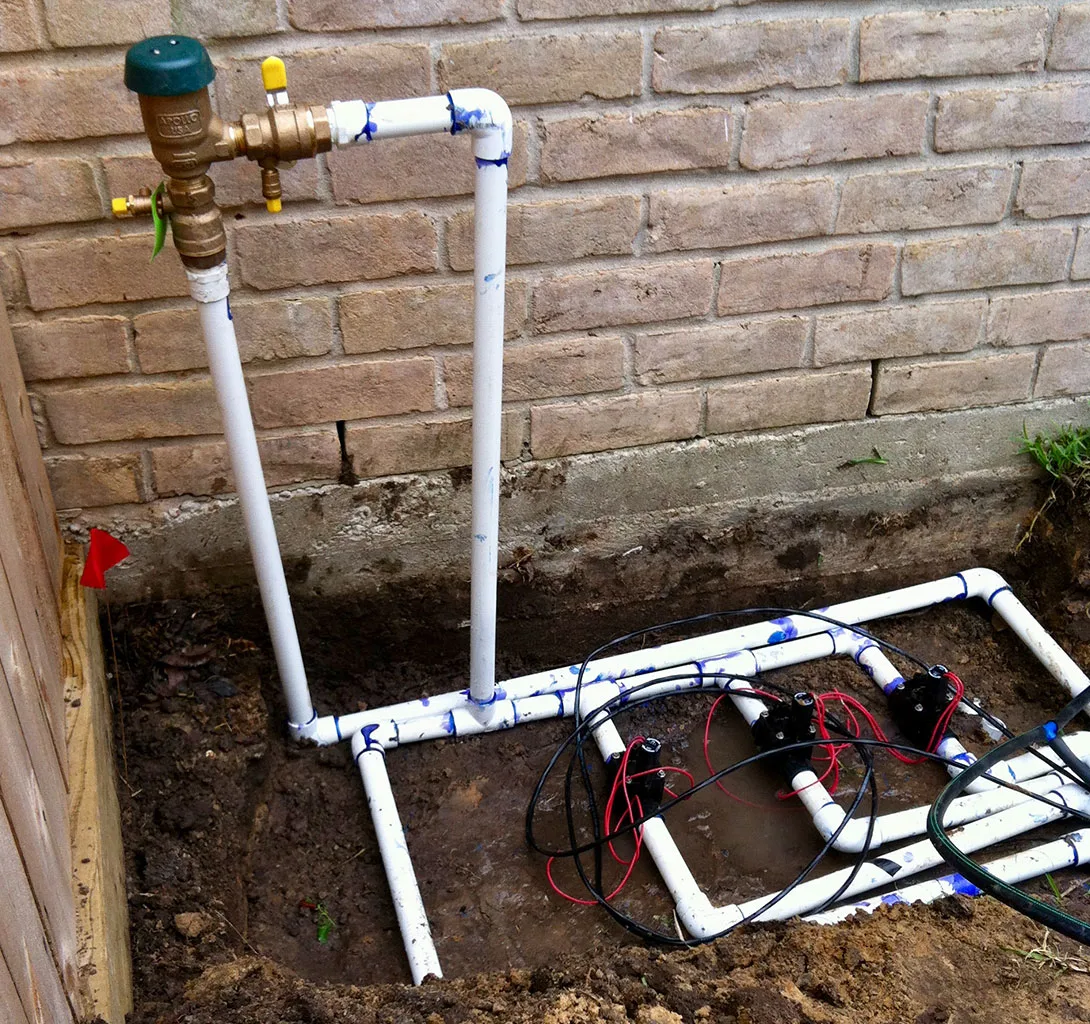
Not every conversion is a real one, though. Here's how a corner-cut job compares to one done right.
| Corner-cut drip conversion | Drip conversion done right |
|---|---|
| Drip tubing tied into a spray zone with no filter | A filter at the head of the zone, so sand and well-water sediment don't clog emitters |
| Full line pressure going into the tubing | A pressure regulator, because drip runs at a fraction of what spray heads need and full pressure blows fittings apart |
| The same emitter on every plant | Emitters sized and counted per plant, so a palm and a dwarf shrub don't get the same flow |
| Old spray heads left running on the same valve | Spray heads capped or removed, and beds on their own valve |
| Tubing laid wherever it fits, dead-ended in the bed | Emitters at the root ball, tubing under mulch or rock, and a flush end to clear sand |
Tip from Dennis: Once a month in the dry season, pull the mulch back at a few plants an hour or so after your drip zone runs and push a finger an inch into the soil. It should be damp. If one plant is wilting while its neighbors look fine, that's usually one clogged emitter, and it's a two-minute fix if you catch it before the plant does.
All of this applies in every yard we work on. What goes wrong first depends on which of our four cities your yard is in.
What changes in North Port, Venice, Port Charlotte, and Englewood
The spray-for-grass, drip-for-beds split holds everywhere we work. The local soil, water, and wind decide where a bad system breaks down first.
North Port
A lot of North Port sits on spodosol, sandy soil with a hardpan layer underneath that slows drainage. A spray head putting down an inch and a half an hour on a bed can stack water up on top of that layer. Drip goes in slowly enough to soak in. If a bed is already holding water after storms, irrigation isn't the fix. The grade is, and that's a grading and drainage job in North Port that comes first. If you're comparing companies for landscaping in North Port, FL, ask every one of them how they plan to water what they plant. Our North Port irrigation page covers local installs and repairs.
Venice
Venice soil is sandy with shell mixed in, and on lots close to the water, wind and salt air are part of daily life. Spray heads lose a lot of water to drift on a breezy evening. If you're looking for irrigation repair in Venice, FL because a bed zone keeps watering the lanai or the heads keep getting buried by shrubs, that's a good time to ask whether the zone should be drip instead of repaired as-is.
Port Charlotte
Canal-front lots are common in Port Charlotte. Spray heads along the back of those yards throw water toward the seawall and onto banks that already want to erode. Drip in the back beds keeps the water on the plants. For irrigation in Port Charlotte on a canal lot, we start at the back of the yard. You can see the rest of our work on our landscaping in Port Charlotte page.
Englewood
Englewood and Rotonda West lots are coastal sand with steady wind off Lemon Bay and the Gulf. Wind is spray irrigation's worst enemy, and blowing sand works its way into beds. Drip under rock or mulch, with a good filter and a flush end, holds up well here. More on our Englewood irrigation work.
Not sure what you have under your own beds? Most homeowners aren't, and that's fine. Here are the questions we hear the most.
Frequently asked questions
Can you use drip irrigation on a St. Augustine lawn?
It's possible, but it's rarely worth it for a home lawn in SW Florida. Buried drip in sand under St. Augustine is hard to get even, easy to cut, and hard to troubleshoot because you can't see a clogged emitter until the grass above it dies. Spray heads and rotors laid out head to head are still the right tool for turf.
Is drip irrigation worth it in Southwest Florida?
For beds, palms, hedges, rock beds, and narrow strips, yes. It uses less water, keeps water off your house and pavers, and under the current water shortage order it can run any day before 8 a.m. or after 6 p.m., while lawn zones get one day a week. For the lawn itself, stick with spray.
What are the benefits of an irrigation system with separate drip zones?
The biggest benefit of an irrigation system set up this way is that your lawn and your plants each get the right amount of water on the right schedule. You waste less water, you get fewer stains on walls and curbing, your beds don't wash out, and your plants have a legal way to get water during the dry season from November through April.
Can I convert a spray zone to drip myself?
If the zone waters beds only, it can be done. You need a filter, a pressure regulator, tubing run to every plant, emitters sized per plant, and the old spray heads capped. Most DIY conversions that fail skip the filter or the regulator, or put drip on a valve that also runs lawn heads.
Why do my drip emitters keep clogging?
Usually sand, sediment, or minerals from well water, and no filter, or a filter nobody has cleaned. Clean the filter, open the flush end to run sand out of the line, and replace any emitter that stays blocked. If the zone has no filter at all, add one before you replace anything else.
Do watering restrictions apply to drip irrigation?
Yes, with different rules. Under the current Southwest Florida Water Management District order, low-volume watering of plants and shrubs is allowed any day before 8 a.m. or after 6 p.m., while lawn watering is limited to one day a week in overnight windows. Check the current order for your address, since it can change.
Do you do irrigation repair in Venice, Port Charlotte, and North Port?
Yes. We handle irrigation installation, repair, and drip conversions across North Port, Venice, Port Charlotte, and Englewood. Call Dennis at (941) 946-8403 and tell him what your beds look like after a cycle. The estimate is free, and you can also send a request online.