.webp)
Drought tolerant means something different down here
The best drought-tolerant SW Florida plants are the ones that can go six months on very little rain in fast-draining sand, then sit in soggy ground all August without rotting. Sabal palms, coontie, firebush, wax myrtle, Simpson's stopper, saw palmetto, and muhly grass handle both halves of the year. Agave, sea grape, and bougainvillea handle the dry half beautifully and need help with the wet half.
That two-sided problem is why so many plant lists let you down. Most lists of landscape plants for Florida are written for the whole state, and some of the drought lists you'll find online were written for Arizona. A plant that shrugs off drought in Tucson can drown in a North Port bed that holds water for two weeks after a July storm. A shrub sold as bulletproof in Orlando can sulk in the salt air on Manasota Key.
Our area gets roughly 52 to 58 inches of rain a year, depending on which city you're in. Most of it falls between June and September. From November through April it can go weeks without a real rain, while your beds sit in sand that drains like a colander. That's the season we're in right now, and it's when planting mistakes show up fastest.
Below is the short list we actually put in the ground, what kills these plants anyway, and what changes between North Port, Venice, Port Charlotte, and Englewood. Start with the part almost nobody tells you: a drought-tolerant plant isn't drought tolerant on the day you buy it.
Why drought-tolerant plants still die in SW Florida yards
We get called out to a lot of yards where the homeowner did everything "right." They picked plants off a drought-tolerant list, put them in, and watched half of them brown out by March. Nine times out of ten it comes down to one of four things.
1. Nobody watered them long enough to get established
"Drought tolerant" describes a plant with a full root system. A 3-gallon shrub from the nursery has a root ball about the size of a coffee can, grown in a pot that got watered every day. Set it in dry sand in November and it can't reach anything. Every plant on this page needs regular water for its first few months, and trees and palms need it a lot longer. UF/IFAS research puts tree establishment in South Florida at roughly three months for every inch of trunk diameter.
2. They share a zone with the lawn
Your St. Augustine lawn and an established coontie want very different amounts of water. If they're on the same valve, one of them is always wrong. Either the lawn goes thirsty or the drought-tolerant plants get drowned three times a week. Group plants by how much water they need and give the beds their own drip zone. Our drip vs. spray breakdown covers how that works, including why drip zones get more watering days under this dry season's water shortage order.
3. Wet feet in the rainy season
This one surprises people. A lot of drought-tolerant plants die from too much water, not too little. Agave, coontie, sea grape, and most succulents need water to drain away from their roots. In North Port, a spodosol hardpan sits 18 to 24 inches down under a lot of lots, and rainwater perches on top of it all summer. A bed that's bone dry in April can be a bathtub in August. Put a succulent in that low spot and it rots from the crown down.
4. They were spaced for the day they were planted
A firebush goes in at two feet tall and wants to be six or eight. Plant five of them three feet apart under a window and within two years they're fighting over the same water, shading each other out, and getting sheared into boxes that never bloom. Space for the mature size. The bed looks thin for one season, then it looks right for ten years.
Get those four right and the plant list almost takes care of itself. Almost. Which plants make the list is where most people still guess wrong.
The best drought-tolerant SW Florida plants we install
These are the plants we trust in Sarasota and Charlotte County yards once they're rooted in. Most are Florida natives. That matters for more than bragging rights. They evolved for exactly this pattern of soaked summers and dry winters, in exactly this sand.
Palms
Sabal palm (cabbage palm). Florida's state tree and the toughest palm you can plant here. It takes drought, salt spray, cold snaps, and standing water. The catch is installation. Field-dug sabals lose most of their roots when they're dug, so they need steady water for months while they grow new ones. Skip that and the head goes brown.
Bismarck palm. Big silver-blue fronds and very drought tolerant once it's established. It needs room. A mature Bismarck can spread 15 to 20 feet across, which makes it a bad pick for a narrow side yard and a great one for a big front lawn.
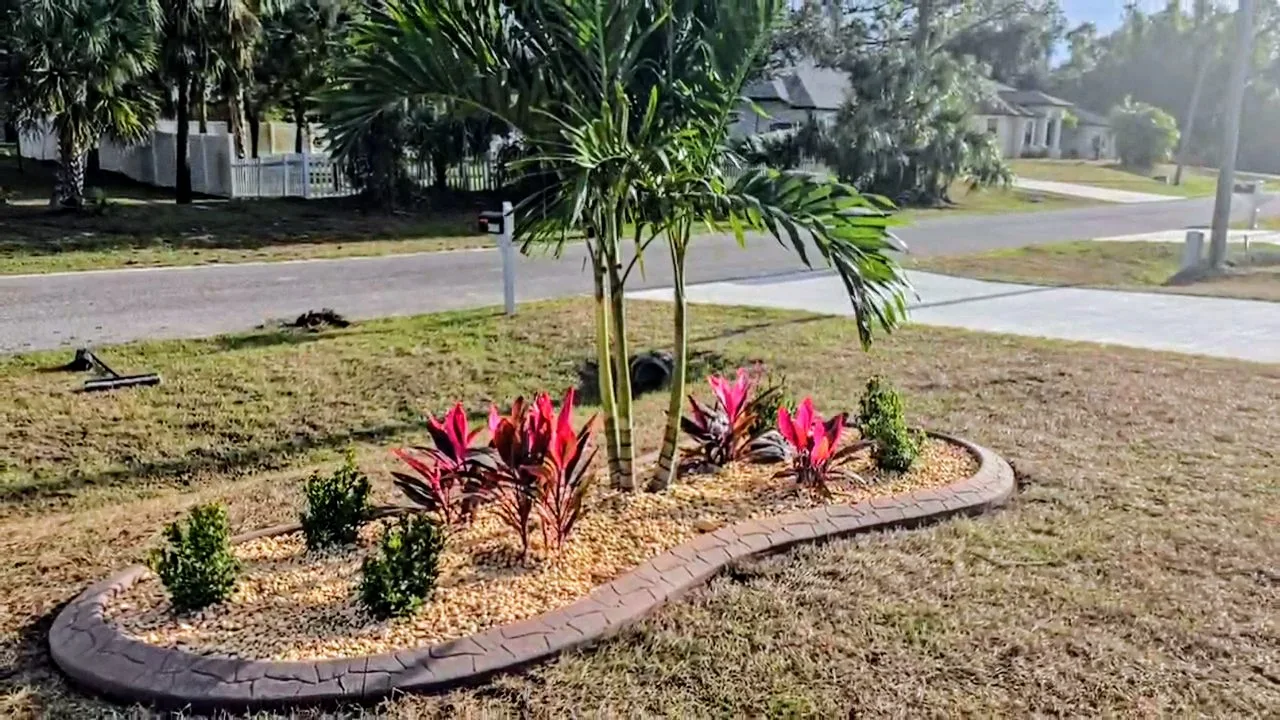
Pygmy date palms, like the one in the photo at the top of this page, are a good fit for a bed near the house. Just know they want more regular water than a sabal or a Bismarck.
Shrubs and hedges
Firebush. Native, with orange-red tubular flowers most of the year. Hummingbirds and butterflies go straight for it. Full sun to part shade. A hard frost knocks it back, but it comes back from the base in spring.
Coontie. A native cycad that stays around three feet tall, grows slowly, and handles anything from full sun to deep shade. It's about as drought tolerant as anything on this list. Two cautions: it needs good drainage, and every part of it is toxic to dogs and cats.
Simpson's stopper. Our go-to native hedge when someone wants privacy without a thirsty plant. Small glossy leaves, fragrant white flowers, and orange berries the birds clean up for you. It takes shearing well.
Wax myrtle. One of the few plants that's comfortable in a dry spell and in a soggy low corner. It grows fast and spreads by suckers, so it works better as a screen along the back of the lot than in a tidy front bed.
Podocarpus. Not native, but it's a workhorse hedge in our area. It handles sun or shade, rides out a dry spell once it's rooted, and holds a clean shape along a fence or wall.

Saw palmetto. The native palm-shrub you see on every undeveloped lot around North Port. Extremely drought and salt tolerant. Buy it container-grown. Palmettos dug out of the woods rarely survive the move.
Plumbago and bougainvillea. Two non-natives for color in hot, dry spots. Plumbago gives you soft blue flowers most of the year. Bougainvillea blooms hardest when it's kept on the dry side and hates wet feet. It also has serious thorns, so keep it away from walkways and pool decks.
Grasses and groundcovers
Muhly grass. A native clumping grass that throws pink, cloud-like plumes in the fall. If you've driven past a pink haze in a median this month, that was probably muhly. Full sun, drought tolerant, and it handles a short flood.
Fakahatchee grass. A bigger native clumping grass, four to six feet tall. It handles wet ground better than most drought-tolerant plants, which makes it one of our picks for pond edges and low spots that dry out hard in spring.
Beach sunflower. A native groundcover with small yellow daisies. It loves sun, sand, and salt. It's short-lived and reseeds itself, so think of it as a patch that wanders rather than a permanent border.
Agave, yucca, and the "SW plants" crowd
A lot of people searching for SW plants have the desert Southwest in mind: agave, yucca, cactus. Several of them do great here, with one hard condition. They need drainage. In a raised bed, a berm, or a rock bed with a well-drained base, an agave will look sharp for years on almost no water. In a flat bed that holds water through the rainy season, it rots. Agave and Spanish bayonet also have spines that will put a hole in you, so set them well back from paths.

Here's how the list stacks up side by side. The "wet summer soil" column is how a plant handles ground that stays soggy after storms. It's the column most plant lists leave out, and it's the one that decides what lives in a lot of our yards.
| Plant | Native? | Sun | Wet summer soil | Salt spray | Cold snap |
|---|---|---|---|---|---|
| Sabal palm | Yes | Sun to part shade | Handles it | High | Tough |
| Bismarck palm | No | Full sun | Fair | Moderate | Handles our winters |
| Coontie | Yes | Sun to shade | Poor, needs drainage | Moderate | Tough |
| Firebush | Yes | Sun to part shade | Fair | Low to moderate | Dies back, regrows |
| Simpson's stopper | Yes | Sun to part shade | Fair | Moderate | Tough |
| Wax myrtle | Yes | Sun to part shade | Handles it | Moderate | Tough |
| Saw palmetto | Yes | Sun to shade | Fair | High | Tough |
| Podocarpus | No | Sun to shade | Fair | Moderate | Tough |
| Muhly grass | Yes | Full sun | Fair | Moderate | Tough |
| Fakahatchee grass | Yes | Sun to part shade | Handles it | Moderate | Tough |
| Beach sunflower | Yes | Full sun | Poor | High | Some damage |
| Sea grape | Yes | Full sun | Poor | High | Some damage |
| Agave | Mostly no | Full sun | Poor, rots | Moderate to high | Varies by type |
| Bougainvillea | No | Full sun | Poor | Moderate | Some damage |
A table can tell you what survives in SW Florida. It can't tell you what survives in your yard. That comes down to three things: sun, salt, and where your water sits after a storm.
Florida plants for sun, shade, salt, and soggy lots
Before Dennis recommends a single plant, he looks at the yard the way the plant is going to experience it. Which way does the bed face? Is there a stucco wall throwing heat back at it? Where does the water stand after a hard rain? Those answers change the list more than any plant tag does.
Full sun and west-facing walls
Florida plants for sun have to handle more than light. A bed along a west-facing stucco wall gets afternoon sun plus heat bouncing off the wall. If it's in rock instead of mulch, it gets heat coming up off the stone too. Firebush, muhly grass, bougainvillea, agave, and beach sunflower are built for that. Most tropicals aren't, and they'll scorch there even with water. Our rock vs. mulch guide goes deeper on how each one changes the heat and moisture around the roots.
Shade under oaks and on the north side
Coontie, podocarpus, and saw palmetto are the drought-tolerant picks for shade. Keep in mind that shade beds lose much less water than sun beds. If both are on the same timer setting, the shade bed is getting overwatered.
North Port: hardpan and standing water
North Port averages around 58 inches of rain a year, and the hardpan under a lot of lots keeps it from draining. Here we plan every drought-tolerant bed around the wet season first. Wax myrtle, Fakahatchee grass, and sabal palms can go in the low spots. Agave and coontie go on raised ground only. If a bed holds water for days after a storm, that's a drainage problem before it's a plant problem. If you're planning bigger landscaping in North Port FL, sort the grade out before the plants go in.
Venice: shell and alkaline soil
A lot of Venice soil carries shell, and shell pushes the soil pH up. Acid-loving plants like ixora and gardenia struggle in it. Their leaves go yellow because they can't pull enough iron and manganese out of alkaline ground. Simpson's stopper, firebush, muhly, and sabal palms don't mind. On Venice Island, close to the Gulf, salt spray decides the list, so sea grape, saw palmetto, and beach sunflower move to the front. More on that on our Venice plant installation page.
Port Charlotte: canal lots
Port Charlotte has miles of canals, and the beds along a seawall take wind and salty air that the front yard never sees. Silver buttonwood, saw palmetto, and muhly grass handle it well. Buttonwood also tolerates wet ground, but it's cold tender, so expect some frost damage in a hard winter.
Englewood: salt, wind, and blowing sand
On Manasota Key and along Lemon Bay, salt spray and wind are the main threats, and sand blows into the beds all year. Sea grape, saw palmetto, cocoplum, and beach sunflower are the backbone of most coastal plantings we do there. See our Englewood plant installation page for more on coastal beds.
Knowing where to plant is half of it. The other half is not getting fooled by plants that look tough sitting on the nursery bench.
Plants that look tough but aren't
Some of the most common plants in SW Florida yards are there because they look great at the garden center, not because they're easy here.
- Crotons. They take heat and some dryness. Cold is their weak spot. One frosty night can strip them, and they're slow to come back.
- Ixora. Needs more water than its reputation suggests, and it turns yellow in alkaline or shell soil.
- Cordyline (ti plant). Gorgeous color, but it wants steady moisture and does best out of the harshest afternoon sun.
- Annual bedding plants. Impatiens, petunias, and the like need water constantly in our sand. They're fine in pots you can reach with a hose.
- Lantana camara. It really is drought tolerant. It's also on Florida's invasive plant list and toxic to pets. Ask for native lantana or a sterile variety instead.
Cold is the one that catches people off guard. Drought tolerant and cold tolerant aren't the same thing, and when a frost hits, the tropicals usually go first. One customer called us back after exactly that:
“I hired Epic Horizons Landscaping again..to remove shrubs/plants that got ruined by frost and cold weather.Dennis designed and installed new beautiful plants..my yard looks nice again..Thank you for excellent job!”
Lily, Google review
When a bed gets wiped out by cold, it's a good time to rebuild it with plants that handle a dry spell and a cold night. Firebush, coontie, Simpson's stopper, muhly grass, and sabal palms all qualify. Whatever you pick, though, the next 90 days after planting decide whether it lives.
The first 90 days decide everything
Planting now, in the dry season, has one big advantage: cooler temperatures are easier on new roots than June heat. The downside is that every drop comes from you, because the sky isn't helping until late May. Planting right as the rainy season starts flips that around. The rain does most of the work, but the plants deal with heat stress and soggy ground in their first weeks. Either one works if you plan for it.
For a 3-gallon shrub in sand, a good rule of thumb is water every day for the first two weeks, every other day for about the next two months, then once or twice a week until you see steady new growth. Palms and trees need longer. Soak the root ball each time instead of sprinkling the whole bed.
Tip from Dennis: Check the root ball, not the bed. Nursery plants are grown in a bark and peat mix that dries out faster than the sand around it. The ground can feel damp while the root ball inside it is bone dry. Push a finger into the original root ball itself. If it's dry an inch down, water.
A few more things that make the difference:
- Mulch two to three inches deep, and pull it back a few inches from stems and trunks. Mulch piled against a trunk holds moisture right where rot starts.
- Go easy on feeding. Drought-tolerant plants don't want much. Push them hard and they put out soft new growth that needs more water.
- Know the watering rules. This dry season Sarasota County and parts of Charlotte County are under a water shortage order, and drip and hand watering of plants get more days than lawn sprinklers. Check the current schedule with the Southwest Florida Water Management District before you set a timer.
Watch for this: Making it through the dry season isn't the finish line. A plant that survived its first winter can still drown in its first August if it's sitting in a low spot. If water stands in a bed for more than a day or two after a storm, call before you replace anything. Moving the plant or fixing the grade beats buying it twice.
If you'd rather not gamble on any of this, that's what our plant installation work is for. Dennis maps the beds, matches each plant to its spot, and sets up the watering so it fits the plants. That's the playbook. Here are the questions homeowners ask us most when they're picking plants.
Frequently asked questions
What are the most low maintenance Florida landscape plants?
For SW Florida, the lowest-maintenance group is coontie, Simpson's stopper, saw palmetto, muhly grass, sabal palms, and podocarpus. Once they're established, they need little water, little trimming, and almost no fussing. The real secret is spacing. A low-maintenance plant crammed too close becomes a high-maintenance hedge you trim every month. Our low-maintenance landscaping guide covers the whole-yard version of this.
What are the best Florida plants for full sun?
Firebush, muhly grass, bougainvillea, agave, beach sunflower, plumbago, and sea grape all thrive in full sun here. For the hottest spots, like a west-facing wall or a rock bed by the driveway, lean toward agave, bougainvillea, and muhly. Those can take reflected heat without scorching.
When is the best time to plant drought-tolerant plants in SW Florida?
Two windows work well. Fall and early winter give you cool temperatures for root growth, but you have to water by hand or by drip because it barely rains. Late May through June lets the rainy season do the watering, but plants face heat and soggy soil right away. Avoid planting tender tropicals right before a cold snap is forecast.
Is there a SW Florida plant guide I can trust?
Yes. The UF/IFAS Florida-Friendly Landscaping program publishes plant lists and a searchable plant database, and the Sarasota County and Charlotte County extension offices can answer questions about your specific area. Use them alongside this list. They'll tell you what a plant can handle. A walk around your yard tells you where it'll actually be planted.
What's the most drought-tolerant grass, and how should I evaluate a sod company's soil prep?
Bahia is the most drought tolerant of the common lawn grasses here. In a dry spell it goes brown and dormant, then greens back up when the rain returns. St. Augustine, including Floratam, looks better and is what most HOAs want, but it needs more water to stay green. When you evaluate a sod company, ask about three things: grading, leveling, and drainage. You want to know how they'll slope the ground away from the house, fill the low spots, and make sure water has somewhere to go. That's how we prep for sod installation, and it matters more for survival than which pallet you buy.
Will these plants work for landscaping in Davenport, FL?
Davenport is inland in Polk County, and it gets colder winters with more frost nights than the coast down here. The natives on this list, like sabal palms, wax myrtle, saw palmetto, coontie, and muhly grass, generally carry over. Cold-tender plants like silver buttonwood, bougainvillea, and crotons take more damage there. We don't work in Polk County. We install plants in North Port, Venice, Port Charlotte, and Englewood.
Can you plan and install a drought-tolerant landscape for my yard?
Yes. Dennis comes out personally, looks at your sun, soil, and drainage, and puts together a plant plan that fits your yard and your HOA. Estimates are always free. Call or text him at (941) 946-8403.