Tree limb removal in Englewood, FL usually costs $75 to $1,000 per limb, the same range you'll see across most of the country. Most homeowners pay $150 to $500. That's a wide spread, and the size of the limb isn't what decides where you land. What decides it is what's underneath the limb, how high up it is, and whether the quote includes hauling it away.
We do tree work across Englewood, North Port, Venice and Port Charlotte. The calls usually come in two waves. One is in spring, when people look up and notice a laurel oak limb reaching over the lanai. The other is right after a storm, when it's already on the ground or on the roof. This article covers both. It goes through the real numbers for every way people ask the question, and it shows how to tell a fair quote from one that leaves you with a pile of wood at the curb.
how much does tree limb removal cost
Tree limb removal costs about $75 to $1,000 per limb in most of the U.S. A small limb you can reach from a ladder runs around $75 to $200. A large limb that needs a climber and ropes runs $400 to $1,000 or more, especially over a roof, pool cage or power line. Most homeowners pay $150 to $500.
| Limb size | How it comes down | Typical cost |
|---|---|---|
| Small (under 4 in. thick), reachable from the ground or a ladder | Pole saw or hand saw, dropped onto open ground | $75 – $200 |
| Medium (4–8 in.), up to about 20 ft high | Ladder or lift, cut in sections | $150 – $400 |
| Large (8–12+ in.), high or heavy | Climber with ropes, pieces lowered on a line | $400 – $1,000 |
| Large limb over a roof, pool cage or near power lines | Full rigging, sometimes a lift or crane, utility coordination | $750 – $1,500+ |
Thickness matters because weight goes up much faster than diameter. A limb twice as thick weighs about four times as much. You can't just drop a 10-inch laurel oak limb. Someone has to cut it in sections and lower each piece on a rope so it doesn't swing into your gutter or punch through the screen.
In SW Florida the trees driving most of these calls are laurel oaks, live oaks, slash pines and queen palms. Laurel oaks are the ones we worry about. They grow fast, they get hollow as they age, and they drop big limbs in wind more often than live oaks do.
One catch with any per-limb number: almost nobody actually bills one limb at a time. The next section explains how the price really gets written.
how much is tree limb removal
Tree limb removal is usually priced by the job, not by the limb. Expect a minimum of about $150 to $300 just to get a crew and equipment to your driveway. Above that, most crews either bill $75 to $150 per worker per hour or walk the tree and give you one flat price for the whole job.
That minimum is why one limb feels expensive and five limbs feel like a deal. Loading the truck, driving out, setting up and raking up at the end cost the same whether we cut one branch or six. If you have a dead limb on the oak and a palm that needs its fronds cleaned up, get them on the same ticket.
When Dennis comes out to price a job, he gives you one flat number in writing. It covers the cutting, the cleanup and the haul-off. If something about the job is going to change the price, like a limb resting on the service line or a side yard too narrow for equipment, he tells you before the first cut, not after.
Flat versus hourly is only half of it, though. Two limbs the exact same size can be priced hundreds of dollars apart. Here's why.
how much does tree branch removal cost
Tree branch removal costs $100 to $1,500, and where the branch is matters more than how big it is. A 6-inch branch over open lawn might cost $150. The same branch over a pool cage or roof can cost $400 to $700, because it has to be roped and lowered in pieces instead of dropped.
| What's under the branch | What the crew has to do | Effect on price |
|---|---|---|
| Open lawn | Cut and drop | Base price |
| Fence, planting beds or irrigation heads | Lower some pieces on a rope, protect the beds | Roughly 25–50% more |
| Roof, lanai or pool cage screen | Rig every piece, lower it by hand, sometimes use a lift | Often double |
| Within 10 ft of power lines | Utility has to clear it or de-energize the line first | Call FPL before anyone cuts |
Don't let anyone cut near a power line on a handshake. OSHA rules keep regular tree crews 10 feet away from energized lines. Branches near the main lines between poles are FPL's job. If a limb is on the wire running to your house, call FPL first. They'll tell you whether they handle it or schedule a disconnect so it can be cut safely.
Access is the other hidden cost. A backyard oak boxed in by a pool cage and a 6-foot fence means every piece gets carried out by hand. That's labor, and labor is most of the bill.
That raises a question we hear from both sides of the fence: what should a crew actually charge for all of this?
how much to charge for tree limb removal
If you're pricing tree limb removal as a contractor, charge enough to cover labor, equipment, fuel, disposal and insurance. That works out to roughly $75 to $150 per worker-hour, a $150 to $300 minimum, and more for climbing or rigging. Pricing well below that usually means skipping insurance, skipping haul-off, or both.
This matters to you as a homeowner, too. A guy with a chainsaw and a pickup who'll do it for $60 isn't running a cheaper version of the same business. He's running a different business. He has no liability coverage if the limb goes through your neighbor's screen. He has no workers' comp if he comes off the ladder in your yard. And there's no plan for the wood except leaving it at the curb.
Here's how Dennis puts it: "When a price seems too low, something got left out of it. My job is to tell you what's in mine." Every job we do is covered by our liability insurance, and you can ask to see the certificate.
So what does a fair number look like once everything is in it? You can check one against another without being in the trade.
how much should tree limb removal cost
A fair price to remove one medium limb from a typical Florida yard is $150 to $400 with cleanup and haul-off included. Quotes far under $100 usually leave the debris behind or skip insurance. A quote over $1,000 for a single limb should come with a clear reason, like rigging over a structure, a crane, or power lines.
The quote that's missing things
- "Cut limbs" on one line, nothing else
- Says nothing about how heavy limbs get lowered
- Branches stacked at the curb for you to deal with
- Flush cuts or stubs left on the trunk
- Interior of the canopy stripped bare ("lion-tailing")
- No insurance mentioned
A complete quote (how we write ours)
- Each limb listed, so you know exactly what's coming off
- Method written in: dropped, or roped and lowered
- All wood chipped or loaded and hauled away
- Cuts made just outside the branch collar
- Canopy thinned evenly, not gutted
- Liability coverage you can ask to see
A bad cut costs you twice. If you cut flush against the trunk, the tree can't seal the wound. If you leave a long stub, it rots back into the trunk. The right cut goes just outside the branch collar, the slightly swollen ring where the limb meets the trunk. Heavy limbs come off with three cuts, so the bark doesn't tear down the trunk when the weight lets go.
Lion-tailing is the one that hurts most in Florida. Strip out the inner branches and leave a tuft at the tip, and you've built a lever. In a tropical storm, those are the limbs that snap. A good crew takes off less and takes it off evenly. The usual rule is no more than about a quarter of the canopy in one season.
Once the limb is down, you still have a pile of wood in the yard. You have more options for it than most people realize.
how to get rid of tree limbs
You can get rid of tree limbs five ways: curbside yard-waste pickup, a county yard-waste drop-off, renting a chipper, renting a dumpster, or paying the crew that cut them to haul them off. Curbside pickup is cheapest but slow and has size limits. Crew haul-off costs more but the yard is clean the same day.
| Method | Typical cost | Best for | The catch |
|---|---|---|---|
| Curbside yard-waste pickup | Usually included in your trash service | A few small branches | Branches cut to about 4 ft, bundled, light enough to lift; size limits vary by city |
| County yard-waste drop-off | Free or a small fee for residents in many counties | A pickup truck load or two | Your truck, your time, your back |
| Rent a chipper | About $150 – $400 a day | Lots of limbs under 6 in. | Heavy, loud and dangerous if you've never run one |
| Roll-off dumpster | About $300 – $600 | Big cleanups mixed with other debris | Some haulers limit yard waste or charge extra for it |
| Crew haul-off | Often $50 – $200 added to the job | Anyone who wants it gone today | The extra cost |
Check your city's or county's exact curbside rules before you start cutting. Bundle length, weight and the thickest branch they'll take all vary, and pickup can slow way down after a storm when everyone's pile hits the curb in the same week.
Burning comes up a lot. Florida does allow some yard-waste burning under Florida Forest Service rules, but local ordinances and HOA rules shut it down in most city neighborhoods. In a North Port or Rotonda West subdivision, figure it's not an option.
Ask for the chips. If your crew chips the limbs on site, ask them to leave a pile for your beds. Wood chips make a decent free mulch around shrubs and trees. Keep them a few inches back from trunks and stems.
All of that assumes you're taking off a limb or two. If you want the whole tree cut back, you're buying a different job.
how much does tree branch cutting cost
Tree branch cutting, meaning trimming a whole tree, costs about $200 to $800 per tree in most of the U.S., and many homeowners pay around $450. Palms usually run $75 to $400 each. Large oaks over 60 feet that need a climber can run $800 to $1,500 or more.
Taking off one bad limb is a removal. Cutting branches across the whole canopy is trimming, and there are a few kinds. Roof clearance pruning keeps limbs about 6 to 10 feet off your shingles. Raising the canopy lifts the low branches so you can mow and walk under them. Thinning opens the crown so wind passes through instead of pushing on it.
Timing matters here. The best window is the dry season, November through April, before hurricane season starts June 1. Crews are easier to book, the ground is firm enough for equipment, and the tree has months to close its cuts before the first storm. If you wait until a named storm is in the Gulf, every crew in Charlotte and Sarasota counties is already booked.
Palms are their own subject. The "hurricane cut," where every frond gets stripped down to a feather duster, actually weakens the palm. We go into that in our palm tree trimming guide.
Trimming keeps the tree. Sometimes the tree, and everything grown up around it, has to go.
how much does tree and brush removal cost
Tree and brush removal costs $200 to $2,000 per tree, plus roughly $500 to $2,000 per acre for light brush and palmetto. An overgrown corner of a yard often runs $300 to $1,000. Tree stump removal cost adds about $100 to $500 per stump if you want the stumps ground out instead of left low.
The tree removal number swings on height. Small trees and palms in an open yard land near $200 to $600. Medium trees between 30 and 60 feet run $500 to $1,200. Big oaks and pines over 60 feet, especially ones leaning over the house, go $1,000 to $2,000 and up.
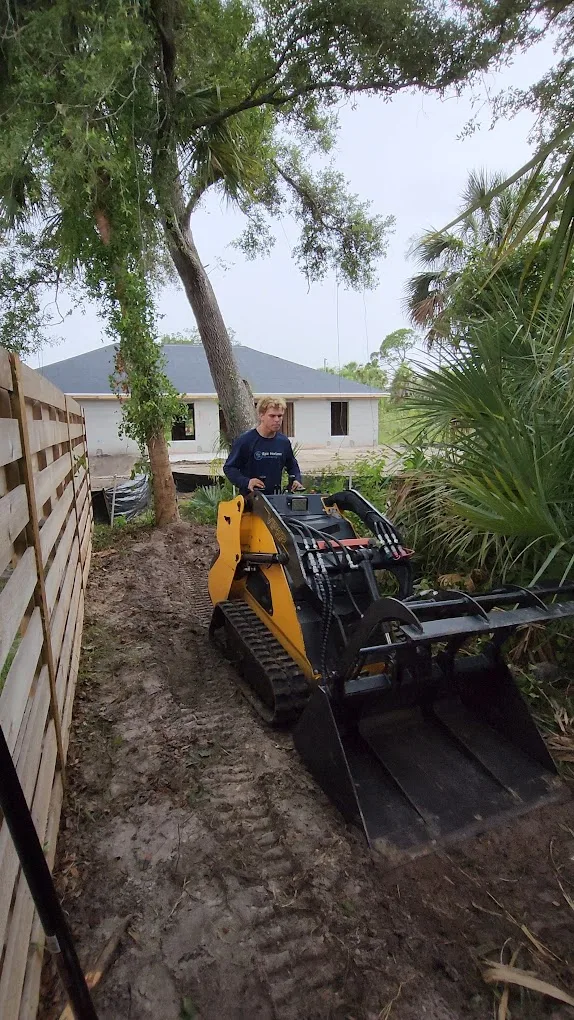
Brush is where SW Florida yards get expensive fast. Saw palmetto, Brazilian pepper and wild grapevine can swallow a back lot in a couple of rainy seasons. On a small area we cut and haul by hand. On bigger ground, our land clearing crew brings a skid steer with a grapple, and that changes the math to machine hours instead of man hours.
Tree stump removal is the line item people forget. Many quotes cut the stump flush and stop. Grinding usually runs $2 to $5 per inch of diameter, and you'll want it done if you plan to lay sod or put in a bed where the tree stood. Make sure the quote says in writing whether the stump stays or goes.
All of these prices assume you get to pick the day. After a storm, you don't.
how much does tree cleanup cost
Tree cleanup costs about $50 to $800 for most residential yards. Raking up limbs and fronds after a trim is the low end. A full post-storm cleanup with several trees' worth of limbs, trunk sections and fronds runs $500 to $1,000 or more. Emergency tree removal off a roof or pool cage costs more on top of that.
We saw it after Hurricane Milton in October 2024. Yards in North Port and Englewood had laurel oak limbs across driveways, queen palms leaning at 45 degrees, and fronds everywhere. The yards that cleaned up fastest had one crew handle the whole thing. Cut, stake what could be saved, haul everything off, then put back what the storm took.
"Dennis and his staff were outstanding. They did everything we asked of them and more. They cleaned up after Hurricane Milton, and did landscaping for us, too. When they finished, the yard looked more beautiful than it did before the storm!"
thomas scavitto, Google review
Three things to know before you sign anything after a storm:
- Photograph everything first. Your insurance company will want to see the damage before it's cleared.
- Check what your policy actually covers. Most homeowners policies only pay for removal when the tree hit a covered structure or is blocking your driveway, and many cap it around $500 per tree and $1,000 per storm.
- Watch out for door-knockers. Out-of-state storm chasers show up after every big Florida storm. Get the price in writing and never pay the whole thing up front.
Our tree debris removal guide covers the haul-off side in more detail. But should you even call a crew for a branch you could cut yourself?
how much is tree branch removal
Tree branch removal costs nothing if you do it yourself and the branch is small, low and over open ground. Hiring it out costs $75 to $200 for a small branch and $400 or more for anything you'd have to reach above your shoulders from a ladder. The ladder is where DIY tree work turns dangerous.
Here's the honest line. If you can stand flat on the ground, the branch is thinner than your wrist and nothing is under it, grab a pruning saw and do it yourself. You'll save the trip charge.
Call someone when any of these are true:
- You'd need a chainsaw on a ladder. That's the classic way homeowners end up in the ER.
- The limb is storm-bent or pinned under another limb. It's loaded like a spring and can whip when you cut it.
- It's over the roof, the cage, the fence or a car.
- It's anywhere near a power line.
- It's thicker than about 4 inches. That's when the three-cut method and a rope start to matter.
Everything above holds anywhere in the country. Our part of Florida adds a few twists of its own.
Tree removal in Englewood FL and North Port: what changes here
Englewood trees live with salt air and wind off Lemon Bay and the Gulf. Coastal sandy soil grows wide, shallow roots, so a top-heavy oak in Cape Haze or on a canal lot can tip over in saturated ground even when nothing snapped. Many sections of Rotonda West are deed-restricted, so check with your association before a big removal.
North Port has a different problem underneath. Much of the city sits on spodosol, a sandy soil with a hardpan layer that stops roots from going deep. Trees there root shallow and wide, and in a wet August the ground around them turns soft. Add one of the highest HOA densities in the area, in places like Heron Creek and the West Villages, and paperwork can take longer than the cutting.
On permits: ordinary trimming of limbs on your own property usually doesn't need one, but removing a whole tree can, depending on your city and the tree. Florida law (Statute 163.045) says a local government can't require a permit to trim or remove a tree on residential property if an ISA certified arborist or a Florida licensed landscape architect documents that it's a danger to people or property. Your HOA can still have its own rules, so check both.
When you call, Dennis comes out himself. He looks at the tree and what's under it, checks how wet the ground is, and tells you straight whether it's a trim, a limb removal or a full removal. If the job needs a crane or a certified arborist's letter, he'll say so. See our tree service in Englewood and tree service in North Port pages, or call (941) 946-8403 for a free estimate.
Tree limb and tree removal questions we get on the phone
How much does tree removal in North Port FL cost?
Most single-tree removals in North Port run $250 to $1,800 with haul-off included, which is in line with the national tree removal cost of $200 to $2,000. Palms and small trees in open yards cost the least. Big oaks over a lanai or roof cost the most. Stump grinding is usually priced separately.
What does emergency tree removal cost?
More than a scheduled job. A limb or tree on a house means rigging, careful weight transfer and often overtime, and every crew in the area is booked at once. Expect to pay well above the normal range. Even in an emergency, get the price in writing and photograph the damage first for your insurance claim.
How do I pick a tree removal service near me?
Pick a tree removal service that comes out and looks at the tree in person, puts cleanup and haul-off in writing, carries liability insurance and has real local reviews. Ask how heavy limbs will come down. Skip anyone who wants full payment up front or showed up at your door after a storm.
Is tree stump removal included when you take down a tree?
Not always. Many crews cut the stump flush and stop. Tree stump removal by grinding costs about $100 to $500 per stump, or roughly $2 to $5 per inch of diameter. If you plan to put sod or a bed where the tree stood, you'll want it ground below grade.
Does homeowners insurance pay for tree limb removal?
Usually only when the limb or tree hit a covered structure, like your house or fence, or blocks your driveway. Many policies cap tree removal around $500 per tree and $1,000 per storm. A limb that fell in the open and hit nothing is usually on you. Check your own policy.
Do I need a permit to cut tree limbs in Florida?
Usually not for trimming limbs on your own residential property. Removing a whole tree can need a permit depending on your city, unless an ISA certified arborist or licensed landscape architect documents that it's a danger. HOAs often have their own approval rules, so check with yours before work starts.