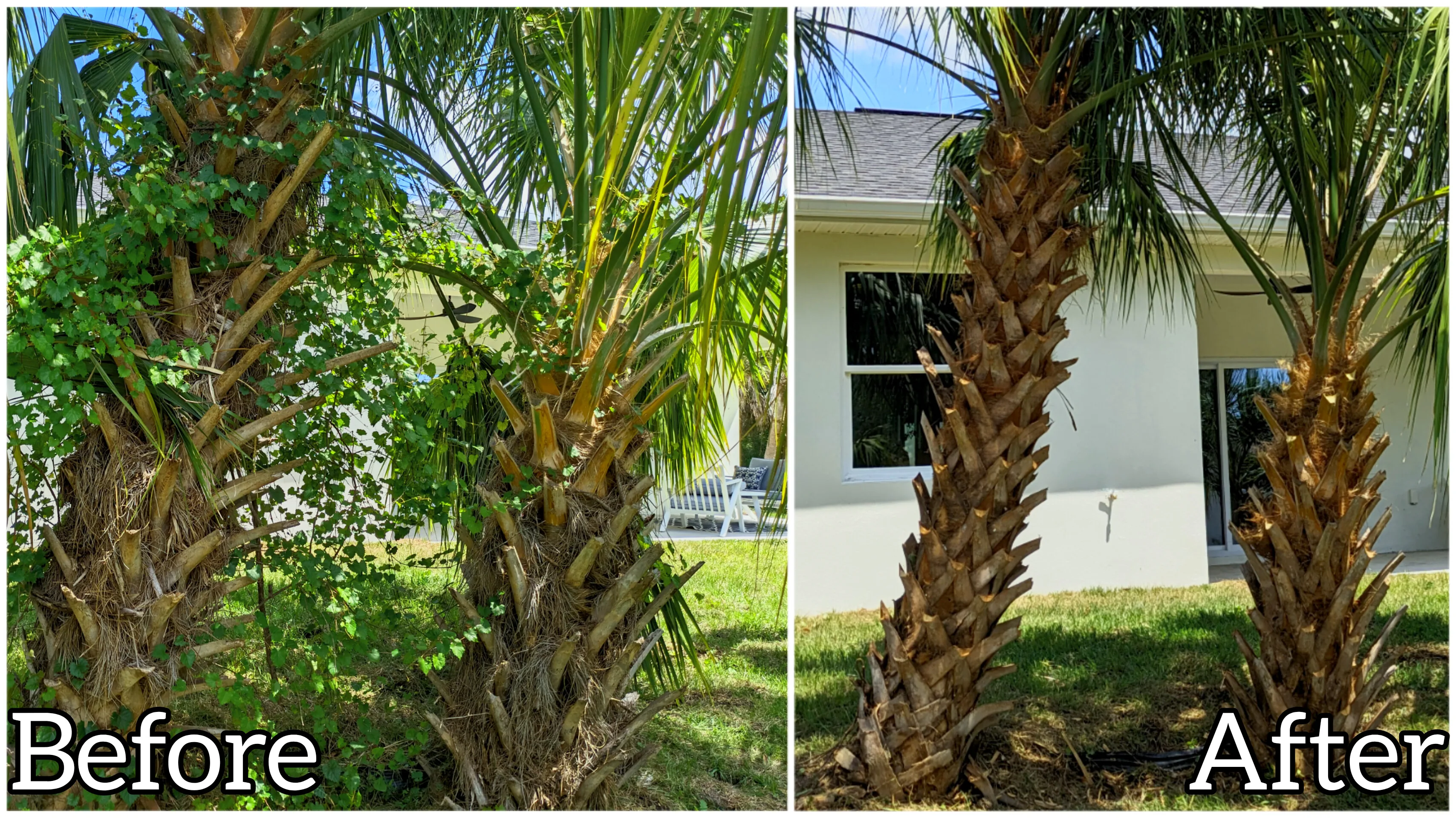
Why Trimming Matters Down Here
Palms are the signature of a SW Florida yard. Drive through North Port, Venice, Port Charlotte, or Englewood and you'll see them everywhere — Sabal palmettos lining driveways, queen palms framing pools, royal palms standing guard along the street. They're tough, they're beautiful, and they're constantly growing.
That constant growth is exactly why trimming matters. Dead fronds don't just look bad — they become projectiles in a tropical storm. Seed pods drop thousands of seeds that sprout everywhere you don't want them. Heavy fruit clusters from palms like queen palms attract rats and create a mess on driveways, patios, and pool decks. And coconut palms? A falling coconut can dent a car hood or worse.
But here's the thing most people get wrong: more trimming isn't better trimming. In fact, over-pruning is one of the most damaging things you can do to a palm tree. We see it constantly — homeowners or cheap crews strip a palm down to a couple of fronds at the top, and within a year or two, the trunk narrows, the tree weakens, and it either dies slowly or snaps in a storm.
Proper palm trimming is about removing what needs to go — dead fronds, seed stalks, fruit clusters — and leaving the rest alone. That's it. Simple concept, but it gets butchered all the time.
When to Trim (And When to Leave It Alone)
In SW Florida, palms grow year-round. There's no true dormancy like you'd see with deciduous trees up north. That said, there are better and worse times to trim.
Best window: Late spring through early summer. By June, most palms have pushed out their new fronds from the winter and spring growth cycle. You can clearly see which older fronds are dead or declining, and you're trimming ahead of peak hurricane season (June through November). That timing matters because you want seed pods and loose fronds removed before high winds arrive.
Acceptable year-round: Removing dead, brown, or hanging fronds is fine any time of year. Same goes for seed pods and fruit clusters. If a frond has gone completely brown, it's done contributing to the tree. Take it.
When to hold off: Don't trim a palm that's been recently transplanted or is showing signs of nutrient stress (yellowing fronds, stunted growth). Those fronds — even the ones turning yellow — are still feeding the tree. Cutting them forces the palm to pull nutrients from even more fronds, creating a cycle that starves the crown.
Warning: Never trim a palm during or immediately after a severe nutrient deficiency. Yellowing fronds on species like queen palms and royal palms often indicate a potassium or manganese deficiency. Removing those fronds makes the problem worse, not better. Address the nutrient issue first — we can help with targeted plant and tree fertilization.
Right Way vs. Wrong Way to Trim
This is where most of the damage happens. Let's break it down plainly.
The 9-and-3 Rule
Picture the frond canopy of your palm as a clock face. The lowest fronds you should leave on a healthy palm should be at roughly the 9 o'clock and 3 o'clock positions — horizontal or above. Everything from that line upward stays. Dead fronds below that line get removed.
That's it. That's the rule professional arborists use, and that's what we follow on every job.
What "Hurricane Cuts" Actually Do
We'll dig into this more in the next section, but the short version: stripping a palm down to a rooster tail of 4-5 fronds at the very top is called a "hurricane cut," and it does the opposite of what people think. It weakens the tree. It doesn't protect it.
Clean Cuts, Clean Tools
Every cut should be made with a sharp, clean saw or pruning tool. We clean our blades between trees — this isn't paranoia, it's prevention. Diseases like Ganoderma butt rot and lethal bronzing can transfer from one palm to another through contaminated tools. One dirty machete can infect your whole row of palms.
Cut fronds flush to the trunk or leave about 2 inches of the petiole (the frond stem). Don't tear them off by hand or rip them with a dull blade. A clean cut heals faster and doesn't leave a wound that invites fungal issues.
What to Remove
- Completely brown, dead fronds
- Fronds hanging below the 9-and-3 line
- Seed pods and flower stalks (especially on queen palms and coconut palms)
- Fruit clusters
- Loose boots (the old frond bases on species like Sabal palmettos — though many people prefer the look of boots left on)
What to Leave
- All green fronds, even if they're slightly yellow at the tips
- Any frond at or above the horizontal plane
- The heart/spear leaf at the very center of the crown — never cut this
"Dennis and his team did an outstanding job on our landscaping. They were on time, professional, and the attention to detail was incredible. Our yard looks better than we ever imagined."
— Mike T.
The Hurricane Pruning Myth
Every May and June, we see crews driving around North Port and Port Charlotte offering "hurricane trims" — basically stripping palms down to almost nothing. The pitch sounds logical: fewer fronds means less wind resistance, so the tree won't blow over. Right?
Wrong. Here's what actually happens when you over-trim a palm before hurricane season:
- The trunk gets weaker. Palms don't have cambium layers like hardwood trees. Their trunk diameter is largely set by the crown. Strip the crown, and the new growth that follows produces a narrower section of trunk — you can actually see this as a pinch point years later. That narrow spot is a structural weak point.
- The root system suffers. Fronds produce energy through photosynthesis. Fewer fronds = less energy = weaker roots. Weak roots are the #1 reason palms topple in storms.
- Wind dynamics change for the worse. A full, healthy crown actually flexes and dissipates wind energy. A bare spear at the top catches wind differently — it can whip and snap more violently.
- Recovery time increases. An over-trimmed palm spends months trying to recover its canopy instead of reinforcing its root system. If a hurricane hits during that recovery window, the tree is more vulnerable, not less.
The University of Florida's IFAS Extension has published research on this repeatedly: proper pre-hurricane palm care means removing only dead fronds, seed pods, and coconuts. That's exactly what we do.
Pro tip: If you're prepping your yard for hurricane season, focus on dead frond removal, seed pod cleanup, and making sure there's no dead wood in nearby hardwood trees. Those broken oak limbs are far more dangerous in a storm than a healthy palm frond.
Common SW Florida Palms and Their Needs
Not all palms need the same level of attention. Here's a quick breakdown of the species we work with most across Sarasota and Charlotte counties.
| Palm Species | Typical Height | Trimming Frequency | Key Notes |
|---|---|---|---|
| Sabal Palmetto (Cabbage Palm) | 40-60 ft | Once per year | Florida's state tree. Very low maintenance. Boots can be left on or shaved — cosmetic choice. |
| Queen Palm | 30-50 ft | 2-3 times per year | Heavy seed/fruit production. Prone to potassium deficiency (yellowing fronds). Don't remove yellow fronds — fertilize instead. |
| Royal Palm | 50-80 ft | 1-2 times per year | Self-cleaning (old fronds drop on their own). Main job is removing the fallen fronds and seed pods before they pile up. |
| Coconut Palm | 30-60 ft | 2-3 times per year | Coconut removal is the priority — liability issue. Fronds are typically trimmed at the same time. |
| Sylvester (Silver Date) Palm | 30-50 ft | 1-2 times per year | Sharp spines on frond stems. Definitely a job for a crew with proper gear. Beautiful diamond-cut trunk when trimmed well. |
| Pygmy Date Palm | 6-12 ft | 1-2 times per year | Small enough for most homeowners to handle. Watch out for the spines near the base of each frond. |
| Foxtail Palm | 25-35 ft | 1-2 times per year | Self-cleaning like royals. Seed pods are the main cleanup item. Very popular in newer North Port and Venice developments. |
The palms that need the most regular attention — queens and coconuts — are also the most commonly over-trimmed. If you have queen palms and they're chronically yellow, the answer isn't more trimming. It's proper fertilization (we fertilize trees, shrubs, and plants — that's different from lawn fertilization, which we don't do). A good potassium-heavy palm fertilizer applied a few times a year makes a bigger difference than any trimming schedule.
DIY vs. Hiring a Crew
Some palm trimming is perfectly fine to handle yourself. Some of it absolutely is not. Here's where we draw the line.
Safe for DIY
- Pygmy date palms and other small palms under 10 feet. You can reach everything from the ground with a pole saw or a step ladder. Just wear gloves — those spines are no joke.
- Removing seed pods from short palms. A pair of loppers and a few minutes.
- Picking up dropped fronds from self-cleaning palms. Royals and foxtails drop their own fronds. Just haul them to the curb.
Call a Crew
- Any palm over 15 feet. This is not a ladder job. Seriously. We see homeowners leaning extension ladders against palm trunks — those trunks are round and smooth. The ladder slides. People get hurt. We use bucket trucks or climb with proper rigging depending on the situation and access.
- Coconut palms of any height. Falling coconuts are a liability and a safety hazard. If you're up in the tree knocking them loose, they're falling toward you. Let someone with the right equipment handle it.
- Sylvester/date palms. The spines on these are 3-4 inches long and hard as nails. Full arm protection and face shields are standard when we trim these. Not worth the ER visit.
- Any situation involving power lines. This should go without saying. If fronds are anywhere near power lines, that's a call to your utility company or a licensed crew. Not a weekend project.
What to look for when hiring: Ask if the crew follows the 9-and-3 rule. Ask if they clean tools between trees. If someone offers you a "hurricane cut" and wants to strip your palms bare, that's your cue to call someone else. A good crew takes off less than you'd expect — and that's the point.
"Very professional and honest. Dennis went above and beyond for our project. The workers were respectful and the yard turned out beautiful. Would recommend them to anyone."
— Renee Davis
What a Typical Job Looks Like With Us
When we show up for palm trimming, here's the general flow:
- Walk the property. We look at every palm, note the species, check for signs of disease or nutrient issues, and assess what actually needs to come off.
- Set up safely. Depending on height and access, that's a bucket truck, climbing gear, or sometimes just a good pole saw for shorter palms.
- Trim to the 9-and-3. Dead fronds, seed stalks, and fruit clusters come off. Green fronds stay.
- Clean up everything. We don't leave fronds on your lawn or seed pods in your flower beds. Everything gets hauled away.
- Flag any issues. If we see signs of Ganoderma (a conk/mushroom growing from the trunk base), lethal bronzing, or significant nutrient deficiency, we'll let you know what's going on and what your options are.
The whole process for a typical yard with 3-5 palms usually takes a couple of hours. We're in and out, and your curb appeal goes up instantly.
Frequently Asked Questions
How often should I trim my palm trees in SW Florida?
Most palms need trimming once or twice a year. Heavy producers like queen palms and coconut palms may need attention 2-3 times annually, mainly for seed pod and fruit removal. Self-cleaning palms like royals and foxtails need less — mainly just cleanup of dropped fronds and seed pods.
Is it OK to trim palms during hurricane season?
Yes — removing dead fronds and seed pods is fine any time of year, including during hurricane season. What you should not do is strip the palm down to a few fronds. Remove only what's dead or hanging. A full, healthy canopy is your palm's best defense against high winds.
Why are my queen palm fronds turning yellow?
Nine times out of ten, it's a potassium deficiency. Queen palms are heavy feeders and SW Florida's sandy soil doesn't hold nutrients well. The fix is proper palm fertilization — not removing the yellow fronds. We handle tree and plant fertilization and can get your queens back on track.
Can I trim my own palms?
If the palm is under 10-12 feet and you can reach everything safely from the ground, go for it. Use clean, sharp tools, follow the 9-and-3 rule, and wear gloves. Anything taller than that, or any palm with significant spines (Sylvester, date palms), is best left to a crew with proper equipment.
How much does palm trimming cost in North Port or Venice?
It varies based on the number of palms, height, species, and access. We give free estimates — call Dennis at (941) 946-8403 and we'll come take a look. No pressure, just a straight answer on what it'll take.
Do you remove palm trees too?
We do. Full palm removal, stump grinding, hauling — the whole job. Sometimes a palm is too far gone from disease or storm damage, or it's just in a bad spot. We handle it start to finish.