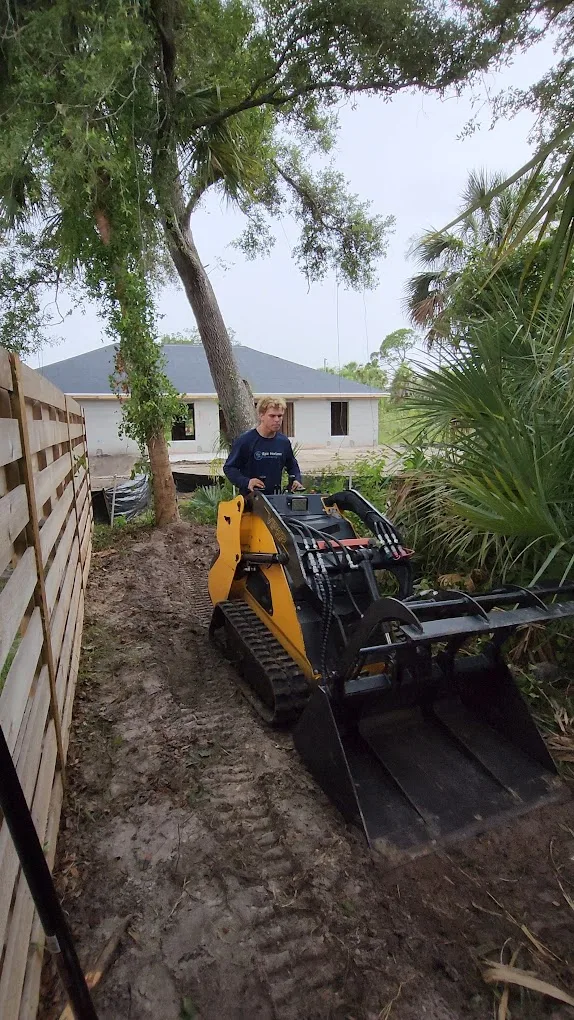
Tree removal in Englewood, FL typically runs $250 to $1,800 per tree, and tree debris removal is the line item that decides where in that range you land. Dropping the tree is the fast part. Cutting up, loading and hauling off everything it leaves behind is where the hours go, and where cheap quotes quietly leave you holding the pile.
Dennis has walked a lot of storm-wrecked yards in Englewood, North Port, Venice and Port Charlotte, especially since Ian and Milton. The question is always the same: what should this cost? Below are the ten questions people type into Google about tree and debris costs, answered in the order they ask them, with the Florida details national cost sites skip.
We'll start with the debris, because it's the part nobody budgets for until it's lying across the lawn.
how much does it cost to remove tree debris
Removing tree debris typically costs $50 to $800 for a residential yard, based on national pricing. A few branches left from a trim sit at the low end. A full yard of storm limbs, trunk sections and fronds sits at the high end, and several downed trees can push the cleanup past $1,000.
Those are national ranges for cleanup and haul-off, not an Epic Horizons price list. We price every pile after seeing it, because two piles that look the same from the street can be half a day apart in labor.
| Debris situation | Rough national range | What pushes it higher |
|---|---|---|
| Leftovers from trimming one or two trees | $50 – $200 | Picking debris out of rock beds and off a pool cage roof |
| One tree's worth of limbs and trunk rounds | $200 – $500 | Trunk diameter. Big rounds need a saw and a machine to lift |
| Storm cleanup, several trees or a whole canopy down | $500 – $1,000+ | Number of truckloads, disposal fees, limbs still hung up in other trees |
Three things move the number more than anything else:
- Weight, not just size. Green oak is heavy. A pile of palm fronds looks huge and weighs very little. Disposal is charged by weight or by load, so a short stack of oak rounds can cost more to get rid of than a mountain of fronds.
- Distance to the truck. If the truck can back up to the pile, it goes fast. If every limb gets carried through a side gate and around a pool cage, you're paying for those trips.
- How clean "clean" is. Picking up the big stuff takes an hour. Raking twigs, leaves and sawdust out of the grass and the rock beds takes another.
Read the debris line before you sign. A quote that says "remove tree" and nothing else may leave the wood stacked at your curb. In North Port that's a real problem: city code says professional tree trimmers and landscapers have to haul their own yard debris, so the city won't take what a hired crew cut. Get "all debris hauled off the property" in writing.
So why do two crews quote the same pile a couple hundred dollars apart? Mostly, it comes down to how they bill it.
how much does tree debris removal cost
Tree debris removal usually costs $50 to $200 per hour of cleanup labor when it's billed hourly, or a flat price of roughly $50 to $800 for most homes. When the debris comes from a tree the same crew just cut down, the haul-off is often built into the removal price instead of billed separately.
Same work, four ways to bill it. Here's what each one means for you:
- Hourly. Crew time multiplied by a rate. Fair on small jobs, risky on big ones, because a slow crew costs you money. Ask for a not-to-exceed number.
- Per load. Priced by how much of the truck or trailer the pile fills. Ask what a "load" means. A pickup bed and a dump trailer are very different loads.
- Flat job price. One number for the whole pile. The easiest to compare, as long as the scope says where the debris ends up.
- Built into the removal. The tree price includes chipping and haul-off. Check that stump grindings and the final raking are included too.
We quote flat. Dennis looks at the pile, the access and where the truck can park, then writes one number with chipping and haul-off spelled out. If there's a stump to grind, it's on the same page as its own line. You shouldn't need a calculator to compare two bids.
Of course, most debris starts out as a tree that's still standing. That's the bigger number.
how much money to remove a tree
Removing a tree costs $200 to $2,000 in most of the U.S., with the national average around $700 to $750. Small trees and palms in open yards land near the bottom of that range. Large oaks or pines leaning over a roof, pool cage or power line land near the top or above it.
| Tree | Approximate height | Rough national range |
|---|---|---|
| Small tree or short palm | Under 30 ft | $200 – $600 |
| Medium tree | 30 – 60 ft | $500 – $1,200 |
| Large tree | Over 60 ft | $1,000 – $2,000+ |
| Any size, hanging over a house, cage or line | Any | Priced up for rigging and sectional takedown |
Two real jobs from our own books, so you can see where actual numbers fall. In North Port, a homeowner needed one palm out before a new planting bed went in. We cut it, hauled it off and ground the stump below grade for $385 total, done before noon. In Venice, two palms stood where new pavers were going. Both came down, both stumps were ground and everything was hauled for $1,000, as part of the larger paver job.
Height is only part of the price. The rest comes from:
- What it can hit. A tree with open lawn on every side can be dropped whole. A tree over your lanai comes down in pieces, lowered on rope.
- Species. Palms have no limbs to rig and come down fast. A spreading live oak can be wider than it is tall, and every limb becomes debris.
- Condition. Dead pines turn brittle. Climbing a dead tree isn't safe, so the method changes and the price follows.
- The stump and the debris. Covered above and below.
- Permits. Some trees need city or county sign-off first. More on that in the Florida section.
Every quote should list those pieces. But a lot of homeowners aren't sure what "debris removal" on that quote even covers.
what is tree debris removal
Tree debris removal is clearing away everything a tree leaves behind after trimming, removal or a storm: branches, limbs, trunk sections, palm fronds, leaves, seed pods and stump grindings. The crew cuts it to size, chips or loads it, hauls it off the property and rakes the area clean.
It overlaps with three other services, and people use the names loosely:
- Tree removal is taking the standing tree down. Debris removal is what happens after.
- Downed tree removal sits between the two. The tree is already on the ground, so there's no felling, but there's still a trunk to section and lift.
- Land clearing is removing many trees and brush to open up a lot, usually with machines. Our land clearing page covers that.
A complete debris job on a residential yard should cover limbs and trunk rounds, chips from the chipper, fronds and seed stalks, leaves and twigs raked out of the lawn and rock beds, and grindings if a stump was ground. What it usually doesn't cover is fixing the lawn where a trunk landed or where equipment rutted wet ground. That's grading and sod work. We do both, so it can go on the same estimate. Our sod installation page explains how we regrade and level before new sod goes down.
Now, if you're staring at a pile right now and wondering whether you need to pay anyone at all, you've got options.
what to do with tree debris
You have four options for tree debris: put it out for curbside yard-waste pickup if it meets your city's size and weight limits, haul it to a county yard-waste drop-off yourself, chip it into mulch on site, or hire a crew to remove it. Whole trunks and lot-clearing debris almost never qualify for curbside pickup.
| Option | Works for | The catch |
|---|---|---|
| Curbside yard-waste pickup | Branches, fronds and trimmings you cut yourself | Size and weight limits. In North Port: pieces 4 ft or shorter, bundles 35 lbs or less and no more than 2 ft across, at the curb by 7 a.m. on pickup day |
| Haul it to a county drop-off | Moderate piles, if you own a truck or trailer | Your back, your truck, your Saturday, and possible disposal fees |
| Chip it on site | Limbs and brush | Needs a chipper. Trunk rounds won't fit a rental unit |
| Hire a crew | Whole trees, storm piles, anything heavy | Costs money. Get haul-off in writing |
Other cities and the counties set their own curbside limits, usually around 4 feet long and 40 to 50 pounds a bundle. Check your hauler's page before you start stacking, because a bundle that's too long or too heavy just sits there. North Port also won't collect debris from a lot being cleared, so a pile from a full clearing job is on you or your contractor.
Fresh chips work fine as mulch in planting beds. Keep them a few inches back from tree trunks and clear of your sprinkler heads.
After a named storm, the rules change. Counties and cities usually run separate storm-debris pickup after a declared hurricane. Keep tree debris in its own pile, apart from shingles, fencing and pool screen. Stack it at the curb, not on top of water meters, fire hydrants or storm drains, and not under power lines. Never push it into a canal or drainage swale. On canal-front lots in Port Charlotte, that's how the next heavy rain turns into a flooded street.
Curbside works for a trim. It doesn't work for a tree. So back to the tree itself, which people ask about in five slightly different ways.
how much is to remove a tree
Expect to pay $200 to $2,000 to remove one tree, and about $700 to $750 on average nationally. Around Englewood and North Port, most single-tree jobs we quote land between $250 and $1,800 with haul-off included. Height, what the tree could hit on the way down and access set the final number.
If you've been searching "tree removal near me" and collecting quotes, the spread can be wild. Usually the gap isn't in the cutting. It's in what each quote leaves out.
The quote that looks cheap
- One line: "remove tree"
- Stump cut low and left in the ground
- Wood stacked at the curb
- No mention of permits or HOA approval
- No proof of insurance offered
- Sawdust and twigs left in the grass
A complete quote (how we write ours)
- Method written out: dropped whole or taken down in sections
- Stump ground below grade, depth written in
- All wood chipped and hauled off the property
- Permit and HOA check before the first cut
- Liability coverage you can ask to see
- Lawn and beds raked clean before we leave
Dennis puts it plainly: most crews price the cut, and he prices the yard after the cut. The second number is the one you'll actually live with.
The line item people forget most often is the stump. It's also the one that comes back to bite.
how much is to remove a tree stump
Tree stump removal by grinding costs about $100 to $500 per stump nationally, with averages around $300. Many crews charge $2 to $5 per inch of diameter. Full tree root removal, where the stump and root ball are dug out with a machine, costs more because of the excavation and backfill.
| Method | What happens | Best when |
|---|---|---|
| Stump grinding | A grinder chews the stump below grade. Roots stay and break down over time | The spot becomes lawn or a planting bed |
| Full tree root removal | Stump and main roots dug out, hole backfilled and compacted | Pavers, a slab, a pool or a retaining wall is going there |
| Cut flush and leave it | Stump stays at ground level | A back corner of the lot nobody walks or mows |
Grinding is what most yards need. Here's how we handle it, and what to ask any crew you're comparing:
- Locates first. Before a grinder touches the ground, we file an 811 ticket with Sunshine 811, which Florida law requires two full business days ahead. We also walk your irrigation and landscape lighting lines, because 811 doesn't mark private lines.
- Depth in writing. We grind 6 to 12 inches below grade, depending on what's going on top.
- The hole gets handled. Extra grindings get hauled off and the hole is backfilled with clean fill so it doesn't sink into a dip a few months later. If you want the grindings for a bed, say so and they stay.
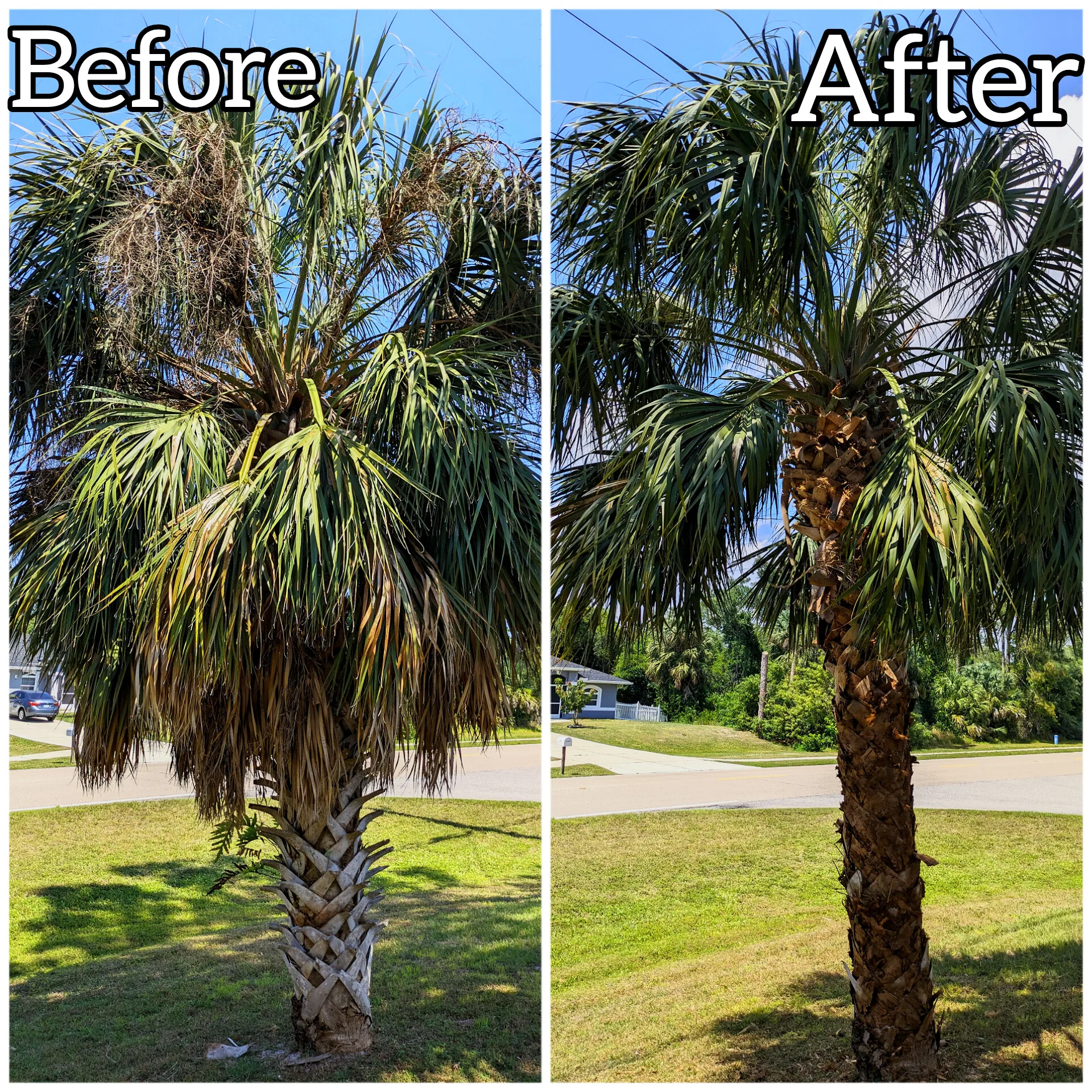
One Florida-specific warning. Brazilian pepper, carrotwood, camphor and ficus send up new shoots from roots the grinder never reached, and they do it in the rainy season, June through September. If one of those was your tree, expect to cut sprouts for a while. Our stump grinding page covers palm stumps and hardwoods in more detail.
Stumps are predictable. The backyard tree with a pool cage on one side and a fence on the other is not.
how much is it to remove a tree from your yard
Removing a tree from a residential yard usually costs $300 to $1,500. A front-yard tree a truck can reach sits at the low end. A backyard tree boxed in by a pool cage, lanai, fence or narrow side yard costs more, because it comes down in pieces and every piece gets carried out.
That describes most backyards around here. Pool cages are everywhere, side yards between homes are tight, and the fence usually sits right on the line. Here's what that does to the job:
- Sectional takedown. Instead of one cut at the base, the tree comes down a piece at a time, lowered on rope so nothing lands on the screen enclosure. It's slower and takes more hands.
- Hand carry. If no machine fits through the gate, every limb and round walks out. Compact equipment helps when the gap allows it.
- Ground conditions. In the rainy season, North Port and Port Charlotte yards stay soft for days. Heavy equipment on wet sand leaves ruts. We plan the path in and out before the first cut, and if the ground is going to take a beating, we say so and price the repair up front.
- HOA approval. In deed-restricted communities, the architectural committee often has to approve a removal even when the city doesn't require a permit. Get that letter before anything is scheduled.
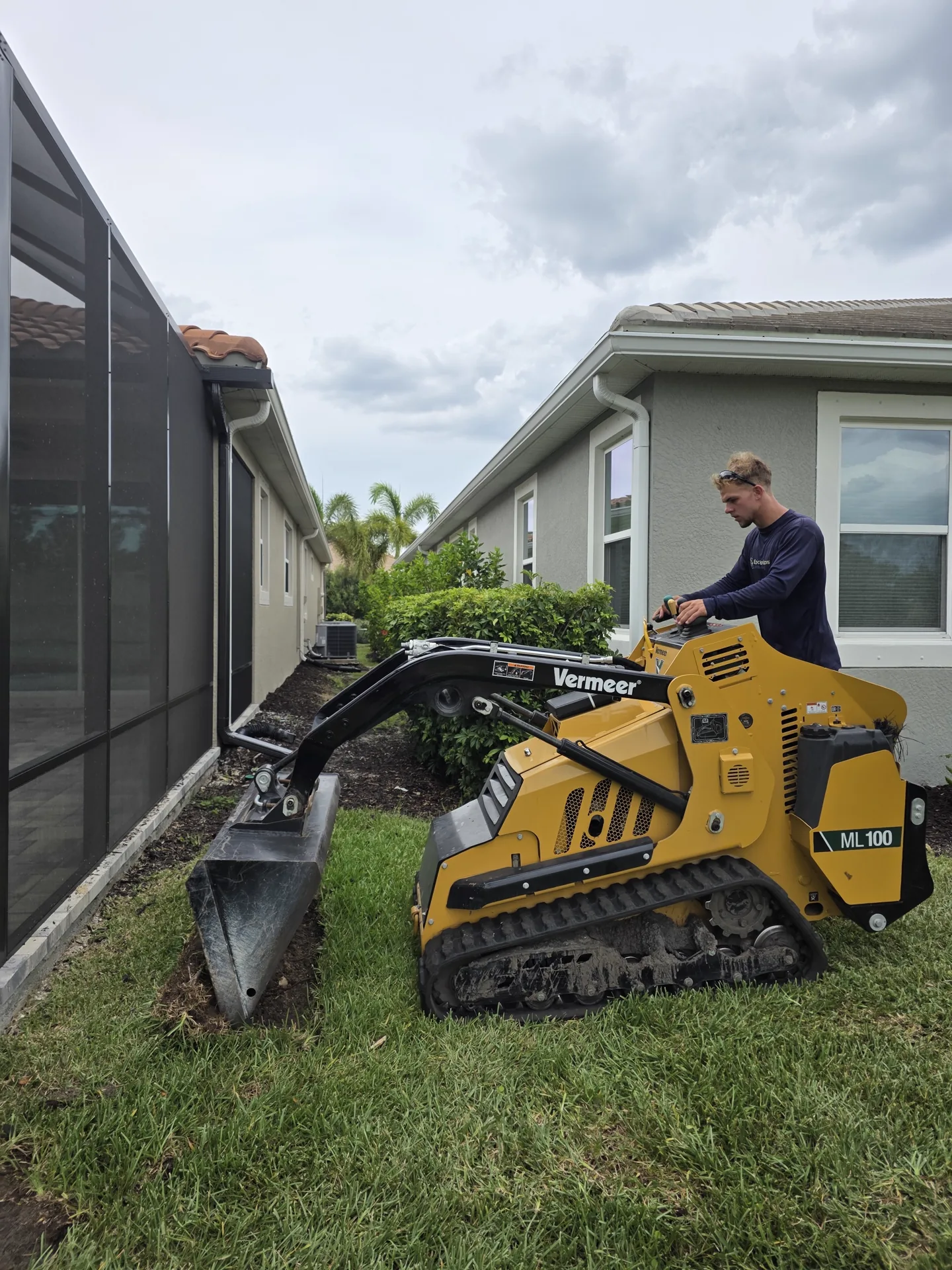
Ask every crew how they plan to get the wood out of your backyard. If they haven't thought about it, they haven't priced it either, and that cost will show up later as a change order.
All of that assumes you picked the day the tree came down. Sometimes the storm picks it.
how much is it to remove a tree that fell
Downed tree removal on open ground usually costs less than taking the same tree down standing, since there's no climbing or rigging. Expect the lower half of the $200 to $2,000 range. A tree lying on a roof, pool cage or fence costs more, and emergency tree removal during storm week costs more again.
A fallen tree is only cheaper when it fell somewhere harmless. On a structure, the crew has to take weight off the roof or cage without letting the trunk shift, and that's slow, careful work.
Two things to never do with a fallen tree. Don't go near one that's touching a power line. Stay well back and call FPL or your electric utility. And don't start cutting limbs that are bent under load. A bent limb is storing energy, and when the cut releases it, it can whip hard enough to break bones. That's the part of downed tree removal that hurts people every storm season.
Insurance. Most standard homeowners policies only pay for tree removal when the tree hit a covered structure, like your house or a fence, or when it blocks your driveway. Limits are often around $500 per tree and $1,000 per event. A tree that fell across the open yard and hit nothing is usually on you. Photograph everything before any cutting, and call your agent before you call us.
Timing. After Hurricane Milton in 2024, crews across Sarasota and Charlotte counties were booked for weeks. Trees on houses and blocked driveways go first. A tree lying in the back lawn can wait a week, and it's usually cheaper if it does.
"Did a wonderful straightening and staking my queen palm after hurricane Milton. Very nice and thorough."
Phil E, Google review
Not every storm-tilted tree has to come out. A palm that's leaning but still rooted can often be stood back up and staked, like the one above. Big hardwoods with the root plate torn out of the ground usually can't. Ask before you pay to remove something that could be saved.
Storms are the dramatic part of Florida tree work. They're not the only reason a tree here prices differently than one up north.
how much is it to remove a tree in florida
Tree removal in Florida generally costs $200 to $2,000 per tree, in line with national averages. Palms usually sit at the low end, while large oaks and pines sit near the top. Permits, storm-season demand and trees hanging over pool cages are what push Florida jobs past the national midpoint.
| Florida factor | What it does to your price |
|---|---|
| Palms | Single trunk, no limbs to rig. Most come down fast. Tall ones next to a house still get sectioned |
| Live and laurel oaks | Wide canopy and heavy wood. More debris per foot of height than a pine or a palm |
| Slash pines | Tall and straight, and often killed by lightning or storms. Dead ones turn brittle and can't be climbed safely |
| Sandy soil and a high water table | Shallow roots. Trees here tend to tip over whole, root plate and all, which leaves a bigger hole to fill |
| Local tree rules | Protected species or larger trunks can need a city or county permit. That adds lead time and fees |
| Hurricane season (June 1 – Nov. 30) | Demand spikes after a named storm. Removing a risky tree before the season is usually cheaper and faster |
The Florida permit rule most people don't know about. Under Florida Statute 163.045, if an ISA-certified arborist or a Florida-licensed landscape architect documents that a tree on your residential property poses an unacceptable risk to people or property, your city or county can't require a permit, fee or replanting to remove it. The assessment has to follow the ISA tree risk assessment standard, and the signed documentation comes from the arborist or landscape architect, not the tree crew. Keep a copy with your records.
One more Florida quirk: plenty of trees that end up coming out didn't need to. Trees planted too close to the house, palms "hurricane cut" down to a few fronds year after year, oaks lion-tailed until the canopy turned top-heavy. Good trimming now costs less than removal later. Our palm trimming field note covers the cuts that weaken palms.
That's Florida in general. Englewood and North Port each add their own twist.
Tree removal in Englewood FL and North Port: what changes the job
Englewood. Lots near Lemon Bay and the Gulf take the wind first. Australian pines, which are invasive, shallow-rooted and brittle, are common on coastal lots and are often the first to go over in a storm. Englewood also straddles the Sarasota–Charlotte county line, so which county's tree rules apply depends on which side your address falls. Rotonda West and many Cape Haze communities add their own deed restrictions on top. After a storm, speed matters more here than inland, because loose limbs in an exposed coastal yard become projectiles in the next blow. See tree service in Englewood for local jobs.
North Port. Many North Port homes sit on lots that were wooded until the house went up, so mature slash pines and oaks stand close to roofs and pool cages. The spodosol hardpan 18 to 24 inches down keeps roots shallow and holds water near the surface. That's why trees here go over in saturated ground, and why rainy-season removals can rut a yard. Deed-restricted communities like Heron Creek and the West Villages need architectural approval first. And remember the city rule: tree crews haul their own debris. More on our North Port tree service page.
Port Charlotte and Venice. Port Charlotte's canal-front lots put trees right on the seawall, where debris can't go in the water and a falling trunk can damage the wall. Venice yards near the beach and on Venice Island deal with salt exposure that stresses trees over time. Same crew, same quote format: Port Charlotte and Venice.
In every one of those cities, Dennis walks the tree before he prices it. He'll tell you whether it's a quick palm job or a sectional takedown over the lanai, whether your HOA needs to sign off, and whether the stump grinding and haul-off fit in one visit. The estimate is free. Call (941) 946-8403 or use the contact form.
Still have a question the ten above didn't cover? These are the ones we hear most on the phone.
Tree removal questions we hear on the phone
How do I pick a tree removal service near me?
Pick one that walks the tree in person, writes stump handling and haul-off into the quote, carries liability insurance and has real local reviews. Be careful with door-knockers after a hurricane. Storm chasers are a known problem in Florida. Never pay the full price up front.
What does emergency tree removal cost?
More than a scheduled removal. A tree on a house means rigging, careful weight transfer and often overtime, while every other crew is booked too. Ask for the price in writing before work starts, even in an emergency, and photograph the damage first for your insurance claim.
Is tree stump removal included in the tree removal cost?
Not always. Many quotes cut the stump flush and stop there. We list stump grinding as its own line so you can see it and decide. If sod, a planting bed or pavers are going over that spot, you want it ground.
Do I need a permit for tree removal in North Port, FL?
Sometimes. North Port has its own tree rules, and protected species or larger trunks can need a permit. HOAs add their own approval on top. We check before we quote. If an ISA-certified arborist documents the tree as an unacceptable risk, Florida Statute 163.045 takes the local permit requirement off the table.
Will homeowners insurance cover the tree removal cost?
Usually only if the tree hit a covered structure, like your house or fence, or blocks your driveway. Many policies cap tree removal around $500 per tree and $1,000 per storm. A tree that fell in the open and hit nothing is usually your cost. Check your own policy before work starts.
Can you replant after the tree comes out?
Yes. Plant installation is one of our core services, and we fertilize the new trees, shrubs and plants we put in. If the removal tore up the lawn, we regrade, level and lay new sod so water drains away from the house instead of pooling in the old stump hole.
Do you haul the debris away or leave it at the curb?
We haul it. Every tree job we quote includes chipping and haul-off, and the yard gets raked before we leave. In North Port you don't have a choice anyway, because the city expects tree crews to take their own debris.