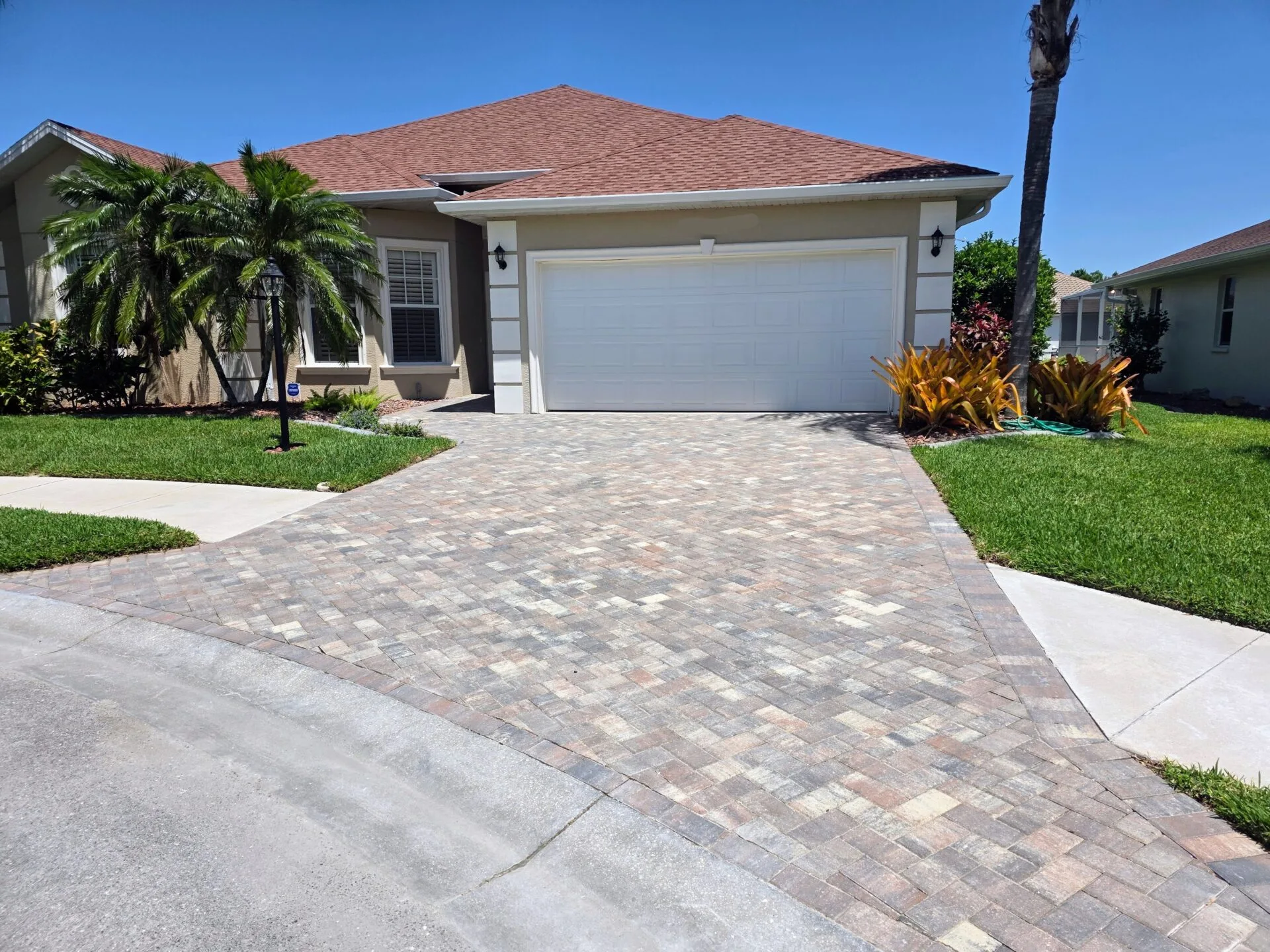
Driveway pavers cost about $12 to $22 per square foot installed in Southwest Florida, and most of that money goes into what you'll never see: the dig, the compacted rock base and the slope that moves rainwater off the driveway. The pavers on top are the easy part.
We're Epic Horizons Landscaping out of North Port. Dennis started the company in 2022, and our crew builds paver driveways, patios and walkways in North Port, Venice, Port Charlotte and Englewood. Dennis walks every driveway before he puts a number on it. A quote written off a satellite photo can't see the low corner that holds water every August.
Below are straight answers to what people actually type into Google about pavers for driveway jobs: cost, base, gravel, sand, paver size and sealing. The answer comes first in every section. The Florida details come after it.
Installed cost: $12–$22 per sq ft for concrete pavers, $20–$30 for travertine.
Typical two-car driveway (400–600 sq ft): roughly $5,000 to $13,000.
Base: 6 to 8 inches of compacted limerock.
Bedding sand: 1 inch, screeded flat.
Paver thickness: 60 mm minimum, 80 mm for trucks and trailers.
Sealing: optional. Every 2 to 4 years if you do it.
how much for pavers driveway
A paver driveway costs about $12 to $22 per square foot installed in Southwest Florida with concrete pavers, and $20 to $30 per square foot with travertine. If an old concrete driveway has to be torn out first, add roughly $2.50 to $4.50 per square foot. Most two-car driveways land between $5,000 and $13,000.
That's a wide range, and it should be. Four things decide where your driveway lands in it:
- What's there now. Bare dirt or old rock is cheap to start from. A cracked concrete slab has to be broken up, loaded and hauled to the dump, and that's real machine time plus disposal fees.
- How much dirt has to move. We dig deep enough for the base, the sand and the paver. If your driveway sits low and holds water, we also regrade so the new surface sheds water toward the street or swale instead of the garage.
- The paver and the pattern. A standard concrete paver in a simple pattern is the cheapest combination. Travertine, herringbone and a contrasting border all add cuts and labor.
- Shape and access. A straight rectangle goes fast. Curves, flares at the street and a side yard too narrow for the skid steer slow everything down.
Notice what's missing from that list: the brand of paver. Two driveways with the exact same pavers can be $4 a foot apart because one needed the old slab hauled off and a low corner regraded. When you compare two quotes, compare what's under the pavers first.
So why would anyone pay $12 a foot or more when plain concrete costs about half that? The answer shows up the first time your concrete cracks.
how much for paving driveway
Paving a driveway in Southwest Florida runs about $1 to $4 per square foot for gravel or shell, $3 to $7 for asphalt, $6 to $10 for poured concrete, $12 to $22 for concrete pavers and $20 to $30 for travertine. On a 500-square-foot driveway, that's anywhere from $500 to $15,000 depending on the surface.
| Surface | Installed cost per sq ft | 500 sq ft driveway | How it handles SW Florida |
|---|---|---|---|
| Gravel or crushed shell | $1–$4 | $500–$2,000 | Drains well, but ruts, scatters and tracks into the garage |
| Asphalt | $3–$7 | $1,500–$3,500 | Softens in July sun and doesn't like standing water |
| Poured concrete | $6–$10 | $3,000–$5,000 | Solid until the sand under it moves, then it cracks |
| Concrete pavers | $12–$22 | $6,000–$11,000 | Flexes with the ground; a sunk or stained paver gets pulled and reset |
| Travertine pavers | $20–$30 | $10,000–$15,000 | Stays cooler underfoot; softer stone that stains without care |
Concrete is the most common driveway in our area, and it's a fair choice on stable ground. The trouble is that ground here isn't very stable. Our soil is mostly sand. It settles, it washes out along the edges in a hard rain, and oak roots lift whatever sits on top of them. A slab can't flex, so it cracks. Patch the crack and you've got a gray scar that never matches.
Concrete driveway pavers handle the same movement differently. Each paver is its own piece, so when the ground shifts a little, the joints take it. If a section sinks or a root heaves it, we pull those pavers, fix the base underneath and set the same pavers back. You can't do that with a slab.
Asphalt is rare on homes down here. Gravel and shell are the budget pick, and we'll get to them in the gravel section below.
Once you've settled on pavers, the next question is what you're actually paying for inside that per-foot number. That's where a cheap bid hides its shortcuts.
how much do pavers for driveway cost
The pavers themselves cost about $3 to $6 per square foot for concrete and $5 to $10 for travertine at a supply yard. That's material only. Base rock, bedding sand, joint sand, edging, equipment, labor and haul-off are what take a finished driveway to $12 to $22 per square foot.
Here's what a complete driveway quote should cover, in the order the work happens:
- Demo and haul-off of the old concrete, rock or grass.
- Excavation to roughly 10 to 12 inches below finished grade, enough room for the base, the sand and the paver.
- Compacting the native soil before any rock goes in.
- 6 to 8 inches of limerock base, spread and compacted in layers.
- 1 inch of bedding sand, screeded flat.
- Pavers, cuts and border, laid in the pattern you picked.
- Edge restraint on every open edge, either a concrete border or spiked edging.
- Polymeric sand swept into the joints and set with water.
- A final pass with the plate compactor over the finished pavers, then cleanup.
If a bid is one line that reads "install pavers, $X," ask one question: how deep is the base? A crew that answers in inches has thought about it. A crew that says "plenty" hasn't. If you're weighing a weekend DIY job instead, our field note on DIY pavers vs. hiring a contractor walks through the real tool and material list.
Every line on the left saves the installer money on day one. Every one of them shows up later, usually in the first rainy season, when the tire paths start sinking into shallow dips.
"Dennis did a great job on our paver driveway! It is truly beautiful."
Karen Appel, Google review
Line items help you read a quote. What most people want, though, is a total for a driveway shaped like theirs.
how much does a driveway with pavers cost
A driveway with pavers in Southwest Florida usually costs $3,600 to $6,600 for a 300-square-foot one-car driveway, $4,800 to $13,200 for a two-car driveway of 400 to 600 square feet, and $9,600 to $17,600 for 800 square feet. Those are concrete paver prices. Travertine and concrete tear-out both add to them.
| Driveway | Typical size | Concrete pavers ($12–$22/sq ft) | Travertine ($20–$30/sq ft) | Add for concrete tear-out |
|---|---|---|---|---|
| One-car | 300 sq ft (12 × 25 ft) | $3,600–$6,600 | $6,000–$9,000 | $750–$1,350 |
| Standard two-car | 400 sq ft (20 × 20 ft) | $4,800–$8,800 | $8,000–$12,000 | $1,000–$1,800 |
| Long two-car | 600 sq ft (20 × 30 ft) | $7,200–$13,200 | $12,000–$18,000 | $1,500–$2,700 |
| Two-car plus turnaround | 800 sq ft | $9,600–$17,600 | $16,000–$24,000 | $2,000–$3,600 |
To size your own, measure the length and width of the driveway in feet and multiply. Add the apron at the street, the walk to the front door if it's part of the job, and about 5 to 10 percent for cuts. Our paver calculator does the math for you, and our North Port paver cost breakdown covers patios and pool decks too.
A few Southwest Florida items change the total in ways national price guides never mention:
- HOA approval. Most HOA communities, from Heron Creek and the West Villages in North Port to Stoneybrook in Venice, want the paver color, pattern and border approved in writing before work starts. Get that approval before you lock in a start date.
- The apron and the swale. The strip between your property line and the street is often city right-of-way, and plenty of North Port driveways cross the roadside swale over a culvert pipe. Work there can need a permit. Ask about it at the estimate, not after the dig.
- Drainage. If your driveway holds water now, the fix belongs in the base and the grade. New pavers on the same low spot just give you a nicer-looking puddle. Some jobs need grading and drainage work first.
Each of our four cities adds its own wrinkle. North Port's low lots hold water. Venice has shell in the soil and salt air near the beach. Port Charlotte has a lot of canal-front lots. Englewood's sand works its way into every joint and bed. We cover each one on our pages for paver installation in North Port, Venice, Port Charlotte and Englewood.
All of those numbers assume a concrete paver. If you've been reading British sites, you've seen the same product sold under a different name.
how much block paving driveway
Block paving is the British name for concrete interlocking pavers, so a block paving driveway costs the same as a concrete paver driveway: about $12 to $22 per square foot installed in Southwest Florida, or roughly $130 to $240 per square meter. A 500-square-foot block paving driveway runs about $6,000 to $11,000.
The system is the same on both sides of the Atlantic: a compacted stone sub-base, a thin bed of sand, the blocks, then sand in the joints. The standard UK block is 200 × 100 mm, which is close to the 4 × 8-inch paver we lay here.
What changes is the weather the driveway has to survive. British guides worry about frost heaving the base. We never see frost under a driveway, but one summer storm here can drop more rain in an afternoon than London averages in a week. That's why we lock joints with polymeric sand. Plain dry sand, which UK installers commonly brush in, washes out of Florida joints within a season or two and turns into a weed bed.
Don't bother converting UK prices, either. Pounds per square meter in Surrey have nothing to do with labor, limerock and dump fees in Sarasota or Charlotte County.
Whatever you call it, the block is only as good as the rock under it. That's the most important number on any driveway, so let's get specific.
how much paver base for driveway
A paver driveway needs 6 to 8 inches of compacted base rock. For a 400-square-foot driveway at 6 inches, that's about 7.4 cubic yards, or roughly 13 tons. At 8 inches it's about 17 tons. Patios and walkways only need about 4 inches, because they never carry a car.
The math is simple. Multiply the square footage by the base depth in inches, divide by 12, then divide by 27. That gives you compacted cubic yards. Base rock shrinks as it's compacted, so supply yards sell it by the ton: multiply cubic yards by about 1.75 to get the tons to order.
| Driveway size | 6-inch base | 8-inch base |
|---|---|---|
| 300 sq ft | 5.6 cu yd / about 10 tons | 7.4 cu yd / about 13 tons |
| 400 sq ft | 7.4 cu yd / about 13 tons | 9.9 cu yd / about 17 tons |
| 600 sq ft | 11.1 cu yd / about 19 tons | 14.8 cu yd / about 26 tons |
| 800 sq ft | 14.8 cu yd / about 26 tons | 19.8 cu yd / about 35 tons |
In Southwest Florida, that base is almost always crushed limerock. It's angular, it's local, and when it's wetted and compacted a few inches at a time it gets close to rock-hard. We run the plate compactor over each layer before the next one goes down. Dumping 8 inches and compacting only the top firms up the top couple of inches and leaves loose rock underneath.
When do we go 8 inches instead of 6? When an RV, boat trailer or work truck parks on it, or when the soil stays wet. Wet soil is common in North Port, where a lot of yards have a hardpan layer 18 to 24 inches down that keeps rain from soaking away. In a normal year of about 58 inches of rain, the sand above that layer can stay soaked for weeks. Soaked sand is weak sand, and a thin base on top of it is where tire ruts start.
The 50-pound bags of paver base at the home store are fine for a garden path. A 400-square-foot driveway at 6 inches takes roughly 13 tons of base. In 50-pound bags, that's about 520 of them. Driveways get bulk deliveries.
Some people search for this layer as gravel instead of base. Same layer, same depth, but the kind of gravel matters more than most people expect.
how much gravel for paver driveway
Plan on about 1 ton of gravel for every 30 square feet of paver driveway at 6 inches deep, or 1 ton for every 23 square feet at 8 inches. A 400-square-foot driveway takes roughly 13 to 17 tons. Use crushed, angular rock that locks together when compacted. Rounded pea gravel or river rock never firms up.
Here's how the common options stack up under a driveway:
- Crushed limerock. The Southwest Florida standard. Fine and coarse pieces are mixed together, so it packs tight.
- Crushed concrete. Recycled concrete crushed to a similar mix. It compacts well and is a common substitute when the price is right.
- #57 stone. Clean, washed stone with no fines. It drains fast and belongs under permeable paver systems, which are built differently from a standard driveway. It doesn't lock up the way a dense base does.
- Pea gravel and river rock. Round stones roll against each other forever. Great in a planting bed, useless under a car.
Some of you landed here because you're weighing a gravel driveway against pavers. A clean rock driveway with a defined edge is a real budget option at $1 to $4 a foot. Lynn had us clean up an existing gravel driveway and line it with stone:
"Dennis and crew did a fantastic job on cleaning up my gravel driveway. They lined it With beautiful stones. It really improved the appearance. I highly recommend them for your landscaping needs."
Lynn Tosi, Google review
Gravel needs raking and topping up every so often, and it tracks into the garage. Pavers need far less upkeep. If the budget is there, pavers win. If it isn't, a well-edged rock driveway beats a cheap paver job every time.
Base and gravel are the heavy part of the job. Sand is the opposite problem: crews get it wrong by using too much.
how much sand for driveway pavers
Driveway pavers need a 1-inch layer of bedding sand, which works out to about 1 cubic yard for every 300 square feet, plus polymeric sand for the joints. A 400-square-foot driveway takes roughly 1.25 cubic yards of bedding sand and 5 to 10 fifty-pound bags of polymeric sand.
Those are two different sands doing two different jobs:
- Bedding sand is coarse, washed concrete sand. We spread it over the compacted base, pull a straight screed board across 1-inch rails, and set the pavers on that flat bed. Play sand and the native sand from your yard are too fine and hold water.
- Polymeric sand goes in the joints after the pavers are down. It's sand mixed with a binder that hardens when you mist it with water, which keeps the joints from washing out and makes it much harder for weeds to take root.
| Driveway size | Bedding sand (1 inch) | Polymeric sand (50-lb bags) |
|---|---|---|
| 300 sq ft | About 0.9 cu yd | 4–8 bags |
| 400 sq ft | About 1.25 cu yd | 5–10 bags |
| 600 sq ft | About 1.85 cu yd | 8–15 bags |
| 800 sq ft | About 2.5 cu yd | 11–20 bags |
Polymeric coverage depends on joint width. A 50-pound bag covers roughly 40 to 75 square feet, and less with tumbled pavers that have wide, rounded edges. Check the coverage chart printed on the bag you're buying.
If a crew dumps 2 or 3 inches of sand to hide a lumpy base, the driveway looks perfect on day one. Then the rainy season soaks that sand, tire weight pushes it sideways, and the pavers sink in the wheel paths. All of the grade belongs in the compacted rock. The sand is only a bed.
Timing matters with polymeric sand down here. It needs dry pavers and a few dry hours to set. In July we sweep it in early, because the afternoon storm shows up most days around 3. Rain on fresh poly sand washes the binder out and can leave a haze on the pavers.
Now the part you'll actually look at every day. Not every paver can take the weight of a car, and the wrong one cracks fast.
what size pavers for driveway
Use pavers at least 2⅜ inches (60 mm) thick for a driveway, and 3⅛ inches (80 mm) thick if you park a truck, RV or boat trailer on it. Stick to smaller face sizes like 4 × 8, 6 × 6 or 6 × 9 inches. Slabs 12 inches and larger tend to crack or rock under tires.
The paving industry's rule of thumb for vehicle areas: the long side of a paver should be no more than three to four times its thickness, and closer to three for heavy vehicles. A 4 × 8 at 60 mm comes in around 3.4, which is fine for a home driveway. A 6 × 9 is better at 80 mm. A 16 × 16 slab would need to be about 4 inches thick to qualify, which is why big slabs stay on patios.
| Paver | Thickness | Driveway use |
|---|---|---|
| 4 × 8 in (brick style) | 60 or 80 mm | Yes. The classic driveway paver, strongest in herringbone |
| 6 × 6 in | 60 or 80 mm | Yes |
| 6 × 9 in | 80 mm | Yes, at 80 mm |
| Tumbled multi-size sets | 60 to 80 mm | Yes, if the largest piece passes the three-to-four-times rule |
| 12 × 12 in and larger slabs | Usually 60 mm or less | Patios and walkways, not under tires |
| Travertine, 3 cm (1¼ in) | 30 mm | Made for pool decks and patios. For cars, ask for thicker driveway-grade stone |
Pattern matters as much as size. Herringbone, laid at 45 or 90 degrees, locks every paver against its neighbors in both directions, so turning tires can't walk it out of line. Running bond and basketweave look great on a patio but can creep on a driveway where cars turn in and out every day.
Color matters in our sun. Dark charcoal pavers get hot enough in summer to feel through flip-flops. Light tan shows oil drips and the brown tannin stains oak leaves leave behind. A blended color hides the most. If you're in an HOA, the color also has to match whatever the committee approves.
One more trap: patio concrete pavers sold in the same aisle can be thinner than driveway pavers. If the pallet says "patio," check the thickness before it goes under your car.
Pick the right paver, set it on the right base, and the driveway will outlast your roof. Whether it still looks new in ten years comes down to the last question: sealing.
how often should driveway pavers be sealed
If you seal driveway pavers in Southwest Florida, plan on resealing every 2 to 4 years, since our sun breaks sealer down faster than northern weather does. Wait at least 90 days after installation before the first coat. Sealing is optional. It helps color and stain resistance. It does nothing to make a weak base stronger.
That 90-day wait gives new concrete pavers time to push out efflorescence, the white chalky film that shows up on fresh pavers. Seal over it and you lock it under the coating.
For driveways, we lean toward penetrating sealers over high-gloss film-forming ones. Film sealers can trap moisture in our humidity, turn cloudy and get slick when wet. Penetrating sealers soak in, keep the paver's natural texture and are much more forgiving to apply.
You'll know it's time to reseal when water stops beading on the surface, the color looks washed out, or joint sand starts loosening. The pavers need to be clean and fully dry for a day or two first, and the forecast has to cooperate. That's easier in the dry season, November through April, than in the middle of summer.
Plenty of paver driveways around here have never been sealed and still look fine. For the full case for and against, read our field note on paver sealing in Florida. Dennis will also tell you straight on the estimate whether your pavers and your trees make sealing worth the money.
The questions below are the ones Dennis hears on almost every driveway estimate.
Frequently Asked Questions
Is a paver driveway better than poured concrete?
For most Southwest Florida homes, yes, if the budget allows. Pavers cost roughly twice as much as poured concrete up front. In return, they flex with our sandy soil instead of cracking, and a damaged section can be lifted and relaid with the same pavers. Concrete is cheaper and fine on stable ground, but any crack you patch will show.
Who installs driveway pavers near me in North Port, Venice or Port Charlotte?
We do. Epic Horizons builds paver driveways in North Port, Venice, Port Charlotte and Englewood. Wherever you search "pavers near me," ask every company that comes out how deep the base is, how they compact it and what holds the edges. Call Dennis at (941) 946-8403 or use our contact form. Estimates are free.
Can I use the same pavers for my driveway and backyard patio?
Usually, and matching your backyard pavers to the driveway ties the whole house together. A driveway-rated paver works fine on a pavers patio. The reverse isn't always true, because some patio concrete pavers and most large slabs are too thin or too big for car weight. A patio needs about 4 inches of base. A driveway needs 6 to 8.
Are travertine pavers good for a driveway in Florida?
Yes, with the right thickness and some care. Travertine stays cooler than concrete in direct sun, which is why it's on so many pool decks here. For a driveway, ask for stone rated for vehicles rather than thin pool-deck pavers. It's softer and more porous, so oil and tannin stains need fast cleanup, and most owners seal it. Expect about $20 to $30 per square foot installed.
What about bluestone pavers for a driveway?
Bluestone pavers come mostly from quarries in Pennsylvania and New York, so they cost more to get to Southwest Florida, and the dark blue-gray stone gets very hot in summer sun. They also need to be thick to carry a car. We rarely see bluestone on driveways here. Most people who like the look end up with a gray concrete paver or a cool-toned travertine.
Do I need HOA or city approval for a paver driveway?
Usually. Most HOA communities in North Port and Venice want the color, pattern and border approved in writing. The apron near the street often sits in city right-of-way, and work there can need a permit. Sort out both before you set a start date.
How long does a paver driveway take to install?
Most two-car paver driveways take about 3 to 5 working days. Tearing out old concrete, regrading a low driveway or a week of afternoon storms can add time. Most polymeric sands want about 24 hours before foot traffic and a couple of days before cars, so plan on parking in the street briefly.