
A land clearing company charges for three things: machine hours, what happens to the debris, and the risk of dropping trees near your house. Everything else on the quote hangs off those three. Dennis walks every wooded or overgrown lot before we price it, across North Port, Venice, Port Charlotte and Englewood, and the questions people ask before they call are almost always about money.
So that's where we start. Below are the exact questions people type into Google about land clearing companies: what they charge, what they make, what their insurance costs, and whether the business is worth getting into. If you're a homeowner, the "what they make" part matters more than you'd think. It's how you read a quote.
how much does a land clearing company charge
Most land clearing companies charge $1,500 to $6,000 to clear a typical residential lot under one acre. Machine time with a forestry mulcher runs about $150 to $400 an hour, or $1,500 to $2,500 for a full day. Stump removal, hauling debris off site, and dense or wet ground push the price higher.
Those are national figures from equipment and cost guides, not our price list. Every Epic Horizons quote comes after Dennis walks the lot, because the same quarter acre can be a one-day mulching job or a multi-day cut, grind and haul.
How the land clearing cost gets calculated matters as much as the number. Companies price jobs one of four ways:
| Pricing method | How it works | Where you'll see it |
|---|---|---|
| Per hour | Machine and operator, clock running | Brush, fence lines, small cleanups. You carry the risk if it runs long. |
| Per day | Flat rate for a machine and operator | Mulching larger open areas |
| Per acre | Rate times acreage, adjusted for how thick the cover is | Rural parcels, one acre and up |
| Per job | One fixed price for a written scope | Residential lots. This is how we quote. |
On a home lot, ask for a fixed price with the scope spelled out: which trees, which stumps, where the debris goes. Hourly billing on a lot nobody walked is how a quote quietly doubles.
"Dennis was polite and very informative. Told me prices right up front did a great job. Will be back again next year. Thanks again guys."
Ron Hoffman, Google review
Per-lot pricing is normal for homes. But once your land is bigger than a lot, the talk switches to acres, and that's where the ranges get wide.
how much do land clearing companies charge per acre
Land clearing companies typically charge about $500 to $2,000 per acre for light brush, $2,000 to $5,000 per acre for moderate woods, and $5,000 to $10,000 or more per acre for dense timber with stump removal and haul-off. Forestry mulching that leaves the chips on site often runs $400 to $1,500 per acre.
| What's on the land | Typical per-acre range | What you get for it |
|---|---|---|
| Light brush, saplings, palmetto | $500 – $2,000 | Cut or mulched, low ground disturbance |
| Moderate woods, mixed pine and oak | $2,000 – $5,000 | Trees down, some stumps out, some hauling |
| Dense timber, large trees | $5,000 – $10,000+ | Heavy equipment, stumps pulled, debris hauled |
| Forestry mulching only | $400 – $1,500 | Brush shredded in place, stumps left low |
| Large rural acreage, light cover | $200 – $600 | Volume pricing on big open parcels |
Per-acre math breaks down on small lots. Most North Port lots were platted at 80 by 125 feet, roughly a quarter acre, and a company still has to load a machine, haul it over and unload it no matter how small the job is. That's why small lots cost more per acre than big ones.
Three things push a SW Florida acre toward the top of its range:
- Wet ground. Through the rainy season, low lots hold water and machines rut the ground or get stuck. In North Port, the hardpan layer under the sand keeps water near the surface after a storm, so clearing gets scheduled around the weather.
- Invasives. Brazilian pepper and melaleuca come back from the roots. A crew that only knocks down the tops leaves you a thicker mess by next summer. Getting the roots out costs more up front and less over time.
- Permits and protected species. Before clearing within 25 feet of a gopher tortoise burrow, Florida requires the tortoises be relocated under an FWC permit by an authorized agent. The City of North Port, Sarasota County and Charlotte County each have their own tree rules too. That's paperwork and lead time, and it belongs in the price.
We broke down the tree side of this in our forest clearing services field note. Ranges are fine for budgeting, though. What you really want is a number for your own lot, and you can get close before anyone shows up.
A land clearing cost calculator you can run on the back of an envelope
You don't need an app. A land clearing cost calculator is really five lines of math. Fill these in and you'll know whether a bid is in the ballpark.
| Line | How to figure it | National range |
|---|---|---|
| 1. Clearing | Acres times the per-acre rate for your cover. Under half an acre, use the per-lot range instead. | $1,500 – $6,000 per lot, or the per-acre table above |
| 2. Stumps | Count the stumps you want gone, times the per-stump cost | $75 – $400 per stump |
| 3. Debris | Mulched on site is cheapest. Chipped and hauled is cleaner and costs more. | Get it written into the quote |
| 4. Permits and surveys | Tree permit, plus a tortoise survey if burrows are present | Varies by city and county |
| 5. Grading | Needed before sod, pavers or a slab | Quoted separately or bundled |
Here's a worked example. Say you have half an acre of moderate pine and palmetto in Port Charlotte, with 12 stumps you want ground out. Line 1: 0.5 × $2,000 to $5,000 = $1,000 to $2,500, which bumps up to the per-lot minimum. Line 2: 12 × $75 to $400 = $900 to $4,800. So you're looking at roughly $2,400 to $7,300 before debris, permits or grading.
Wide, yes. Stump size alone can swing a quote by thousands, and that's exactly why a walk-through beats a phone quote.
Tip from Dennis: Before you call anyone, walk the lot and count three things: stumps you want gone, trees bigger than about a foot across, and any holes in the ground that look like burrows. Take photos. You'll get a tighter estimate, and you'll know right away if a land clearing contractor quotes you without asking about any of it.
Now flip it around. Once you see those hourly rates, the next question is obvious: how much of that is profit? More than some trades. Less than you'd guess.
how much do land clearing companies make
Land clearing companies typically bill $150 to $400 per machine hour and keep roughly 20 to 40 percent as net profit after equipment payments, fuel, insurance, maintenance and labor, according to equipment-industry estimates. Margins run higher for owners with paid-off machines and lower for new operators still carrying equipment loans.
Here's why that matters to you as the customer. The hourly rate isn't the crew's take-home. A forestry mulcher burns fuel all day and wears through its cutting teeth, and the machine payment shows up every month whether it rained all week or not.
how much do land clearing companies make a year
A land clearing company running one compact track loader with a forestry mulcher grosses about $200,000 to $350,000 a year when fully booked in a midsize market. Solo and small-crew operations range from about $100,000 to more than $500,000 a year. Bigger outfits with several machines and commercial contracts gross well beyond that.
The math behind those numbers is simple. It's billable hours times rate:
| Billable hours a week | Hourly rate | Weekly gross | Yearly gross (52 weeks) |
|---|---|---|---|
| 20 | $175 | $3,500 | $182,000 |
| 25 | $200 | $5,000 | $260,000 |
| 30 | $250 | $7,500 | $390,000 |
That's gross, before fuel, labor, machine payments and insurance. And nobody here bills 52 weeks. In SW Florida, rainy-season washouts and storm weeks make sure of that.
how much do land clearing business make
The owner of a one-machine land clearing business typically takes home about $60,000 to $130,000 a year after equipment financing, insurance, fuel and an operator's wage. Where an owner lands in that range depends on billable hours, whether the machine is paid off, and how much of the day goes to driving instead of cutting.
The swing factors look like this:
- Utilization. A machine sitting on the trailer still costs money. The owners who do well keep it working.
- Equipment debt. A paid-off mulcher changes the whole picture.
- Travel and mobilization. Hauling a machine 40 minutes to a quarter-acre lot eats into the day.
- Weather. Storm years bring a burst of cleanup work, then it drops off. You can't plan a business around hurricanes.
how much can a land clearing business make
In peak season, one operator running a dozer and a skid-steer mulcher on four to six residential jobs a week can bill $8,000 to $15,000 a week. Multi-machine land clearing companies with commercial site contracts can gross well past $500,000 a year. The ceiling is set by machines, operators and steady work.
That ceiling is real. So is the floor. When one bid comes in far below the others, ask yourself what got cut to get there. It's usually stump work, the haul-off, or insurance. The first two you'll see on your lot. The third one you won't see at all until something goes wrong.
how.much is insurance for a land.clearing.company
General liability insurance for a land clearing company typically costs about $3,000 to $10,000 a year for $1 million in coverage, according to industry guides. That's several times what a mowing or landscaping business pays. Workers' compensation, equipment coverage and commercial auto are separate policies that add to the total.
For comparison, Insureon reports landscaping businesses pay a median of about $530 a year for general liability. Land clearing costs more to insure because the risk is bigger: falling trees, flying debris, heavy machines on soft ground next to someone's pool cage.
| Policy | What it pays for | What to know |
|---|---|---|
| General liability | Damage to your house, fence, driveway or a neighbor's property, and injuries to people who aren't on the crew | $1 million minimum. Commercial jobs often require $2 million. |
| Workers' compensation | Crew injuries on your property | Florida law counts clearing as construction, so it's required with even one employee. Owners can exempt themselves, not their workers. |
| Inland marine (equipment) | The mulcher, skid steer and attachments | Priced on what the machines are worth |
| Commercial auto | Trucks and trailers hauling machines and debris | Personal auto policies usually exclude business use |
Check before anyone unloads a machine. Ask for a certificate of insurance sent straight from the contractor's agent, with your name on it as certificate holder. Then look the company up on the Florida Division of Workers' Compensation proof-of-coverage search online. If an uninsured crew drops a pine on your neighbor's lanai cage, you could end up making a claim on your own policy.
We carry liability insurance on every job, and we'll send the certificate if you ask. Add it all up, though: expensive machines, expensive premiums, rain days. Is any of this actually worth it for the people running it?
is land clearing profitable
Yes. Land clearing is profitable for operators who keep their machines busy, with net margins commonly cited at 20 to 40 percent. It turns unprofitable fast when equipment sits idle, when bids leave out stumps or hauling, or when one uninsured accident wipes out a season of earnings.
What separates the profitable ones is mostly discipline. They walk every lot before they bid. They write the debris plan into the quote. And they don't underbid the dense jobs just to win them, because a dense acre can take twice as long as it looks from the road.
is land clearing a good business
Land clearing is a good business if you can finance the equipment, carry the insurance and keep a steady stream of work coming in. Startup costs are high: a used forestry mulcher and skid steer alone run roughly $35,000 to $115,000. Demand is strongest in growing areas where new homes keep going up.
Used equipment prices from industry guides give you a sense of the buy-in: about $15,000 to $60,000 for a forestry mulcher, $20,000 to $55,000 for a skid steer, $30,000 to $120,000 for a dozer, and $40,000 to $130,000 for an excavator. That's before a truck and trailer.
The demand side describes North Port and the Port Charlotte area pretty well. North Port was platted decades ago with far more lots than homes, and those empty lots keep getting built on.
Dennis will be straight with you about where Epic Horizons fits. We're not a pure land clearing company. We're a landscaping company that clears land, and that's on purpose. A cleared lot is the start of the job, not the end. Somebody still has to grade it so water runs away from the slab, then put down sod or rock and get plants in the ground. When one crew handles all of it, nobody's waiting on the next contractor and nothing gets lost in the handoff.
"We had the two brothers do raking in the backyard after the hurricane and did a great job. We also had them help us with clearing of a lot next to us and the also put 140 bags of mulch in our backyard and did a great job and in short time. We will be hiring them again to help with lawn maintenance."
Peggy Keller, Google review
Which brings us back to the most basic question on the list. The answer covers more ground than most people think.
what is land clearing
Land clearing is removing trees, stumps, brush, rocks and debris from a piece of land so it can be used for something else, like a home, driveway, pool, pasture or yard. It can mean a full clear down to bare ground, or a selective clear that keeps the good trees and takes out everything else.
Land clearing services usually come down to one of these jobs:
- Underbrushing. The brush, vines and saplings come out. The big trees stay. Good for opening up a wooded backyard.
- Selective clearing. Specific trees come down for a pool, a driveway or a view. The rest are protected.
- Forestry mulching. A machine shreds brush and small trees in place and leaves the mulch on the ground. Fast, and easy on the soil. See our forestry mulching page.
- Full clearing. Trees, stumps and roots all come out so the ground is ready to build on. Usually paired with stump grinding.
- Storm cleanup. Downed trees and debris piles after a hurricane. We covered that in tree debris removal.
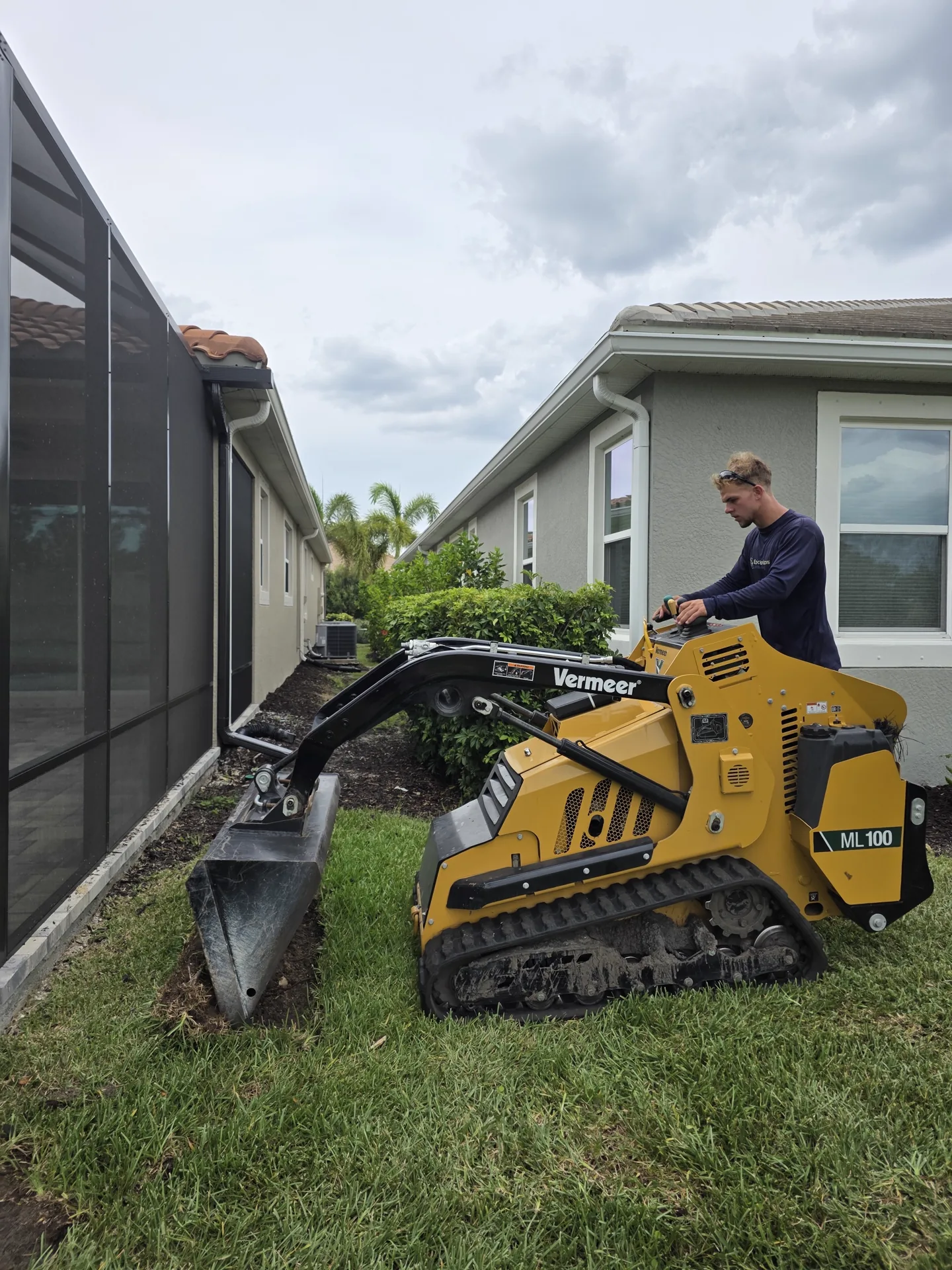
Clearing leaves loose, uneven sand behind. Before sod, pavers or a slab go down, that ground needs grading and leveling so water drains away from the house instead of sitting against it. We handle that part too, through our grading and drainage work, and then sod installation if you want grass.
If your lot is in North Port, Venice, Port Charlotte or Englewood, call Dennis at (941) 946-8403. He'll walk it, tell you what's actually there, and give you a fixed written price. The estimate is free. More on how we work is on our land clearing page.
Frequently asked questions
How do I find good land clearing companies near me?
Look for a company that walks the lot before it quotes, puts stumps and debris in writing, sends proof of insurance, and has real local reviews. If you're searching for land clearing companies near me in Sarasota or Charlotte County, Epic Horizons covers North Port, Venice, Port Charlotte and Englewood.
What should I ask land clearing contractors before hiring one?
Ask four things. Is the price fixed or hourly? Which stumps come out, and how deep? Where does the debris go? Who checks permits and gopher tortoise burrows? Land clearing contractors who can't answer those clearly will likely surprise you on the invoice.
Is a land clearing service the same as tree removal?
Not quite. Tree removal takes down specific trees. A land clearing service opens up a whole area, which can mean brush, stumps, roots and debris too. Most crews that clear land also remove single trees.
How fast can I get a land clearing estimate near me?
With us, usually after one site visit. Send Dennis photos and your address, and he'll set a time to walk the lot. A real number for land clearing near me needs eyes on the ground, because stumps, wet spots and burrows don't show up in photos.
Is "forrest clearing" the same as forest clearing?
Yes. "Forrest clearing" is a common misspelling. Forest clearing means removing trees and undergrowth from wooded land, which is one type of land clearing.
Do I need a permit to clear my lot in SW Florida?
Often, yes. The City of North Port, Sarasota County and Charlotte County each set their own tree rules, and gopher tortoise burrows need an FWC permit before clearing nearby. We check what applies to your lot before work starts.
How long does land clearing take?
A typical residential lot takes one to three days. Dense acreage with stump removal takes longer, and rainy-season weather can push the start date. You'll get a timeline when Dennis walks the lot.