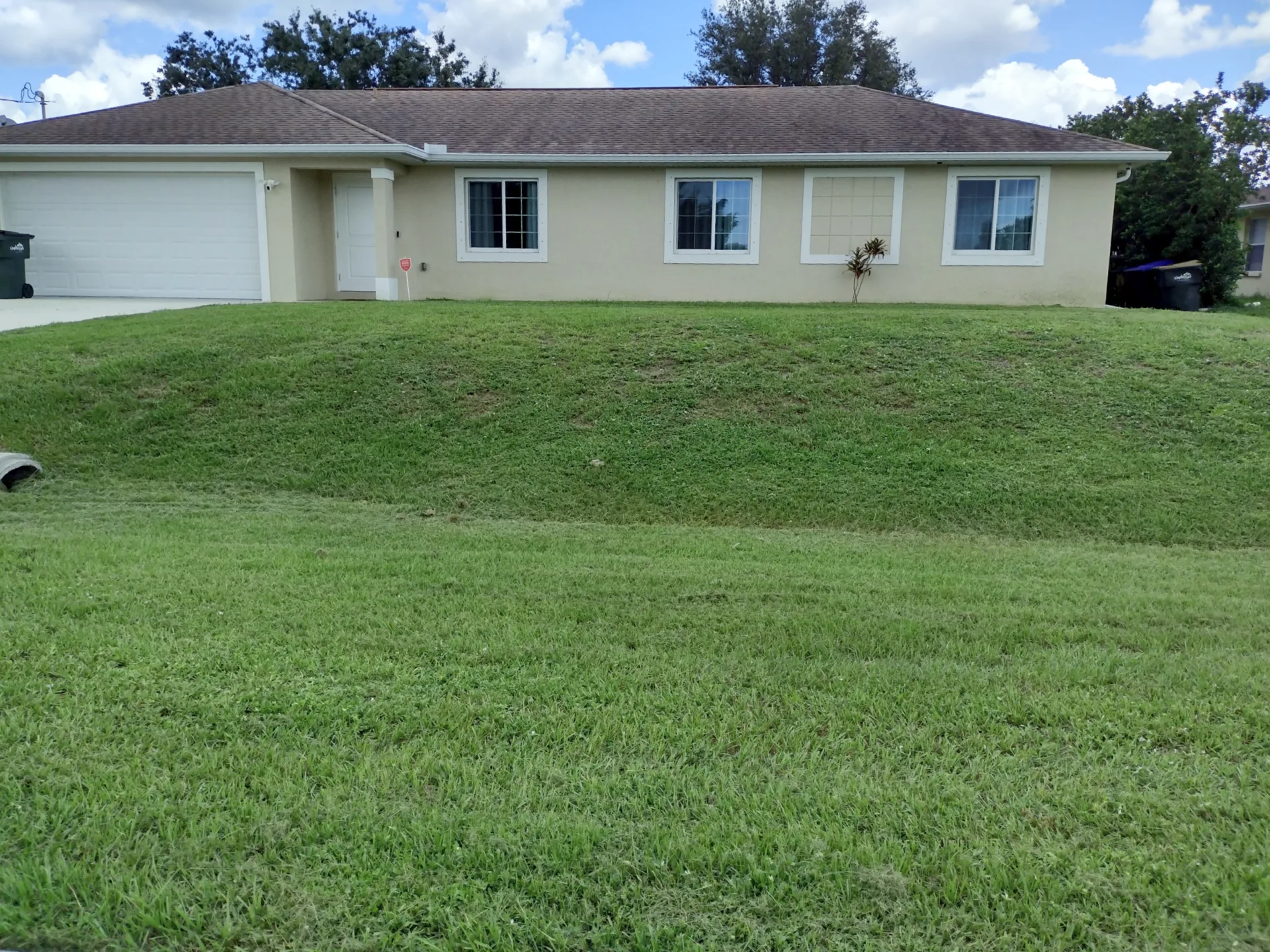
How often should the lawn be mowed? Often enough that no single cut takes off more than a third of the grass blade. For most lawns that means once a week while the grass is growing hard and every 10 to 14 days when it slows down. In Southwest Florida, it never fully stops.
We're Epic Horizons Landscaping, based in North Port. Dennis started the company in 2022 as a mowing outfit, and our crew still cuts lawns every week in North Port, Venice, Port Charlotte and Englewood. So this isn't a schedule copied from a northern lawn guide. It's what we see on the trailer, month by month.
Below are straight answers to the mowing questions people search most: how often to mow in summer and in spring, how many cuts a year your lawn really needs, what mowing and mowers cost, and how often to change the oil. Each answer comes first, then the Florida details.
Summer (May–Sept): every 5 to 7 days.
Spring and fall: every 7 to 10 days.
Winter (Dec–Feb): every 14 days.
Height: St. Augustine at 3.5 to 4 inches. Never cut off more than a third of the blade.
how often lawn mowing
Mow most lawns once a week during the growing season and every 10 to 14 days when growth slows. In Southwest Florida, that means weekly from May through September and every other week from December through February. The real trigger is height: never let the grass get so tall that one cut removes more than a third of the blade.
That rule of thumb holds for nearly every warm-season grass in the country. The University of Florida's turf specialists (UF/IFAS) give a range of days instead of one number, because growth swings with heat, rain and irrigation. Here are their numbers for the two grasses that cover most yards in Sarasota and Charlotte counties, next to what we see on our routes.
| Grass | Mowing height (UF/IFAS) | Mow before it reaches | UF/IFAS frequency | SW Florida summer | SW Florida winter |
|---|---|---|---|---|---|
| St. Augustine (Floratam) | 3.5–4 in | 5–6 in | Every 5–14 days | Every 5–7 days | Every 14 days |
| Dwarf St. Augustine (Seville, Captiva) | 2.5 in | About 3.75 in | Every 5–14 days | Every 5–7 days | Every 14 days |
| Bahia (Argentine, Pensacola) | 3–4 in | 4.5–6 in | Every 7–17 days | Every 7 days | Every 2–3 weeks |
Heights and frequency ranges from UF/IFAS, "Mowing Your Florida Lawn." The SW Florida columns are what we see on routes in North Port, Venice, Port Charlotte and Englewood.
Most lawns on our routes are Floratam St. Augustine. Bahia shows up on bigger lots, unwatered side yards and roadside swales, because it gets by on rain alone. Not sure which one you have? St. Augustine has wide, flat blades with rounded tips and spreads by thick runners that sit on top of the soil. Bahia has narrower blades and sends up tall, V-shaped seed heads all summer.
Look at the UF/IFAS column again. Five to fourteen days is a wide spread. So where is your lawn inside that range this week? A calendar can't tell you. A ruler can.
How often should the lawn be mowed? Measure the grass, not the calendar
Mow before the grass grows 50 percent past its target height. That keeps every cut to a third of the blade or less, the rule UF/IFAS and nearly every turf program in the country follow. For St. Augustine kept at 4 inches, mow before it reaches 6 inches. For Bahia kept at 3 inches, mow before it reaches 4.5.
Why a third? The blade is where the grass makes its food. Take off a third and it hardly notices. Take off half or more and the plant puts everything into regrowing leaves, and root growth stalls. Those roots are what carry it through a bone-dry April and a waterlogged August. UF/IFAS lists what happens when lawns get cut too short: weak roots, more weeds, more disease. On St. Augustine, you see it go yellow, then thin, then bare, and weeds fill the bare spots.
Checking takes ten seconds. Push a ruler into the lawn in a few spots midweek. If your target is 4 inches and it reads 5.5, mow tomorrow. If it reads 7, you already missed the window.
If your St. Augustine got to 8 inches while you were away, set the mower at about 5.5 inches for the first cut. Bring it down to 4 a few days later. Two gentle cuts beat one scalp. A single scalping in July heat can set a lawn back for weeks.
The ruler works in any month. But there's one season when the window closes so fast that most people never catch it.
how often mow lawn summer
In summer, mow every 5 to 7 days. Warm-season grass grows fastest in heat and rain, and during Southwest Florida's rainy season, June through September, St. Augustine kept at 4 inches can pass 6 inches in less than a week. Skip one week in July and the next cut almost always takes off more than a third.
Up north, summer is when lawns slow down and brown out. Here it runs the other way. Most of our yearly rain falls from June through September, usually as an afternoon storm, and heat plus daily water is exactly what St. Augustine and Bahia want.
Frequency isn't the only thing that changes in summer:
- Mow in the morning. Storms build after lunch. Grass that dried overnight cuts clean at 9 a.m. By 3 p.m. it's soaked again.
- Stay off soggy ground. If your footprints squish or fill with water, wait. Mower wheels rut wet sand, and you'll be looking at those tracks until fall.
- Keep the deck high. Taller St. Augustine shades its own soil and holds moisture through the hottest hours. Summer is the worst time to lower the mower.
- Bahia seed heads won't wait. Bahia pushes up seed stalks all summer, and a fresh cut can look shaggy in three days. Weekly mowing with a sharp blade is what keeps it neat.
- New sod gets a pass. Don't mow fresh sod until it's rooted and you can't lift a corner. Our piece on why new St. Augustine dies in its first summer covers the rest.
Our crews run summer routes in the morning for exactly this reason. When a storm washes out a mow day, the cut gets moved, not dropped. Dropping one July cut means scalping on the next one.
Summer is easy to call: weekly, no debate. Spring is harder, because it's the one season when your sprinklers, not the sky, decide how fast the grass grows.
how often mow lawn in spring
In spring, mow every 7 to 10 days, then switch to weekly once growth takes off. In Southwest Florida, lawns wake up in March as the days warm, but spring is also the end of the dry season, so growth follows your irrigation. By May, most St. Augustine needs a cut every week.
In most of the country, spring is when the mower comes out of the shed for the first time. Here, it never went in. What changes in March is speed. Days get longer and warmer, and grass that coasted through January starts moving again. If your sprinklers are doing their job, you'll notice within a few weeks.
April and May are where people get caught. It's hot, the rains haven't started, and the lawn lives on whatever your system puts down. Thirsty grass grows slowly, so it's tempting to cut it short and stretch the time between mows. That's backwards. A drought-stressed lawn needs its height more than ever.
UF/IFAS lists the signs that your lawn needs water more than a mow: blades folding in half lengthwise, a blue-gray tint, and footprints that stay pressed in instead of springing back. See those, water on your allowed day, and hold off on mowing until it perks up. Watering days in Sarasota and Charlotte counties are set by the Southwest Florida Water Management District along with your county or city, and they can tighten during a shortage. Check yours before you blame the grass.
One more spring trap: cold damage. After a frost, St. Augustine can brown in patches. Don't scalp it to clean it up. Leave the height where it belongs and let it green back up as the weather warms.
So spring runs every 7 to 10 days and summer runs weekly. Lay all twelve months side by side, though, and a pattern shows up that most mowing contracts ignore.
how often to cut lawn
Cut your lawn whenever it reaches about one and a half times its target height. For St. Augustine kept at 4 inches, that's when it hits 6 inches. In Southwest Florida, that works out to weekly from May through September, every 7 to 10 days in spring and fall, and every two weeks from December through February.
| Months | St. Augustine | Bahia | What's driving it |
|---|---|---|---|
| Dec–Feb | Every 14 days | Every 2–3 weeks | Cool nights, short days, little rain. Growth slows but doesn't stop. |
| Mar–Apr | Every 7–10 days | Every 10–14 days | Warming up, still dry. Growth follows your sprinklers. |
| May–Jun | Every 7 days | Every 7 days | The heat arrives, then the rain. Growth jumps. |
| Jul–Sep | Every 5–7 days | Every 7 days | Peak heat and daily storms. Bahia seed heads nonstop. |
| Oct–Nov | Every 7–10 days, stretching to 14 | Every 10–14 days | Rain tapers off and nights cool down. |
If you've wondered how often to cut grass that's half in sun and half under a live oak, the shady side grows slower. Mow it on the same day, but you may barely touch it. UF/IFAS also recommends keeping shaded St. Augustine at the tall end of its range, since it has less light to work with.
Every other week is a real schedule for the cool months. It only works if the crew actually shows up on it. One customer put it plainly:
"Great service..Always there every other week and my lawn looks great…had a few other people and by far these guys are the best!!!"
— George Rodgers, Google ReviewAdd up that table and you get a number few homeowners have ever counted: how many times a year this lawn needs cutting.
how much lawn mowing
A Southwest Florida lawn needs about 40 mowings a year, and roughly 22 of them fall between May and September. A lawn in a state with a real winter gets closer to 25 or 30, packed into the warm months. At 45 minutes to an hour per cut with trimming and edging, that's 30 to 40 hours a year here.
Here's the count from the schedule above, using the middle of each range:
- May through September, weekly: about 22 cuts
- March, April, October and November, every 7 to 10 days: about 13 cuts
- December through February, every two weeks: about 6 or 7 cuts
Lot size changes the hours, not the count. Much of North Port and Port Charlotte was platted in 80-by-125-foot lots, a little under a quarter acre. Take out the house, driveway and pool and there's usually well under a quarter acre of grass. Venice and Englewood lots vary more.
Some things add time no matter the size. Most North Port streets drain through grassy roadside swales, and mowing a slope without gouging it is slower than mowing flat ground. Canal-front lots in Port Charlotte have a seawall edge that gets trimmed by hand, not run over at full speed.
Forty cuts is the number to keep in your head when you read a mowing quote. Multiply it by the per-visit price and the real yearly cost shows up, the one national averages miss.
how much lawn mowing cost
Lawn mowing costs $30 to $85 per visit for a typical 1/8 to 1/4 acre yard, according to HomeGuide's 2026 national pricing, and larger lots run about $60 to $150 per acre. Weekly service usually costs less per visit than every other week, because shorter grass cuts faster. In Southwest Florida, plan on about 40 visits a year.
Here's what those 40 visits add up to:
| Per-visit price | Yearly total at 40 cuts |
|---|---|
| $40 | $1,600 |
| $50 | $2,000 |
| $60 | $2,400 |
| $75 | $3,000 |
Per-visit range from HomeGuide's 2026 national lawn mowing data. Yearly totals are straight multiplication. Your price depends on your lot.
National guides often put mowing at $900 to $2,000 a year. That assumes a season that shuts down for winter. Ours doesn't, so a SW Florida yard lands at the top of that range or past it, even when the per-visit price is ordinary. We broke down per-visit, monthly and crew-pay numbers in what lawn care professionals charge.
Make sure every quote covers the same work. A mowing visit should include the cut, string trimming around beds and obstacles, edging along concrete, and blowing clippings off the driveway and walks. Our crew edges every visit. We don't do lawn treatments or spraying of any kind, so if another quote bundles those in, you're comparing two different services.
A low monthly price sometimes means one cut a month. That's fine in January. In July, St. Augustine is past 8 inches by the time the crew shows up, and they cut it back to 3 so it lasts until next time. That's how a lawn goes thin and yellow by August.
Dennis prices every yard after he walks it, because gates, swales, beds and grass type all change the time on site. Call him at (941) 946-8403 and he'll tell you what your lot needs and how often.
The other way to answer the cost question is to buy a mower and do it yourself. That math has its own surprises.
how much lawn mower cost
A new lawn mower costs about $190 to $430 for a gas push mower, $110 to $840 for an electric push mower, $260 to $2,000 or more for a self-propelled model, $1,200 to $3,000 for a riding mower, and $3,000 to $6,000 for a residential zero-turn, based on 2026 national price guides.
| Mower type | Price range | Typical | Fit for a SW Florida lawn |
|---|---|---|---|
| Manual reel | — | About $135 | Poor for St. Augustine. Most reel mowers can't cut as high as 3.5 to 4 inches. |
| Electric push (corded or battery) | $108–$836 | About $322 | Small lots. Check the highest cutting setting before you buy. |
| Gas push | $188–$431 | About $286 | Handles most 80×125 lots |
| Self-propelled gas | $260–$2,072 | About $604 | Easier on swales and bigger lots |
| Self-propelled battery | $368–$1,712 | About $786 | Same, quieter. Battery runtime limits big yards. |
| Riding mower | $1,200–$3,000 | About $2,200 | Half an acre of grass or more |
| Residential zero-turn | $3,000–$6,000 | About $4,500 | An acre or more |
| Robotic | From about $1,490 | — | Check the maximum cutting height. Many models stop short of 4 inches. |
Price ranges from LawnStarter's and Lawn Love's 2026 lawn mower price guides.
The sticker isn't the whole bill. A mower alone leaves ragged edges, so add a string trimmer, an edger and a blower. Then there's gas, oil, blades, air filters and the repair shop. Commercial equipment is a different world again: a crew's zero-turn costs far more than any homeowner model and runs all day.
Price tells you what a mower costs. It doesn't tell you how much mower you need, and that's where most people overspend.
how much lawn mower
Most homeowners need less lawn mower than they buy. A 21-inch push or self-propelled mower handles up to about half an acre of grass. A riding mower starts to make sense between half an acre and an acre, and a zero-turn past that. A typical 80-by-125 North Port or Port Charlotte lot is a push-mower job.
A rider on a small lot causes problems. It may not fit through your side gate, so the backyard still needs a push mower. It can't get tight around palms and beds, so the trimmer works harder. And it's heavy on soft ground in August. On a swale, a 21-inch self-propelled mower is easier to control than either a push mower or a rider.
Before you buy anything, it's worth putting the two options side by side:
That mower-in-the-shop row is the one nobody plans for. One customer put it like this:
"Reached out to them in hopes of getting my overgrown yard taken care of. My mower needed repairs and my HOA was getting on me about the grass weeds."
— Josh Marple, Google ReviewIf you'd rather keep mowing it yourself, the cheapest way to keep your mower out of the shop is a five-minute job most people put off.
how often lawn mower oil change
Change lawn mower oil after the first 5 hours on a new engine, then every 50 hours or once a season, whichever comes first. Briggs & Stratton shortens that to every 25 hours under heavy use, high heat or dusty conditions, which describes a Florida summer pretty well. Check the oil level before every mow.
| Situation | Change the oil |
|---|---|
| Brand-new engine | After the first 5 hours (break-in) |
| Normal use | Every 50 hours or once a season |
| Heavy use, heat or dust | Every 25 hours |
| SW Florida homeowner, about 40 cuts a year | At least twice a year |
Intervals from Briggs & Stratton's maintenance guidance. Your engine's manual has the final word.
Why twice a year here? Forty cuts at 45 minutes to an hour is 30 to 40 hours of run time. That's already past the 25-hour heavy-use mark, and our summers are hot and our yards are sand. A good rhythm is once in late spring before the rains start and once in the fall.
While you're under there:
- Air filter. Sandy, dusty yards clog it fast. A choked filter makes the engine run rich and dirties the oil sooner. Check it monthly in the dry season.
- Blade. A dull blade tears grass instead of slicing it, and torn tips brown in the heat. Sharpen it at least once a season, and again after you hit a sprinkler head or a root.
- Spark plug. Replace it once a season. It's cheap, and it's the first thing to check when the mower won't start.
Commercial mowers rack up 50 hours in a couple of weeks, which is why crews go by the hour meter, not the calendar.
One more question keeps showing up next to all of these, and it comes from the other side of the world.
how much lawn mower in the philippines
In the Philippines, a gas grass cutter (brush cutter) costs about ₱6,000 for a budget 4-stroke model and ₱15,000 to ₱19,500 for name brands. Walk-behind mowers cost more: about ₱12,900 to ₱64,250 for Makita cordless models and ₱21,000 to ₱33,000 for gasoline push mowers, based on 2026 retailer listings.
| Type | Example listings | Price |
|---|---|---|
| Budget 4-stroke grass cutter | Megatools MGX35 | ₱6,200 |
| Name-brand gas grass cutter | Honda GX35-powered units, Ingco 31cc | ₱15,000–₱19,500 |
| Cordless walk-behind mower | Makita DLM330 up to the self-propelled DLM462 | ₱12,900–₱64,250 |
| Gasoline push mower | Ingco GLM196201, Stihl RM 248 | ₱21,000–₱33,075 |
Prices from Philippine tool retailer listings checked in 2026. They move with the seller and the peso.
We don't sell mowers, and we don't work in the Philippines. We looked this one up because it keeps appearing alongside the other mowing questions. Two things carry over from our yards to theirs. Tropical grass in a wet season grows the way ours does in July, so a weekly cut fits. And the one-third rule works the same in any country.
Back to Southwest Florida. These are the mowing questions we hear most on the phone.
Frequently Asked Questions
Do you offer lawn service in Port Charlotte, FL?
Yes. Lawn service in Port Charlotte FL is part of our regular week, including Murdock, Deep Creek and the canal-front lots. Canal lots get careful hand trimming along the seawall. See our lawn care in Port Charlotte page, or call Dennis for a price.
What should I ask when comparing lawn care services in Venice, FL?
Ask four things: how many visits you get in a five-week month, what height they cut St. Augustine, whether they edge every visit, and what happens when it rains on your day. Venice has a lot of HOA communities, and ragged edges are what get flagged. Our lawn care services in Venice, FL page covers what we include.
Is a central Florida lawn care schedule different from Southwest Florida's?
Somewhat. Inland central Florida gets more frost and a longer winter slowdown, so winter mowing can stretch past two weeks between cuts. The Panhandle is different again. Lawn care in Gulf Breeze or Pensacola deals with grass that often goes off-color and nearly stops growing in winter. The one-third rule and the weekly summer cut hold everywhere in the state. We only work in Sarasota and Charlotte counties.
What are the most useful Florida lawn care tips for mowing?
Keep St. Augustine at 3.5 to 4 inches. Never cut off more than a third of the blade. Keep the blade sharp. Mow in the morning during the rainy season. Leave clippings on the lawn, which UF/IFAS recommends, but blow them off the street and away from storm drains. Clippings in the road are also one of the first things an HOA notices.
Can I mow the day after a heavy rain?
Only if the surface has dried. Walk the lawn first. If your shoes come back wet or the ground squishes, wait. Wet grass tears and clumps, and soft sand ruts under the wheels. In the rainy season, the next morning is usually your best window.
Can I cut the grass shorter so I can go longer between mows?
No. It's the most common mowing mistake we see. Cutting Floratam St. Augustine down to 2.5 inches to buy an extra week scalps it, and in summer heat it yellows and thins within days. If you're traveling, set up a cut while you're gone.
How do I get a mowing price for my yard?
Call Dennis at (941) 946-8403. He'll come out, look at your grass type, gates, swales and beds, and give you a written price. Estimates are always free.
Not sure whether your lawn should be on a weekly or every-other-week schedule right now? Call Dennis at (941) 946-8403 or request a free estimate. He'll tell you what your grass needs this month and what it will cost, before anyone starts a mower.